Sosman & Landis, Shaping the Landscape of American Theatre. Perry Landis: From Soldier to Salesman

Copyright © 2023 by Wendy Waszut-Barrett

Perry was the eighth of twelve children born to Henry H. Landis (1809-1893) and Catherine Johnston Landis (1817-1902). He was the third Landis brother to fight for the Union.

In 1860, the following children were living at the Landis farm in Steady Run Township, Iowa: David (21 yrs.), Jacob (19 yrs.), Joseph (16 yrs.), Perry (12 yrs.), James H. (8 yrs.), Edgar (6 yrs.), Franklin (3 yrs.) and Charles (2 yrs.).  Their eldest daughter, Mary, and son, John lived in nearby Martinsburg.

Martinsburg was less than two miles south of Steady Run Township, Iowa.

Between  1860 and 1863, three of the Landis children passed away.

On Dec. 18, 1860, 9-yrs.-old son, James Henry Landis, and was buried in Martinsburg Cemetery.

The gravestone of James H. Landis in Martinsburg Cemetery.

On Jan. 1, 1861, their 29-yrs.-old daughter, Mary Ann Landis Marshall, also died. She was buried near her brother in Martinsburg Cemetery.

Gravestone of Mary Landis Marshall in Martinsburg Cemetery.

Then came the Civil War, with four of the Landis sons enlisting in the Union Army. On Jan. 8, 1863, both John and David Landis were severely injured in battle, with 23-yrs.-old David passing away that December.

Gravestone of David Landis in Martinsburg Cemetery.

War and death loomed over the Landis’ Iowa home.

Five of the eight Landis sons were old enough to fight in the Civil War. Only Edgar, Frank, and Charles were too young to fight.

John, David, Jacob and Perry Landis all enlisted in the Union Army. John Landis was the first to enlist, rapidly rising through the ranks for his heroic actions. He must have been a tough act to follow; a courageous risk-taker who made the headlines for his bravery. By 1863, both John and his younger brother David were in the same regiment and severely wounded in Springfield, Missouri.

The same year that John and David mustered out of the Iowa Infantry, Jacob and Perry mustered into the Ohio Infantry and Indiana Infantry, respectively. Only Joseph managed to avoid combat. Although he registered for military service alongside David and Jacob in Steady Run, Iowa, he did not serve. I have yet to locate any records verifying that he enlisted at all.

Here is what I have been able to track down for each of the four Landis brothers who fought in the Civil War.

18th Regiment, Iowa Infantry

John Landis

John Landis was 27 yrs. old when he enlisted on June 13, 1861. He joined Co. I, 1st Iowa Calvary, and was promoted to first battalion quartermaster by October 8, 1861. John became a Captain in Co. D, 18th Iowa Infantry, on June 6, 1862. He was promoted after capturing the Rebel flag during the Battle of Blackwater in Missouri. I was shocked to find one of his descendants post a picture of the flag he captured online.

Rebel flag captured by Quartermaster John Landis at the Battle of Blackwater in Dec. 1861. Photograph by Lester Letson and posted at findagrave.com on July 6, 2012.

On Jan. 8, 1863, John was severely wounded during battle in Springfield, Missouri. His bravery was described in the Daily Ohio Statesman on Feb 24, 1863 (page 1):

An Incident of the Battle of Springfield.

I must close third letter with an incident of the battle of Springfield, which deserves accord. Captains Landis, Van Meter, and Blue of the 18th Iowa, were all with that unfortunate brass cannon, which then fell into the hands of rebels. All three were shot. Two have since died, but Capt. Landis happily survives. It is said that Captain Landis stood by the gun, deserted by all else, when rebels took possession, determined never to surrender. Major Bowman, of the Confederate army, approached at the head of his men. Touched with a sense of the man’s chivalry, he cried: ‘Surrender!’

‘Never!’ said Captain Landis. ‘I was here first. Never!’

The Major seized a rifle and fired, carrying away the Captain’s shoulder strap. The Captain returned the compliment and wounded Major Bowman so severely that he has since died. Captain Landis himself fell at the next fire, and the dying Major sent him this message, as he lay dying upon his bed: ‘Tell Captain Landis,’ said he, ‘that I am gratified to have fallen by the hand of so brave a man.’ It seems that the age of chivalry is not yet passed. –Springfield (Mo.) Cor. St. Louis Republican.

John mustered out on Feb 28, 1863, in St. Louis, Missouri; resigning, and listing his residence as Martinsburg, Iowa. After the war, John moved west, spending the remainder of his life in Colorado, California, Oregon and Washington State. He returned to life on a farm. Despite living so far away from his family, John named his three sons after the brothers he left behind:

Perry John Landis

John Albert Landis

Joseph Franklin Landis

I have located only one newspaper article that mentioned John’s return to the Midwest. On March 16, 1882, the Fairfield Tribune announced, John Landis, a citizen of Fairfield twenty years ago, was in the city this week” (page 3).

John passed away in 1915, and was buried in Oakwood Cemetery in Tacoma, Washington. His obituary was published in the Tacoma Daily Ledger on April 28, 1915 (page 5):

“John A. Landis, age 80, died Monday night at a local hospital. He was a veteran of the Civil War and was severely wounded at Springfield, Mo. Mr. Landis enlisted June 13, 1861, in Company I, 1st Iowa Calvary, and was promoted to first battalion quartermaster October 7, 1861. He was appointed captain of Company D, 18th Iowa Infantry, June 6, 1862. He resigned February 28, 1863, after being wounded. Mr. Landis had lived at Puyallup a year, coming from Olympia and Orting. He was a member of Tacoma Post of Olympia. Custer post of Tacoma will have charge of the funeral, the date which will be announced later. Besides his widow, he is survived by two sons, Joseph and Perry Landis. The body is at the C. C. Mellinger company’s.”

OLYMPUS DIGITAL CAMERA

18th Regiment, Iowa Infantry

David Landis

David Landis was the second to fight, joining the Union Army two years after John. He was living in Martinsburg, Iowa, when he enlisted on Aug. 15, 1862. Martinsburg is the same town where his sister Mary passed away in 1860. At 24 yrs. old, he mustered in as a Private in Co. D, 18th Regiment, Iowa Infantry, on August 23, 1862. This was the same regiment where John served as a Capt. of the first Cavalry. The 18th Regiment arrived in Springfield, Missouri, on September 13, 1862. He participated in the Defense of Springfield from and was wounded in battle on Jan. 8, 1863, and included in the list “Iowa Soldiers Killed and Wounded at the Battle of Springfield, Missouri, Jan. 8th,” On Jan. 30, 1863, the Muscatine Weekly News announced, “David Landis, D, 18th – right hip and leg, slight” (page 2). He never recovered from the injuries and passed away on Dec. 20, 1863.

Both John and his younger brother David Landis were listed in the “Army Correspondence” section of the Burlington Daily Hawk Eye Gazette on Jan. 22, 1863 (page 2). In the section entitled “Camp of the 18th Iowa, Fort No. 1, Springfield, Missouri, Jan. 10th, 1863,” a detailed account of the battle was included, along with a listing of those killed or wounded with each of the companies. The article reported,

“Company D.- Killed, none. Capt. John A. Landis, wounded in the calf of the leg, severely; private David Landis, calf of the leg and thigh, severely.”

Although John mustered out on Feb. 28, David was not mustered out until May 8, with “wounds” being the reason for his release. David returned home to Martinsburg, but never fully recovered and died from complications on Dec. 20, 1863. He was buried in the same Martinsburg Cemetery as his older sister Mary.  

Joseph Landis did not serve in the Iowa Infantry but was twice listed in Iowa records as a person subject to military duty in Steady Run Township; once in 1863 at the age of 18 yrs. old (Jackson County), and once in 1864 at the age of 19 yrs. old in (Keokuk County). If any new information comes to light, I will update this post.

131st Ohio Infantry

Jacob H.  Landis

Jacob H. Landis was listed in Ohio’s Third Congressional District Civil War Draft Registration Record on July 11, 1863, This district included the counties of Montgomery, Preble, Butler, and Warren. At 21 yrs. old, Jacob his occupation as a carpenter in Randolph. He entered military service on May 2, 1864, mustering in as a Private with Company K, 131st Regiment Ohio Volunteer Infantry. This regiment was organized at Camp Chase on May 14, 1864, with the intent to serve for 100 days. They were immediately sent to Baltimore, Maryland, where they were assigned to garrison duty at Forts McHenry, Fort Marshall, and Fort Federal Hill. The regiment remained at the forts until August 19, when the soldiers were sent back to Columbus, Ohio, arriving on Aug. 21, 1864. Landis mustered out on Aug. 25, 1864, at Camp Chase.

116th Regiment, Indiana Infantry

Perry Landis

Perry Landis enlisted in the Indiana Infantry at Lafayette and was mustered in on August 12, 1863. For geographical context, Lafayette is located approximately halfway in between Chicago and Indianapolis. Landis mustered out a second time out on March 1, 1864. Landis served as a private in Co. F of the 116th Regiment, Indiana Infantry.  Perry when he served as a private in Co. F, 116th Regiment, Indiana Infantry. This places him in Lafayette, Indiana, by the spring of 1863. After the war, Perry returned to the Fairfield area of Iowa, soon settling in Ottumwa, a town 25 miles west of Fairfield. In 1867, he purchased property there. The sale was reported in the Ottumwa Semi-Weekly Courier on Nov. 28, 1867 (page 3).  For $1500, Landis purchased “pts w se sec 29, tp 72, r 13” from T. Devin.” On Sept. 24, 1868, The Ottumwa Courier listed Perry Landis in the “Register of Voters of Center Township, Wapello County, Iowa, for 1868” (page 3).

Buying land did not necessarily mean that Perry was ready to settle down. He soon ventured east to briefly worked as a news agent in Ohio. He was listed in the 1868 Cincinnati Directory, rooming as 137 Race.

Perry Landis listed in the 1868 Cincinnati Directory.

Perry was also was listed in the unclaimed letter section of the Cincinnati Commercial on April 5 and April 12, 1868. By 1869, he was living with his parents in Connersville, Indiana.

Like Perry, Jacob also returned to Iowa after the war. In Fairfield he opened a watch and clock repair shop at the northeast corner of Park. By 1866, he began placed a series of advertisements in the Fairfield Ledger for his new business. On October 25, 1866, his ad announced:

“Have you got a watch or clock that won’t keep time? If you have, take it to Jacob Landis, North-east corner of the Park, and for a reasonable compensation, he will put it in first0rate working order. If you wish to have a piece of gold or silver manufactures into a particular pattern, he can accommodate you Call and try him. See card” (Fairfield Ledger, page 5).

Like his brothers, “Jake” continued to travel throughout the region; his comings and goings noted in local papers. On Feb. 27, 1868, the “Fairfield Ledger” reported, “Back Again. – Jake Landis is a sensible fellow and good workman. He is a good fellow, because he likes Fairfield better than any other place, he has seen during the last six months. And he is a good workman, because he can clean a watch as well as any man who has tried in our city for years – He has hung out his sign at his old stand in F. M. Stewart’s store and will repair clocks, watches, jewelry, &c., in the best manner and on the lowest terms. See his card” (page 6).

Advertisement placed by Jacob Landis in the “Fairfield Ledger” on June 25, 1868.

In addition to running his shop in Fairfield, he also invested in a new product – the ready binder.

On June 4, 1868, the Fairfield Ledger announced, “A Ready Binder. – The Covert File and Binder, patented by Landis & Co., of St. Louis, is just the thing for persons who wish to preserve their pamphlets and papers. Any person can readily bind his own books and preserve them in good style. J. Landis, of our town, has the agency for Iowa, and will sell county and individual rights on the most favorable terms. Covers for Godey, Peterson, Harper, sheet music, and the weekly papers, sold at reasonable process. Every family that takes a magazine ought to have one of more of these binders. Persons desiring rights should address J. Landis, Fairfield, Iowa” (page 6).

I have yet to locate any information about the firm “Landis & Co.” in St. Louis. The ready binder, however, was short-lived. Jake continued to place ads for his repair business in the Fairfield Ledger (June 25, 1868, p. 6).

Despite Perry owning property in Ottumwa, Iowa, and Jacob managing his repair shop in Fairfield, Iowa, both relocated to Indiana in 1869. They were following their parents and helping out at the new farm. In 1868 Henry, Catherine and their younger children moved east, purchasing a vineyard just south of Connersville, Fayette County, Indiana.

Map showing the location of Connersville, Indiana, in relation to Indianapolis, Indiana, and Cincinnati, Ohio.

Their return east was likely instigated by Henry’s 88-yrs.-old mother. Perry and Jacob moved to Connersville where they again worked for their father on his farm. The only difference was that Henry now raised grapes. I was fascinated to learn that this region of Indiana is considered the “birthplace of the American wine industry. The first successful winery was founded by a Swiss immigrant around 1806.  Here is a link for more information about the history of Indiana Wine Trail: https://www.indianawinetrail.com/history

On April 8, 1868, Henry Landis began placing advertisements in the Connersville Weekly Times (page 2):

Attention.

I offer for sale, 1,500 Concord, Hartford, Prolifie, and Delaware Grape vines, one year old, in fine thrifty condition. Apply at the farm formerly owned by Job Stout, two and a half miles south of Connersville.  By that winter, Henry Landis divested himself of all property in Fairfield.  On Dec. 16, 1868, the Weekly Ledger announced the following real estate transfer: “N. MENDENHALL from H. H. LANDIS and wife, lot 2, block 15, old plat of Fairfield. deed dated August 14, 1868. 1,300 00.”

I was only familiar with the common Concord grape as I read the advertisement.

The common Concord grape.

In case you are wondering, the Hartford grape variety is an American red grape, also known as Framingham grapes. The Delaware grape is hybrid popularized in Delaware City, Ohio, also an American red grape. I have yet to identify the “Prolifie” grape and have begun to wonder if it was a misprint.

Henry’s new vineyard brought him very close to his aging mother and sisters. Henry’s mother, Elizabeth Landis Moss was then living with her daughter Elizabeth McWhorter in Blooming Grove, just 13 miles south of Connersville. As Landis’ new vineyard was on the southside of Connersville, this distance was even shorter that.

Map showing the relatively short distance between Connersville and Blooming Grove, Indiana. Nearby Liberty (top right corner of map) was where Joseph Landis lived and worked.

The 1860 U. S. Federal Census had listed 82-yrs.-old Elizabeth Moss living with her 73-yrs.-old husband, John Moss, on a farm in Blooming Grove, valued at $6,120. When John passed away on Oct. 22, 1862, Elizabeth Moss went to live with her widowed daughter, Elizabeth McWhorter. The 1870 US Census listed Moss as still part of the McWhorter household in Blooming Grove. At the time, Moss was 91 yrs. old and living with the one child who truly understood her past struggles.  Both mother and daughter had outlived two husbands. Elizabeth Moss had been widowed while pregnant with David Landis’ fourth child in 1814. For the next four years she struggled as a single parent, raising her four small children.  In 1818, she married John Moss; a union that resulted in the birth of their only child, Phebe Moss. 

Elizabeth McWhorter was also married twice and widowed as a young woman. She first married Thomas Ellis, and the two celebrated the birth of five children. After his passing, she married Samuel H. McWhorter. Their union also resulted in the birth of a single child, Perry L. McWhorter. Both women lived to be 92 yrs. old, with Elizabeth Moss passing in 1871 and her daughter following in 1906. Each was an amazingly strong and independent woman. In fact, I was surprised to discover that at the age of 91-yrs.-old, Elizabeth Moss purchased a property in Connersville. On Sept. 22, 1869, the Connersville Examiner announced the following real estate transaction: “Lemuel R. Webb to Elizabeth Moss, nw qr of sec 31, town 15, range 13, $1,000” (page 3). For context, $1,000 in 1869 has the equivalent purchasing power as $22,306.10 in 2023. Keep in mind that the Moss family farm had been valued at $6120 in 1860 (the equivalent purchasing power of $223,684.53 in 2023). Unless everything was lost at the time of her husband’s passing or during the Civil War, Elizabeth Moss likely left a large estate for her children and grandchildren.

Portrait of Elizabeth McWhoterlate in life.

The passing of Elizabeth Moss on June 21, 1871, sparked another relocation Landis family members. Her burial at Sims-Brier Cemetery in Old Bath, Franklin County, signaled the end of an era for her kin. Her descendants began to look toward their own futures, released from the caretaking ties that bind. Henry H. Landis left farming entirely and moved work as a merchant in Rushville, following in the footsteps of his sons.

It certainly made sense, as he was now in his 60s. Working the land becomes an insurmountable task unless you have a young and fit labor pool. Such was not the case for Henry Landis by the early 1870s. It became increasingly apparent that his sons were not going to work the family farm.

Joseph was a prime example. Although Jacob and Perry returned to help sell produce at the family vineyard in 1869, Joseph continued to work as a jeweler in nearby Liberty, Indiana. Keep in in mind that David Landis (their paternal grandfather) was laid to rest in Liberty in 1814. The family had deep ties to the area for several decades at this point.

On March 9, 1869, Joe placed an advertisement in the Liberty Herald announcing:

“Joseph Landis,

Watchmaker and Jeweler, Liberty, Ind. Special attention given to repairing watches, clocks, and jewelry of all kinds. Will be found at Sam Sterling’s Grocery Store. Work warranted for one year” (page 2).

Joseph eventually moved his business to the northeast corner of Main and Union Streets in Liberty.  He became extremely well known and respected as a merchant in the area and remained there for almost two decades.

Advertisement placed in the “Liberty Herald” on March 19, 1869.

Advertisement placed in the “Liberty Herald” on May 20, 1875.

In 1869, Joseph Landis made frequent travels from Liberty to Connersville, visiting his grandmother, parents, and siblings. On Sept. 1, 1869, the Connersville Examiner announced, “Jo. Landis, Esq., formerly of your lovely city, is here enjoying life, repairs, watches, sells jewelry, and occasionally drives fine horses, and has setting by his side in his fine buggy as dear a creature as ever wore charms.

Love is a passion by no rule confined,

The great first mover of Joseph’s mind.

I believe Jo will marry, if the girl will, and

They’ll both be well mated in life.

She’ll have a good man for a husband

And he’ll have a charming wife.

Joe married a local Liberty girl two years later. He and Prudence Mae Hughes were united in marriage on Oct. 19, 1871. He remained in the area for quite some time, frequently making the news for the next two decades. For example, on Oct. 30, 1872, the Liberty Herald reported, “It was a nice job of white washing which Jos. Landis did the other day with his little brush” (page 3). On Sept. 23, 1874, the Liberty Herald reported, “Joe. Landis has been having his storeroom very much repaired and is now re-established in it, and has brought on a new stock of choice jewelry. Persons desiring to purchase jewelry are respectfully requested to give him a call” (page 3).

All the while, Joseph continued to gain business savvy and leadership skills. These became a great asset once he began working for his brother at Sosman & Landis. On July 22, 1875, the Liberty Herald reported, “The street drains have been cleaned in some places the past week, and this has added very much to the appearance and good drainage of the town. Joe. Landis was prime mover and worker in the improvement.  His incentive may have been the anticipated arrival of his first child. In 1875, Joseph and Prudence celebrated the birth Kathryn E. Landis. This was the same year that he helped sell his father’s vineyard in Connersville.

On Sept. 30, 1875, the Liberty Herald published the following announcement:

“Farm for Sale.

The finest Fruit Farm in Fayette county, at a bargain. 3,000 Grape Vines; other fruit in proportion; Hedge Fence around the entire farm. Every foot tillable land, second bottom. Offered at a great bargain. Address JOE. LANDIS, Liberty, Ind.” (page 3).

Joe continued to gain ground as a successful merchant in Liberty. On Feb. 20, 1889, the Connersville Examiner reported, “Joe Landis, leading jeweler of Liberty, was over yesterday afternoon, making inquiries about our gymnasium. Some time ago Liberty boasted a gymnasium, but like many other places, it was allowed to go down, and now they want to dispose of the paraphernalia, hence Mr. Landis’ visit to our city” (page 3). It was not until the 1890s that he sold everything in Indiana and moved to Chicago to help his brother Perry.  His move says a lot about the Landis family, as well as the scenic studio industry that he was investing in. When Joseph moved to Chicago, he worked at the firm as an electrical engineer, later establishing and managing the American Reflector & Lighting Co., established by the Landis brothers and Joe Sosman.

After his grandmother’s passing, Jacob Landis returned to Iowa and married Fannie E. Russell, a local Ottumwa girl. Their marriage was announced on Oct. 9, 1873, in the Ottumwa Semi-Weekly Courier (page 3):

“LANDIS-RUSSELL – At Samuel Harper’s residence, in this city, today, by the Rev. H. B. Knight. Mr. Jacob Landis, of Connersville, Ind., to Miss Fannie Russell, of Ottumwa.”  He continued in the jewelry trade, eventually moving west and settling in California.

As for Perry…

Despite relocating to Connersville and working for his father in 1869, he also embarked on a new business endeavor with a gentleman named Samuel M. Zent (1834-1897). Zent was a tinsmith in nearby Roanoke who invented a machine that dehydrated fruits and vegetables. At the time, it was referred to as a Drying Stove or Dry house. The partnership of Landis & Zent marks the beginning of Perry’s career as a sales. As a salesman, Landis traveled throughout the region, selling both his father’s fruit and Zent’s Dryhouse.   On May 26, 1869, The Indiana Weekly Herald of Huntington reported. “Messrs. Landis & Zent are this year engaged in the manufacture of a very useful contrivance for drying fruit and baking. It consists of a large sheet iron box, with a small heating stove at the bottom. The box, or upper part, is filled by sliding shelves so made that the heat from the stove can pass through the various shelves and fill the box. Arrangements are made so as to regulate the amount of heat. This Dryhouse has been thoroughly tested and is found to work admirably in drying fruit and as an outdoor bake oven. No farmer who has much fruit to preserve, should be without one” (page 3). Zent patented his invention in Indiana that fall. On Oct. 21, 1869, the Fort Wayne Daily Gazette published a list of U. S. patents issued to Citizens of Indiana for the week ending Oct. 12, 1869, including “No. 95,726 – Baking and Drying Stove; F. S. Reefy and S. M. Zent, Roanoke” (page 4). Perry continued to travel that fall and was listed in the gentleman’s list of unclaimed letters in the Terre Haute Weekly Express on Nov. 10, 1869, page 8.

Portrait of Samuel M. Zent.

Landis possibly met Zent during the Civil War. Zent was a Colonel in the Thirteenth Indiana Volunteers. Landis was with the 131st Regiment, Indiana Infantry. I was surprised to find an article Zent published in an Indiana newspaper. On Oct. 16, 1861, The Indiana Herald reported, “We have one man who is worth his weight in pure gold. He has run more risks in scouting and done more hard service than any four men in the Company, and that too without murmur. He is always pleasant and cheerful, kind to the sick, and always performing some generous act for those in need. His name is Samuel Zent. He is just the man for the service, and deserves promotion” (page 2).  Years later, Zent’s obituary announced, “Samuel Zent died very suddenly at Roanoke, Huntington county, a day or two ago. Previous to the war he was a resident of Warsaw, and engaged in the tinning business here When war broke out, he enlisted at an early day and finally became the colonel of the regiment known as the ‘Fighting Thirteenth,’ and remaining such until the close of the war. In the younger days of both, he was a warm and personal friend and chum of the editor of this paper. He was a brave and gallant solider and enjoyed a reputation as such throughout the Army of the Potomoc.” On. Nov. 27. 1869, the Fort Wayne Gazette announced in “News from Neighboring Towns, Roanoke” that “Sam Zent has gone on a pleasure trip to the west” (page 4). Many veterans, including the Landis brothers, ventured west in the years that followed the war.

Perry continued to sporadically work at his father’s vineyard, especially during the planting and harvest season. On September 21, 1870, The Connersville Examiner listed Perry Landis in the “Fruits” section as selling the “best and greatest variety of grapes.” That fall, Perry entered some of their produce in the Fayette County Fair. In the “Fruits” section of the article “Premiums Awarded at the Fayette County Fair,” Perry Landis was recognized for “best and greatest variety of grapes” (page 1).

The 1870 U. S. Federal Census listed that the Landis household in Connersville as including Henry Landis (63 yrs.), Catharine Landis (52 yrs.), Jacob Landis (28 yrs.), Perry Landis (21 yrs.), Edward Landis (17 yrs.), Francis Landis (14 yrs.), Charles Landis (11 yrs.), and Hetta Morrison (13 yrs.). Again, during this time Joseph Landis was living in Liberty, Union County, Indiana, and John Landis was living out west.

The family vineyard was soon known as H. H. Landis & Son, grape and small fruit growers. I have no idea who was the “son,” but there were five sons working the land. Local newspapers repeatedly carried Landis’ advertisements for grape vines sales.  On September 21, 1870, the Connersville Times announced:

“Grape Vines! Grape Vines! – TenThousand Concord Grape Vines for sale at a reasonable rates.

H. H. Landis,

(P. O. Box 132) Connersville, Ind. (page 3).”

Advertisement placed by Henry H. Landis in the “Connersville Times” on Sept. 21, 1870.

The Connersville Examiner also carried the same advertisements throughout October 1870, including Oct. 12, 1870 (page 3).

On September 28, 1870, the Connersville Times reported, (page 3):

“Grapes! Grapes! Grapes!

Ten thousand pounds of choice Concord grapes for sale! Also, ten thousand vines of the above-named variety, for sale at reasonable rates. All offers left at the P. O. Box will receive prompt attention. Vines will be delivered either in Fall or Spring. Address all orders to

H. H. Landis

P. O. Box 103 Connersville, Ind.”

These advertisements continued until the following spring. On March 29, 1871, the Connersville Times announced:

Grape Vines! Grape Vines!

All persons wanting grape vines of the leading varieties such as Concord, Prolifie, Delaware, Ives, Clinton, Iona, Martha, Salem, and others, should bear in mind that we have a splendid stock of the above and other varieties, which we are selling reasonable and warranting, also a fine lot of Raspberry plants, including Doolittle, Black Cap, Davison, Thornless and Mammoth cluster. Our day of delivering in Connersville is April 10th. Remember the day and leave orders at Pratts’.

Two hundred bottles of Concord grape wine for sale.

H. H. Landis & Son grape and small fruit growers, Connersville, Ind.

P. O. Box 132.

Vineyard two miles south of Connersville” (page 3).

By the summer of 1871, however, Perry Landis was selling grapes under his own name. On Aug. 18, 1871, the New Castle Courier of New Castle, Indiana (page 5) listed:

“Perry Landis.

1st Variety grapes, 2 00”

Perry Landis’ listing in the “New Castle Courier” on May 25, 1871.

Perry also purchased property in Indianapolis, Indiana, suggesting a definitive break from the family business. On June 21, 1871, the Indianapolis News reported the following real estate transfer: “Sarah A Hall and husband to Perry Landis, lot 38, 2d Brookside sub, $1250” (page 4). Despite the purchase, Perry soon left the region, heading west to Colorado. In short, he followed his older brother John.

To be continued…

Sosman & Landis, Shaping the Landscape of American Theatre: Sosman’s Mentor, T. B. Harrison

Copyright © 2022 by Wendy Waszut-Barrett

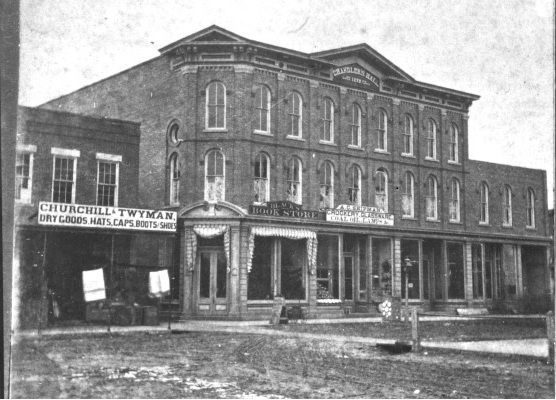
In 1873, Joseph Sosman assisted scenic artist T. B. Harrison at the Chandler Opera House in Macomb,. Illinois.  At the time, Sosman was well-known as a sign painter in town, having moved to Macomb only eight years earlier.

On April 17, 1873, “The Macomb Journal” reported, “SCENE PAINTING. As well as the entire design and arrangements of the stage is the handiwork of the eminent artist, T. B. Harrison, of Chicago. The stage, of course, is the focal point of all the attractions of the establishment and he who took the task of its design and execution has indeed an onerous one. But the one who looks upon the work of Mr. Harrison will decide that he has in masterly manner accomplished more than was expected. In the painting he has been ably assisted by our young friend, Joe Sosman; Joe has superior abilities, and our citizens will wake up some fine morning and fin in him, that Macomb has a first-class artist” (page 3). Sosman continued to make the Macomb news over the years, as this small town followed his continued success as a scenic artist and founder of Sosman & Landis.

Chandler’s Opera House in Macomb, Illinois: http://www.wimuseum.org/wp-content/uploads/2015/10/chandler_hall.jpg

This was a turning point in Sosman’s career, initiating his shift from sign painting to scenic art. In regard to Harrison, Sosman could not have selected a better mentor.

This post is about the life and career of Thomas B. Harrison (1836-1895). In later years, Harrison was remembered by citizens of Clinton, Missouri, as an “erratic genius” (June 23, 1900, “The Clinton Eye”). Harrison must have greatly inspired Joe Sosman at the beginning of his career. Here was an individual who appears to have dreamed big, trying his hand at everything within reach. Harrison was also key to the later Chicago connections for Sosman, facilitating many introductions for Sosman’s later success.

I do wonder how involved Harrison was with the mechanical engineering at Sosman and Landis throughout the 1880s and early 1890s. I also wonder how much he really contributed to the firm, contributions that made Sosman so loyal to Harrison throughout his life.

Newspaper accounts purport that Thomas Benjamin Harrison was born in Hull, England, on February 16, 1836. However, I have yet to locate any definitive proof. Harrison’s baptismal records were dated less than a week later on Feb. 21, 1836, in Selby in North Yorkshire. For geographical context, the Selby is approximately 38 miles due west of Hull, with a river and canal system connecting to two. In 1840 the railway from Selby to Hull opened, expanding transportation options.

The parish of Selby where T. B. Harrison was baptized in 1836.

Thomas was the eldest of two children born to Benjamin Harrison (1804-1891) and Ann Smith (1804-?). Benjamin and Ann’s Marriage Banns, dated from May 15, 1834, in nearby Leeds.  This is the same year that the Leeds and Selby Railway was completed, further expanding transportation options for local residents. Leeds is approximately 25 miles due west of Selby. Selby is approximately halfway between Hull and Leeds. Here is a great link to an article about Selby that was published in the “Yorkshire Post” – https://www.yorkshirepost.co.uk/heritage-and-retro/heritage/history-selby-once-port-west-riding-and-reputed-birthplace-henry-i-2936178

The 1841 England Census listed the Harrison family as living in Selby. Household members included head-of-household Benjamin Harrison (35 yrs.), wife Ann (35 yrs.), son Thomas (5 yrs.) and daughter Ann (1 yr.). Sometime between the 1841 census and 1847, the Harrisons relocated south to Oxfordshire. In 1847 Benjamin Harrison was listed as a cabinet maker, located at 28 St. Aldate’s street. It remains unclear as to what prompted the move or what exactly happened to his first wife; I have yet to locate any death certificate.

The trip from Selby to Oxfordshire if one were to travel by foot.

In 1849, Benjamin Harrison married a second time. He and Sarah Schutt were wed at St. Wilfrid’s Church in Calverley on Feb. 18, 1849. Calverley is approximately six miles northwest of Leeds.

St. Wilfrid’s Church, Calverly.

Soon after their marriage, the Harrisons emigrated to the United States of America. Sailing aboard the Columbus, their arrival is documented in an Arriving Passenger Crew List, dated June 29, 1850. At the time, the Harrison family included Benjamin (46 yrs. cabinet maker), wife Sarah (41 yrs.), and four children: Thomas (14 yrs.), Ann (10 yrs.), Charles (9 yrs.) and unnamed infant. I have yet to confirm if Charles was the biological son of Benjamin and his first wife, or Sarah’s child from a previous marriage. He could have even been relative, simply traveling with the couple at the time, which may be possible as he disappeared shortly after arrival.

A view of NY Harbor at the time of the Harrisons’ arrival: https://digitalcollections.nypl.org/items/510d47e0-d305-a3d9-e040-

The Columbus sailed with 661 passengers from Liverpool to New York. Amazingly, the Harrison family is even included in the publication, “The Famine Immigrants: Lists of Irish Immigrants Arriving at the Port of New York, 1846-1851 Vil VI (June 1850-March 1851)” by Ira Glazier and Michael Tepper (Baltimore: Genealogical Publishing Co., 1985, pp. 1-150).

The Harrison family was also counted in the 1850 US Federal Census. At the time, they were living in Bloomfield, Clinton County, Iowa.  Oddly, only two of the four children from the ship’s passenger list were listed in the census report: Thomas (15 yrs.) and Anne (11 yrs.). It remains uncertain if 9 yrs. old Charles and the infant passed away, or if they were reunited with relatives. There were only a few months in between their arrival and the census report.  

Six years later, the Harrisons were living in nearby Maquoketa, Iowa, counted in the State census. The 1856 Iowa census listed 52-yrs.-old Benjamin Harrison as a cabinet maker, living with his wife Sarah (47 yrs. old) and four children: Thomas Harrison (20 yrs.), William H. (4 yrs.), Sarah J. (2 yrs.), and Mary A. (1 yr.). These were all the biological children of Benjamin and Ann, born after the couple’s arrival in America, and when Sarah was in her mid-40s; Thomas’ half-siblings. The 1850 census also listed Thomas Harrison’s occupation as a painter.  Later reports purport that Harrison’s artistic and academic training were solely obtained in England, but this would have been only until the age of 14.

The 1860 US Federal Census report listed that the Harrison family household included Benjamin (58 yrs.), Sarah (50 yrs.), William (8 yrs.), Sarah (7 yrs.) and Mary (5 yrs.), all still living in Maquoketa. By this time, Thomas was 24-yrs.-old and living on his own. I have yet to locate his whereabouts between 1857-1861. He briefly disappears from public records until 1862 when he enlisted in the Iowa Infantry. He possibly traveled as an itinerant painter, going from town to town throughout the region, as was common with many scenic artists at the time.

Harrison’s US Civil War draft registration card listed his occupation as “painter.” At the time, he was 27 yrs. old.  The US Army register of enlistments provides addition information about this young unmarried man. His appearance was listed as black, hair, black eyes, and a ruddy complexion. Harrison enlisted Sept. 30, 1862, as a 2nd Lieutenant in Co. B., 26th Iowa Infantry. He was soon discharged, however, due to constant illness. He served a second time, with the same company.  Harrison’s obituary remembered, “He saw much service and was twice severally wounded at Fort Donelson and in Arkansas, from the effects of which he never recovered. He was a true soldier and patriot.” Harrison mustered out on March 10, 1863, in Young’s Point, Louisiana. From Louisiana, he headed to New York. By fall, he sailed from New York to New Orleans aboard the Evening Star. On Oct 18, 1863, “The New York Times” listed T. B. Harrison of a steamship passenger bound from New Orleans (page 8).

From New Orleans, Harrison moved to Chicago, where he rapidly rising to the top of his profession as a scenic and easel artist. In 1864, Harrison was listed a one of several artists exhibiting their oil paintings at Jevne & Almini’s. The group included two other well-known scenic artists such as Minard Lewis and William Voegtlin. On June 17 – 20, 1864, a “Chicago Tribune” advertisement announced:

“Chicago Artist’s Sale, by Gilbert & Sampson, of Fine Oil Paintings, at Auction. We will sell on Tuesday Evening, June 21st at 8 o’clock precisely, the fine collection of Oil Paintings, by Chicago Artists, which have been on exhibition at Jevne & Almini’s, and are now removed to our salesroom, in order to accommodate those who wish to purchase and could not get admittance at the room on Washington street. All the paintings exhibited at our room will be sold without reserve. The paintings of the artists who had someone to bid on their paintings unbeknown to the others will not be put into the sale. The paintings will be on exhibition day and evening until the time of the sale (Sundays excepted.) This collection has been very much admired and are from the hands of our best artists, viz: H. C. Ford, Mrs. Nicholson, J. H. Drury, Paul Brown, P. Fishe Read, Jacob Cox, J. R. Sloan, D. F. Bigelow, Alfred Sederberger, Belden J. Woodman, Kaye E. Cameron, H. N. Gager, Mary A. Thomas, Wm. Voegtlin, Miss E. Mackway, Minard Lewis, Mrs. Hall and T. B. Harrison. The attention of all our citizens who are in want of good paintings particularly called to this sale, and are invited to call and see then while on exhibition. Gilbert & Sampson” (page 4).

T. B. Harrison listed as one of the artists in 1864.

Now, this places a few key players in the same group.  Harrison was intimately involved with the Chicago Academy of Design (CAD) and the Chicago Academy of Fine Arts. There is a fascinating article by John Dryer entitled “The Demise of the Chicago Academy of Design and the Rise of the Art Institute of Chicago (“Journal of the Illinois State Historical Society” Vol. 113 Nos. 3-4 Fall/Winter 2020). According to Dryer, “Shortly after the war ended, the CAD was founded in 1866. Its stated purpose was to offer artists a studio to rent, regular exhibitions and teaching ateliers.” By 1867, many of the organizations activities were held at the top floor of the newly constructed Crosby Opera House on Washington Street.

To place this within the history of American scenic art, Lou Malmsha (1845-1882)  was one of the scenic artists who worked at Crosby’s Opera House during this time. He initially trained with Mr. Arragon at the venue, having emigrated from Sweden in 1863. By 1866, Malmsha was also painting scenery in New York, and was listed as one of the scenic artists who delivered scenery for the original production of “The Black Cook” at Niblo’s Garden.

Thomas G. Moses trained with Malmsha in 1873, at the same time that Sosman trained with Harrison. Both Moses and Malmsha also worked at P. M. Almini’s during this time as decorative painters.  Late in life, Moses recalled the talents of Malmsha, writing, “He was a very clever man. In all the years that have passed since then, I have never found a man that could do so little and get so much out of his work, very simple in drawing and color, but very effective.”

In 1868, Harrison was listed as one of the Committee members  for a Chicago Academy of Design event, held at Crosby’s Opera House. At the time, there were approximately sixty members in the organization.

On March 3, 1868, the “Chicago Evening Post” included T. B. Harrison was listed as a Committee member or the tableaux vivant, a featured event for the Chicago Academy of Design art reception at the Opera House (page 4). The tableaux scenes that were reproduced included The Laocoon Groupe; Fighting for the Dead Body of Patrocius, as seen on the frieze of the Parthenon; Dirce; Thorwaldsen’s Apollo and the Muses; Groupings from Raphael and Murillo; and a scene reproducing the features of ancient Egyptian art.  The article reported, “The effects of these pictures, given living figures, will be indescribably beautiful and afford something that has never been presented in this city. Tickets can only be attained from the Committee, which is composed of the following gentlemen: Chas. Knickerbocker, U. H. Crosby, Conrad Diehl, H. C. Ford, Walter Shirlaw, J. F. Gookins, Louis Kurtz, Chas. H. Brower, P. Almini, Chas. Peck, J. F. Aitken, G. S. Collis, T. B. Harrison, G. A. Binkert, W. B Baird, or at Room No. 9 Opera House.”

There are a few things to note about some of the abovementioned individuals in this group. In 1865 Jevne & Almini joined with Louis Kurtz to form the Chicago Lithographing Co. Their portfolios provide great insight into the bustling city of Chicago before the great fire of 1871. Kurtz, a German emigrant, moved to Chicago in 1864 where he worked as a scenic artist at both Crosby’s Opera House and McVicker’s Theatre.

The Chicago Academy of Design held private gatherings and public events at Crosby’s Opera House prior to the great Chicago Fire of 1871. The organization’s art exhibitions were frequently featured at the Crosby Art Gallery or in The Almini & Jevne Building on Clark Street. The CAD also leased space at a new building on Adams Street by 1870.

For a little more context, after the 1871 fire, Jevne and Almini separated, each going their own way and founded two new companies: Otto Jevne & Co., 226 E. Washington Street and P. M. Almini & Co., 344 State Street.  Almini remained much more active with the CAD, constantly employing many of the artists.

Although CAD membership greatly declined after the firs, in 1872 the Council of the Chicago Academy of Design rented L. W. Volk’s building at the corner of Michigan Avenue and Van Buren Street (Chicago Tribune 18 Oct 1872, p 8). Leonard Wells Volk (1828-1895) was a sculptor and president of the CAD. This was a period of great transition for the CAD, helping prompt the rise of the Chicago Academy of Fine Arts.

Like many scenic artists after the fire, Harrison travelled throughout the country again, securing work as a scene painter, photographer, lecturer, and inventor. He sporadically appeared various directories across the country.

Keep in mind that his travels also coincide with the onset of the Long Depression in 1873, and economic downturn that and lasted until 1879. This period of financial struggle is considered the first Great Depression in the United States. The event prompted many artists to expand their services, and immediately grasp at any business opportunity that came their way.

The 1873 Chicago Directory listed Thomas Harrison as a photographer at 79 Blue Island Ave. Again, this was a common listing for many scenic artists who were very active in early photographic endeavors. They accepted a variety of projects that included, photography, interior décor, sign painting, carriage painting and illustration. Photograph was also the same occupation as Harrison’s later short-term business partner Ed Pearce.

In 1873 Harrison was likely accepting any work that came his way. It was at this time that he  painted scenery at Chandler’s New Opera House in Macomb, Illinois. Again, it was in Macomb that he met, befriended, and trained Joe Sosman. Chandler’s New Opera House opened on Monday, April 21, 1873. Constructed by C. V. Chandler as a cost of $30,000, work commenced on April 7, 1872. The theater was located on the second floor of the building, with retail occupying the first floor. The lower story was 16’ high and the second story was 24’ high. The seating arrangements were divided as follows: level floor (60×40, 850 chairs); the rear 20×60 is separated by low balustrade, the seats five in number, rising one above another to the rear, thus giving the farthest from the stage an elevated position; about 175 persons can, with ample room for each occupy this division….Dress circle, or gallery seats 225.

On April 17, 1873, “The Macomb Journal” reported, “SCENE PAINTNG. As well as the entire design and arrangements of the stage is the handiwork of the eminent artist, T. B. Harrison, of Chicago. The stage, of course, is the focal point of all the attractions of the establishment and he who took the task of its design and execution has indeed an onerous one. But the one who looks upon the work of Mr. Harrison will decide that he has in masterly manner accomplished more than was expected. In the painting he has been ably assisted by our young friend, Joe Sosman; Joe has superior abilities, and our citizens will wake up some fine morning and fin in him, that Macomb has a first-class artist” (page 3).

On May 8 and 15, 1873, “The Macomb Journal” reported, “Oh! How beautiful! A thing of beauty is a joy forever. They include nearly every scene now finished in Chandler’s magnificent new Opera House and all are for sale any size card, stereoscopic, or 8 x 10. These pictures are from the paintings by Prof. T. B. Harrison, who is a master in his profession. They can be had at Hover & Zumbro’s, East Side Square” (page 3).

Harrison continued to travel throughout the country, and briefly settled in Boston during 1874.  On Jan. 16, 1874, the “Chicago Tribune” announced Harrison’s arrival at the Sherman House in Chicago (p. 7). Despite extended travels, Harrison maintained a home with Edward Pearce in Macomb, Illinois, until 1875. On Jan. 7 and 14, 1875, “The Macomb Journal” announced, “Prof. T. B. Harrison and Ed Pearce have gone to make their home in the city of Quincy. How the band will get along without them we can’t tell” (page 3).

Pearce returned to Macomb two years later. On Oct. 25, 1877, “The Macomb Journal” reported, “Ed Pearce has returned to Macomb and opened a new photograph establishment in the rooms over Joe Adcock’s store” (page 3). He continued in this business for the next few years. On Oct 16, 1879, “The Macomb Journal” reported, “Ed Pearce having returned from taking lessons in the higher art of photography, can be found at Tom Philpot’s excellent photographic rooms” (page 3).

Harrison also returned to Macomb for various projects. In 1876 he designed “Red Man’s Room” decorations. The local newspaper described Thos. B. Harrison as  “a well-known artist of this City.” The paintings were executed by both Harrison and Jos. S. Sosman.

On June 7, 1877, “The Macomb Journal” reported the following in regard to “Proceedings of a Regular Meeting of the Macomb City Council” (page 2):

“On motion, an appropriation of $10 was made to pay T. B. Harrison for a map of cemetery, and clerk was instructed to draw order on treasurer for the amount.
 A second announcement stated, “On Motion, T. B. Harrison was instructed to make another map similar to the one just finished, the cost not to exceed $7.50.”

Later in life, Harrison’s obituary recalled that he studied in Europe, Egypt and the Holy Land. It detailed that his natural proficiency for multiple languages prompted his career to branch off in an additional direction. Harrison’s obituary recorded that he contributed magazine articles on both scientific and art subjects under a nom de plume, and publicly lectured on foreign lands.

In 1878, Harrison was still traveling as a scenic artist throughout the Midwest. On October 10, 1878, The Osceola Sun  reported, “T. B. Harrison scenic artist of Chicago is here painting the scenery for Hedrick’s new Hall. This hall when completed will be one of the best in southwest Missouri” (page 3). On Nov. 2, 1878 the Butler Bates County Record reported, “The Messrs. Hendrick, of Appleton City, are finishing one of the finest halls in the southwest. It is 25×100 feet, is provided with a stage and scenery and will be seated with chairs. The scenery and fresco work is being done by Mr. Harrison, a scenic artist of Chicago, and is as fine as that done anywhere. The Appleton Dramatic society will dedicate the hall as soon as completed, due notice of which will be given” (page 3).

Harrison purportedly helped establish the Chicago Academy of Fine Arts in 1879, later renamed the Art Institute of Chicago. Harrison was well respected as a professor at the Institute.  

On Oct. 31, 1879, “The Cass County News” reported, “T. B. Harrison, the artist-traveler, has been entertaining our people with his lectures on Foreign travel during the past three evenings, closing the season for which he was advertised on Wednesday evening, having had good audiences of a highly appreciative class during the entire course. At the close on Wednesday evening a request was made by a unanimous expression of the audience, asking him to remain longer, whereupon Mr. H. signified his willingness, and announced the three nights closing the week. Our citizens who have not attended these superbly illustrated lectures, which are in themselves of the highest order, have missed a treat, Yesterday evening the lecture embraced a tour of Holland, Denmark, Norway, Sweden, Russia, Turkey and Greece. To-night (Friday) Africa, Palestine, the Ruins of Pompeii, and Spain. Saturday evening, the Lakes of Northern Italy, Milan, Pisa, Florence, Bologna, Naples, Venice, Rome, St. Peter’s Church and the Vatican. We predict large audiences, as a lifetime may be spent without another opportunity of hearing lectures of as high an order or of witnessing as superb illustrations” (page 3).

On November 29, 1879, “The Lexington Intelligencer” reported, “Thos. B. Harrison’s Pantascope, a unique series of art illustrations, forming an epitome of foreign travel, producing with realistic effect the most beautiful, picturesque and romantic places of the world, which has been exhibiting at the opera house the past week, is an entertainment of the highest order of merit and has been liberally patronized by our citizens. The programme for the first  evening was France, Paris and Switzerland, the second evening, Germany and the river Rhine; third, England, Ireland and Scotland; fourth, the Netherlands, Russia, Turkey, Greece and Egypt, and last evening, the Holy Land, Pompeii, Africa and Spain. To-night will be Italy, Venice, Rome and the Vatican. There will also be a matinee this afternoon at two o’clock, at which will be presented Germany and the river Rhine. Mr. E. D. Graham, the advance agent and business manager, was formerly editor of the Clinton Advocate, in this state, and is a thorough gentleman, as are all those connected with the exhibition. From here they go to Richmond, and we cordially recommend them to the citizens of that ancient burg. The money expended in thus getting a glimpse of the Old World and its many historic places and buildings could not be more beneficially spent by either old or young”  (page 3).

1880 advertisement for Harrison’s Pantascope.

On February 27, 1880, the “St. Joseph Gazette” included an advertisement for Harrison’s Pantascope (p. 1). Harrison exhibited “A Unique series of Art Illustration Forming a Perfect Epitome of Foreign Travel, producing with realistic Effect the Most Beautiful Picturesque and Romantic Places of the World.” The advertisement promised, “Am entertainment of the Highest Order of Merit, universally commended by all persons of culture, taste and refinement.” Harrison’s show was performed at the Fifth Street Methodist Church every day that week for a price of 25 cents for adults and 10 cents for children. A short announcement in the “St. Joseph Gazette” on Feb 27, 1880, reported, “Harrison’s Pantascope is among the very best entertainments of the season. To-night the program is unusually attractive. It includes a ‘journey’ through the Holy Land, views of Pompeii, and scenes in Old Spain” (page 4).

On March 11, 1880, “The Macomb Journal” announced, “T. B. Harrison, formerly of this place was in St. Joseph, Mo., last week, exhibiting his pantascope” (page 2). On Oct 29, 1885, “The Macomb Journal” reported, Professor Thomas B. Harrison, a former well-known citizen of Macomb, has been in our streets the present week” (page 5).

Later that spring Harrison returned to Macomb. The “Henry County Democrat” announced, “Remember, Pantascope, City Hall, April 19” (p. 3).

Although his work with Sosman in Macomb was short-lived, the two remained close friends until Harrison’s passing in 1895.  Sosman was even mentioned in Harrison’s obituary. The “Henry County Democrat” remembered, “While painting scenes in the Macomb Opera House, he took in a young boy to mix paints and be of general utility. That boy was Joe Sosman, now senior member of Sosman & Landis, Chicago, the leading theatrical contractors, and outfitters in America. Joe Sosman made his fortune, but he never forgot how much he owed to Tom Harrison. And during all of the ups and downs of Tom’s career, Joe was his steadfast friend.”

Harrison was also an inventor, developing a series of inventions over the years that included a steam hammer, a compressed air hammer, and other improvements for both manufacturing machinery and typewriter machines.

Described as an “artist of rare merit,” he remained in Clinton, Missouri, after painting a drop curtain for the opera house, teaching both drawing and music.

While in Clinton, Harrison grew attached to Samuel J. Seifried, taking the young man on as an assistant The 1880 Census listed Harrison, Samuel Seifried, and his father, William Seifried, all living at the same boarding house on Main Street. The census report listed Harrison as a 41 yrs. old artist, Seifried as 14-yrs. old “at home,” and William as 36 yrs. old “hotel clerk

Samuel Seifried was born in 1866 in Missouri, the eldest son of William J. Seifried (1844-1935) and Amelia M. Heckler (1858-1885). His siblings included Henry C. (1872-1875), Charles E. (1875-1896), George E. (1877-1878), Willie E. (1879-1881), and Barbara (1882-1912). Amelia passed away on Feb. 18, 1885. William married his second wife Emma E. Volkman (1867-1934), about 1889, and five children were born to this union: Winfred W. (1891-1976), Louis M. (b. 1897), Alberta (1895-1979), Reinhold V. (1904-1968), and Eunice (?-1896)

Samuel’s maternal grandmother, Katherine Drach, was known in Clinton, Missouri, as “Mother Seifried.” She was born in 1818 in Unistadt, Germany, emigrating to America in 1837, and marrying Jacob Seifried (?-1899) in March 1841. The couple celebrated the birth of eight children, including Samuel’s father, William John Seifried (1844-1935).

For a little context…Samuel’s father worked as an interior decorator, who, in 1882, he was listed as a painter in the St. Louis directory, residing at 2821 Sheridan Ave.

On Nov. 1881, “The Windsor Review” in Missouri reported, “Last Weeks Spree. Four Days at the Appleton City Fair.

By the kindness of Mr. Harrison, the scenic artist, we were shown through the magnificent Durley Hall of which this town is justly proud. It is undoubtedly the finest Opera House in Southwest Missouri and stands an everlasting record to one man’s enterprise. Harry W. Grantley, the builder of this gran edifice has spare neither money nor brains in rearing it and it certainly does him great credit, Complete in every detail, any play can be realistically produced on the stage. The artist, Mr. Harrison, has done excellent work here, the drop curtain being a masterpiece of artistic originality, and all of the vast amount of scenery shows evidence of his genius.”

On April 23, 1882, The Leavenworth Standard reported, “Around the World. The unique art delineation of European life will open at the Delaware Street Opera House Tuesday evening. It is said to produce with realistic effect the most beautiful, picturesque and romantic places in the world. It is in the hands of G. W. Hutchins, of Philadelphia, and T. B. Harrison, artist traveler and member of the London, Paris, Berlin, Florence and Rome schools of art” (page 4)

On July 26, 1882, the Ottawa Daily Republic of Kansas announced, “Mr. Harrison, the scenic artist of the new Opera House had begun work on the large drop curtain, and it promises to be one of the handsomest pieces of art in the state” (page 1).

Harrison also produced stock scenery for Moore’s Opera House in Nevada, Missouri.  Harry Miner’s Dramatic Directory for the 1882-1883 season credited Harrison with 20 sets of scenery at the venue. Harrison’s scenic art was also listed in Harry Miner’s Theatre Directories, for 1884 and 1887. He was credited with stock scenery collections at the Opera House in Clinton, Missouri; L&S Moore’s Opera House in Nevada, Missouri; Lamar Opera House in Lamar, Missouri; and the New Odeon Theatre in Maquoketa, Iowa.

Here is a summary of the known stock scenery collections delivered by Harrison during his lifetime:

Chandler’s Opera House (Macomb, Illinois, 1873)

Opera House (Clinton, Missouri, 1880)

Opera House (Lamar, Kansas, c. 1882-1884)

New Odeon Theatre (Maquoketa, Iowa, c. 1882-1884)

L&S Moore’s Opera House (Nevada, Missouri, c. 1882-1884)

Opera House (Ottawa, Kansas, 1882)

Opera House (Sedalia, Missouri, 1883)

On May 13, 1882, “The Falls City Journal” of Falls City, Nebraska, reported, “Around the World. A unique series of artistic delineations of European life; by G. W. Hutchings, of Philadelphia, and T. B. Harrison, Artist Traveler, and member of celebrated art schools of London, Paris, Berlin, Florence, and Rome. A perfect epitome of foreign travel. Am entertainment of the highest order of merit, universally commended by all persons of culture, taste and refinement. At the Opera House, May 16th and 20th, Admission 25 cts. Reserved seats 35 cts. Children and gallery seats, 15 cts. Season tickets only 75 cts” (page 5).

On Aug. 5, 1882, The Ottawa Daily Republic (Kansas) reported,
“Mr. Harrison, the scenic artist at the new opera house, thinks the REPUBLICAN was premature in inviting folks to see the new drop curtain. He don’t care to be bothered by visitors and has locked the public out. So you needn’t go to see the new curtain just now.” (page 4)

1883- Sedalia, Missouri: On March 13, 1883, the “Sedalia Weekly Bazoo” of Missouri reported, “H. C. Moore, president of the opera house stockholders. presented T. B. Harrison, the scenic artist, with a fine gold headed case on which is handsomely inscribed” From W. C. Moore to F. B. Harrison, 1883” (page 5). All this time, Harrison traveled with his assistant “Sammie.”

On March 24, 1886, Harrison became a naturalized citizen in Montgomery, Missouri. This may have been prompted by a series of inventions that both he and Seifried were working on at the time. On Dec. 27, 1888, the “Versailles Republican” announced the patent was granted for T. B. Harrison’s Anderson, typewriter” (page 4).

Seifried proved to be not only a wonderful assistant, but also a fellow inventor.  Harrison later listed “Sammie” as his adopted son, leaving him everything upon his passing in 1895; an estate valued at $4000. The two repeatedly toured the European continent for well over a decade, although I have yet to uncover any travel records or passport applications. During their travels through France became interested in the Braille system, returning with information and several ideas. Upon their return, the couple developed a typewriter for use by the blind and established the manufacturing firm of Harrison & Seifried. Harrison & Seifried was located at 181 E. Division Street in Chicago. They advertised as “Designers and Builders of Light Machinery.”

Here is a link to Bi-fold brochure of Harrison & Seifried, “Sole Manufacturers of the Hall Braille Writers and the Stereotype Maker.” https://aphmuseum.org/record/hall-braille-writers-and-stereotype-maker-brochure/

T. B. Harrison and Samuel Seifried advertisement for their firm Harrison & Seifried, Chicago.
The typewriter manufactured by Harrison & Seifried.

The Hall Braille typewriter (also called a Braillewriter or Brailler) was invented in 1892 by Frank Haven Hall, who was the Superintendent of the Illinois Institution for the Blind. The Hall Braille typewriter was manufactured by the Harrison & Seifried company in Chicago, Illinois, USA. Hall introduced his invention on May 27, 1892, at Jacksonville, Illinois. It types raised Braille dots onto paper. For more information, see: http://www.enchantedlearning.com/inventors/1800b.shtml]

Here is a link to another detailed history of the machine: https://www.antiquetypewriters.com/typewriter/hall-braille-writer-1/

“In 1892, Hall had the skilled local Gunsmith and Metal worker Gustav Siebel make a prototype of his machine. Hall took Sieber’s prototype to the Munson Typewriter Company in Chicago, where superintendent T.B. Harrison and designer Samuel J. Seifried, inventor of the Munson typewriter, created six pilot models. Harrison and Seifried in seeing the great potential of this revolutionary machine, then left the Munson Typewriter Company to start their own company. They made an additional 94 machines based on the initial design for Hall. The Hall Braille-writers that followed were essentially of the same design but there were alterations to be seen, especially in the carriage construction.”

The braille typewriter manufacturer by Harrison & Seifried, c. 1892.

Previously, each was associated with the Munson Typewriter Company. On Dec. 7, 1890, the “Chicago Tribune” announced, Samuel J. Seifried, Secretary of the Munson Typewriter company, filed a certificate to record the increase of the capital stock of the company from $60,000 to $100,000”  (page 6).

Harrison’s involvement with the typewriter was detailed in an 1887 newspaper article. On April 7, 1887, “Logansport Pharos Tribune” of Logansport, Indiana, reported:

“The Pharos spoke briefly the other day of the Harrison type writer being on exhibition in the city, but if failed to mention some interesting facts connected with the history of the patent. The machine is the result of the genius of Prof. T. B. Harrison, the gray-haired gentleman who gave a series of illustrated art lectures at Dolan’s opera house last year. The Professor has traveled all over the world and is a cultured and interesting talker. After leaving Logansport he went to Anderson, and while there fell in with Father Weichtman, the Catholic minister, a whole-souled gentleman who immediately took a great liking to the aged traveler. Prof. Harrison was full of his proposed type-write patent, and Rev. Weichtman immediately set to work to interest local capitalists in the device. The result was they advanced the money to secure the model and patent, and the little machine was finally built and improved, until it was brought to the point of perfection shown in this city, the model alone costing $900. We see from the Indianapolis papers that the Anderson company has been incorporated with $10,000 capital and will soon begin manufacturing Harrison’s typewriter. It can be stated in this connection that good judges in this city who examined the machine pronounce it decided improvement over other standard typewriters” (3).

Harrison continued to invest in the performing arts and established a touring company. I have yet to track down the details, but on July 7, 1892, the “Sterling Standard” the T. B. Harrison Theatrical Co. as the employer of leading man, Thomas Alexander  (page 3).

In regard to Harrison’s extended family in America…his father, Benjamin, passed away on Oct. 8, 1891. Buried in Mt. Hope Maquoketa, Jackson, Iowa, he is buried next to several other family members, including his eldest son Thomas. Thomas B. Harrison passed away on August 13, 1895 in Chicago, Illinois. Newspapers reported that Harrison’s death was caused from “slight paralysis occasioned by excessive mental labor.” His noted occupation at the time was listed as “inventor.”

On Sept. 19, 1895, “The Henry County Democrat” of Clinton, Missouri (page &) reported,

“Death of Tom Harrison. Sketch of the Life of a Talented Artist and Genial Man.

The people of Clinton who learned to admire Tom Harrison, the artist, for his many genial qualities, will be pained to learn of his death in Chicago. Mr. Harrison painted the scenery for the Clinton Opera house and as a young man, of this city, Sam J. Seifried, has been his constant companion for years. The editors of the DEMOCRAT had a warm personal acquaintance with Mr. Harrison long before he came to Clinton. For many years he lived in Macomb, Ill., and every man, woman, and child in that city admired his abilities and excellent qualities of mind and heart.

While painting scenes in the Macomb Opera House, he took in a young boy to mix paints and be of general utility. That boy was Joe Sosman, now senior member of Sosman & Landis, Chicago, the leading theatrical contractors, and outfitters in America. Joe Sosman made his fortune, but he never forgot how much he owed to Tom Harrison. And during all of the ups and downs of Tom’s career, Joe was his steadfast friend. The Chicago “Inter Ocean” of Sept. 8th contains the following brief account of his life:

Thomas B. Harrison who died recently at his residence, No. 27 Pleasant street, of slight paralysis occasioned by excessive mental labor, was buried with Masonic and G. A. R. honors Friday, Aug. 30, at his former home, Maquoketa, Iowa.

He leaves a sister and half-brother, as well as an adopted son, Samuel L. Seifried, to mourn his loss.

Mr. Harrison came of an excellent English family and was distantly related to the family of that name which was so conspicuous in England and has been in the United States, two of the members having been presidents.

He was born in Hull, England, Feb. 16, 1836. His preliminary and academical education was obtained there and, in this country, though he was an essentially self-educated man, and his attainments in the arts, sciences and general literature were extraordinary. He has an immortality of fame in this connection and by virtue of his material achievements.

He came to this country in 1850, with his father’s family, which settled in Maquoketa, Iowa, where he lies beside his father.

At the outbreak of the war, he enlisted in an Iowa cavalry regiment, but after a few months’ service was discharged on account of constant illness. When restored he again enlisted in Company B., Twenty-sixth Iowa Infantry, served to the end of the war and obtained a captaincy. He saw much service and was twice severely wounded at Fort Donelson and in Arkansas, from the effects of which he never recovered. He was a true soldier and a patriot.

At the close of the war, he came to Chicago and entered upon a successful career as an artist, and at the time of the great fire he was in the front rank of his profession. He was one of the founders of the Academy of Fine Arts and one of its ablest professors. He lost largely in the fire, and instead of resuming his business he concluded to indulge he love for travel and adventure and gratify his professional instinct by a trip abroad.

Thereafter he was a constant traveler for fourteen years in most of the European countries, also visiting Egypt, the Holy Land, becoming familiar with the language, habits, and customs of many people. He could speak and write several languages. He was a contributor to magazine literature on scientific and art subjects, but always over a nom de plume, hence not known to the public directly. On his return to the country, he was engaged in various pursuits in connection with art and obtained favor as a lecturer on foreign lands.

He had decided genius as an inventor. Among the most useful of his inventions are a steam hammer, a compressed air hammer, various improvements in manufacturing machinery, a stereotype printing machine for making printing plates for the use of the blind. The latter is in use in all parts of the world. The last year of his life, while in partial retirement, was devoted largely to the inventing and perfecting of typewriter machines.”

Harrison lies in rest at Mt. Hope Cemetery in Maquoketa, Iowa, near many members of his biological family.

The grave of T. B. Harrison, scenic art instructor to Joseph S. Sosman.

After Harrison’s death in 1895, Seifried and his younger brother Ed developed the latest improved on the stereotype maker and created the Seifried Braille Shorthand Machine.  In the years following Harrison’s death, Seifried continued to pop up in newspapers, here and there.

On April 25, 1897, “The Chicago Chronicle” announced the following real estate transfer “North Fifty-ninth st., 112 ½ ft. w of Wright st. s.f., 25.28×124 ½, April 22 – M. A. Trainer to S. J. Seifried”  (page 21). This pinpoints a location for Seifried in the late 1890s.

In 1900, “The Clinton Eye” reflected on the town’s history, again mentioning Seifried and Harrison. On June 23, 1900, “The Clinton Eye” reported, “Sometime after T. B. Harrison, another erratic genius, came here to paint the drop-curtain for the opera house. He was an artist of rare merit. Though not learned, he was well read, cultured. He painted the curtain, taught drawing, music. Was so pleased with Clinton remained two or three years. He painted and arranged a scenic exhibition, writing the accompanying lectures, and interesting the genial Will Graham, then publishing the Advocate, the late Henry Marvin and others, put the venture on the road, with varying success. While here Harrison grew very much attached to Sammie Seifried, son of W. J. The attachment was so reciprocal that young Seifried became his protégé. They toured the continent, returning located in Chicago. The protégé proved to be a genius too, of the inventive sort, and bringing forth a typewriter of extraordinary value, and the firm Harrison & Seifried ventured into the manufacturing business, successfully. A recent production is a typewriter for use by the blind, spoken of in highest praise by the Eastern press. Harrison died a year or two since, but Sam J. Seifried revers his memory by continuing the business under his name” (page 6).

I was surprised to read about an accident involving Seifried and his sister in 1906.

On Sept. 27, 1906, the “Henry County Democrat” reported “Miss Barbara Seifried Narrowly Escapes Injury. The following from the Galesburg, Ill. Republican Register of Monday will greatly interest the many Clinton friends of Sam J. and Miss Barbara Seifried:

The second railway-automobile accident to occur I the history of Galesburg, took place Saturday night when S. J. Seifried and sister, Miss Barbara Seifried, narrowly escaped severe bodily injury at the crossing of the Knoxville road and the Peoria tracks, of the C.B.&Q., their machine being struck by a freight engine and the occupants severely shaken up. The accident occurred shortly after 7 o’clock. The machine in which the Seifrieds were riding was a light Frankly touring car and they were out for a ride to Knoxville. At the crossing of the Knoxville road and the Peoria tracks the road makes a sharp turn and crosses the tracks at a right angle.

No notice of the approach of the freight train was brought to the ears of the pair in the auto, until just as they were on the tracks when Miss Seifried noticed the engine of the train, then almost upon them. It was too late to attempt to run the car over ahead of the train and Mr. Seifried’s hastily utilized what spare moments were left in the effort to back the car clear of danger, Miss Seifried having jumped when the danger became apparent. The efforts to back the car clear of the tracks was successful and the entire front end of the machine was smashed by the pilot of the locomotive, entailing a loss of several hundred dollars.

Fortunately neither of the occupants were severely injured, although both were badly shaken up and would not care to repeat their experience. No bones were broken, Miss Seifried having sustained a sprained ankle in the jump from the car seat to the ground while the close proximity of the crash between the car and engine pilot to Mr. Seifried served to give him a severe shaking up. The nervous shock and narrow escape was unusually severe, and even as late as this morning neither of the pair had completely recovered their normal nervous state” (p. 2).

On Jan. 9, 1913 the “Henry County Democrat” of Clinton, Missouri, announced: “All persons having claims against the estate of Barbara H. Seifreid, deceased, are hereby notified to present same at once to Samuel J. Seifried, 1712 Foster Ave., Chicago, Ill.” (page 8).

Seifried passed away on Dec. 29, 1912 in Chicago, Illinois, and was buried at the Englewood Cemetery in Clinton, Missouri. He was only 45 yrs. old at the time.

“Great Loss.

Sam J. Seifried Mourned by the Blind.

The death of Samuel J. Seifried, whose funeral service was held in Clinton Thursday afternoon, will be felt with keenest sorrow in all parts of the civilized world, on account of the service his life has brought to the blind.

For many years he has devoted his energies to inventions and devices for the amelioration of the condition of the sightless. When a young man he was an intimate friend of Thomas B. Harrison, an artist well known here, and accompanied him on a journey to France. Both became much interested in the Braille system of writing for the blind, which had not made much progress in later years; and upon their return devoted much study to a plan of bringing it up to date. After Mr. Harrison’s death, the opportunity at length came to Mr. Seifried to carry out a long-cherished plan of devoting his entire time to the needs of the blind; and he added to inventive genius, a good judgement that placed the venture on a sound basis that insured its permanence. The company was incorporated and closely associated with the founder was his younger brother Ed. A practical type writing machine was invented making the Braille characters, so that books and manuscripts were easily transcribed for the use of the bind. The business so broadened so as to take care of every necessity of these afflicted ones, and it stands alone in the world today, the only one of its sort in existence. A recent triumph of his inventive genius is a stenograph or shorthand machine suited for the use of the blind; and there are stenographers and even court reporters who use these machines, indenting characters on a long tape which they can afterwards readily read and transcribe on an ordinary typewriter.

So it is that his life was one of service, too, where it was most needed. And -to-day, wherever there are those in darkness, they love this man who has gone to his reward and will long mourn him as a friend and helper.

Clinton is proud that one of her sons was permitted to achieve so much of real good in the world; and we ae also rejoiced that his work is not to stop, but will be taken up and carried on by his brother.

The funeral service was conducted at the home of his father, Wm. J. Seifried, on North Third street, on Thursday afternoon at 2 o’clock, by Rev. A. N. Lindsey, who spoke words of appreciation of the departed and comfort to the bereaved relative. The house was filled with old time friends who braved shill weather to show by their presence their friendship and extend their heartfelt.

The interment was by the Masonic fraternity, which deposited the body in mother earth with beautiful ritualism” (page 6).

On Jan. 9, 1913, “The Henry County Democrat” announced, “Ed Seifried and wife arrived last night from Chicago, to accompany the remains of the late Samuel J. Seifried” (page 3).

To be continued…

Sosman & Landis, Shaping the Landscape of American Theatre: Joe Sosman – From Soldier to Sign Painter, 1864-1874

Copyright © 2022 by Wendy Waszut-Barrett

The story of American scenic artist and studio founder, Joseph S. Sosman, begins like many other German-Americans.  “Joe” was the grandson of George Sosman (1768-1848) and Catherine Wethers (1765-1842). On July 16, 1796, George, Catherine, and their two young daughters boarded a ship in Hamburg, Germany. They arrived in Baltimore, Maryland, on October 9, 1796, and settled in Hardy County, Virginia; an area now located in West Virginia.

1794 map of Virginia.

Joe Sosman’s father, Hiram A. Sosman, was the youngest of three sons born to the couple after moving to the United States. His two older brothers were George (1797-1863) and Jacob (1800-1866).

The Sosman family moved west to Ohio in 1821. In Chillicothe, George Sosman opened a bakery on Water Street, between Paint and Walnut. His shop was located near a major shipping route. Keep in mind that the construction of the Ohio & Erie Canal occurred throughout the 1820s and 1830s. Chillicothe became a major canal port, especially for merchants, mills, and meat processors. In the midst of the town’s progress, Hiram matured to adulthood and married his first wife, Eliza Green (1804-1839). The couple was married on February 26, 1828, and soon celebrated the birth of four children:  George William Sosman (1832-1832), Mary Jane Sosman (1834-1916), William M. Sosman (1836-1912), and Maria Sosman (1838-1839). Eliza and their youngest child passed away in 1839.

Hiram married his second wife, Rachel Edmonds (1817-1896), on September 20, 1841. The couple celebrated the birth of three children, with two surviving to adulthood. Their daughter, Martha M. Sosman was born in 1844. Joseph S. Sosman arrived two years later on September 12, 1846. The same year that Joe was born, artist Henry Howe created the engraving, “Chillicothe, from the hill west.” It shows a picturesque view of the small town, with Mount Logan in the distance. Here is the link to Howe’s engraving: https://www.ohiomemory.org/digital/collection/p267401coll32/id/8264

Chillicothe, Ohio, in 1846. Engraving by Henry Howe.
The woods near the Mound City Group in Chillicothe, Ohio. 2020.
Fall foliage near Chillicothe, Ohio. 2020.

The Sosmans prospered in Chillicothe for almost another two decades. In 1850, the Sosman Household included Hiram, Rachel, and the four children: Mary J. (15 yrs.), William M. (13 yrs.), Martha (6 yrs.) and Joe (4 yrs.)  Hiram and his father, George, operated a bakery. Sadly, the building burned to the ground two years later. Their disaster was included in B. F. Sproat’s publication, “The Great Fire: Chillicothe Ohio, 1852.” Sproat wrote, “Mr. George Sosman’s bakery on West Water street was established June, 1924. His son, Frank, says that when it caught fire, his father pumped water to extinguish the flames until the pump itself caught fire” (page 17).

A map and article about the great Chillicothe fire from 1852, listing the Sosman bakery on Water Street between Paint and Walnut.
The Sosman bakery was located on Water Street between Paint and Walnut. This was right next to the Scioto River in Chillicothe, Ohio.

Joe’s older brother, William M. Sosman, followed in his father’s and grandfather’s footsteps. In 1858 he worked with his father at the Union Bakery, located on the west side of Walnut Street, between Water and Second St. Two years later, William introduced the first mechanical machine to make crackers. At the peak of his success, Civil War broke out.

Coin for William M. Sosman, the Chillicothe baker, was Joe Sosman’s older brother.
The reverse side of William Sosman’s coin, recently listed and sold at NGC Coin.

Hiram was one of many prominent Chillicothe citizens who took a firm against slavery and supported the Union. He helped organize the Chillicothe Association on March 21, 1863. This group organized to oppose rebel sympathizers and the Knights of the Golden Circle.

William was the first to enlist, joining the 54th Reg. Ohio Volunteers. William later served in Co. F, 63rd Ohio Vol. Infantry, His final commission was second lieutenant in the 106th regiment, U.S. colored troops. He made quite a name for himself during the Civil War, and continued to make news for his heroic feats and accomplishment throughout the remainder of his life. Joe was especially close with his older brother, evening hiring William’s son, Fred H. Sosman, in the 1890s.

Joe enlisted as a private in the Union Army on May 2, 1864, mustering with Co. C if the 149th Regiment, Ohio Infantry. Soldiers for the 149th were recruited from Ross and Clinton Counties. This regiment was one of several, established for a 100-day service in 1864. The veterans from these regiments were nicknamed “The Hundred Days Men.” Although short-term and lightly trained, these troop freed veteran units from routine duty, such as guards, laborers and rear echelon soldiers, allowing troops to advance to the front line for combat. The 149th Regiment was organized at Camp Dennison near Cincinnati, Ohio, and mustered in as an Ohio National Guard unit for 100 days of service on May 8, 1864. They were under the command of Col. Allison L. Brown.

Col. Allison L. Brown pictured in Perkin’s book.

On May 11, 1846, Sosman was transferred to Co. A of the 149th Regiment. He was transferred on the same day that the regiment left for Baltimore, Maryland. The regiment became attached to the 8th Army Corps. From various points along the eastern shore of Maryland in June, they moved to Monocacy Junction on July 4. They were involved in the Battle of Monocacy Junction on July 9, with 100 casualties. On July 13 they moved to Washington DC, then advanced to Snicker’s Gap, Virginia.  On July 20, they were attached to operations in the Shenandoah Valley and saw action with Mosby at Berryville on August 13. The regiment mustered out on August 30, 1864, completing their 100 days of service. On gentlemen from Sosman’s Company A, George Perkins, wrote of their return to Chillicothe:

A special train was furnished, cars with seats in them, and we sped homeward. When we arrived in Chillicothe we were met by a large outpouring of the citizens, who, to music furnished by the German Brass Band, escorted us up town. We marched up Main Street, and we stepped proudly, but were saddened as we passed the homes of James Ghormely and Edward Armstrong. We were coming home, but these, our friends and comrades, never returned. They starved to death in Salisbury, N.C. prison pen. The good people of Chillicothe had prepared a dinner for us in the market house, and we did justice to it. After dinner we “fell in” for the last time. Marched up Paint street and drew up in front of the Court House, where after a few remarks by the Colonel we broke ranks, each went to his home, and the 149th Regiment, Ohio Volunteer Infantry, became a memory” (page 38).

Here is a link to Perkin’s publication, “A Summer in Maryland and Virginia; or, Campaigning with the 149th Ohio volunteer infantry, a sketch of events connected with the service of the regiment in Maryland and the Shenandoah Valley, Virginia” – https://archive.org/details/summerinmaryland00perk  Perkins was credited as “a member of Company A, at the earnest request of his Comrades of the Regiment,” and publication was printed in Chillicothe.

George Perkins was in the same company as Joe Sosman in 1864.

At the end of the war, Hiram relocated his family to Macomb, Illinois. Only William remained in Chillicothe, where he continued to work as a baker. Meanwhile, Hiram established another bakery in Macomb.

Little is known about Joe Sosman’s artistic studies before the war. However, there was an art supplier on Second Street in Chillicothe . J.R. Whittmore placed a series of advertisements in the “M’arthur Democrat” during the 1850s. On Dec. 6. 1855, his advertisement stated,

“Artist’s Materials of every description furnished at short orders and fair process. A large supply of paints and brushes for Portrait Landscape Painters, Toy Paints and Best Water Colors on Hand” (page 3).

If Sosman dabbled in any type of painting before the war, he likely purchased supplies from Whittmore. In Macomb, Joe was recognized as a successful artist and sign painter. Newspaper articles and advertisements track both Joe’s social interests and sign painting career between 1867-1872.

Sosman’s first business partner in Macomb was fellow Independent Order of Good Templars member John B. Russell (1847-1909). John was the eldest son of Hiram Russell (1816-1893) and Elizabeth W. Vaughan (1825-1897). Russell was previously associated with the painting firm of Hail & Russell, “practical painters and paper hangers” (The Macomb Journal, 25 Oct., 1867, page 4).

Hail & Russell advertisement from 1867.
Sosman & Russell advertisement from 1868.

On Dec. 6, 1867, “The Macomb Journal” listed Jos S. Sosman as Worthy Secretary of Olive Branch Lodge, No. 165, I.O. of G.T.” (page 1).

Membership certificate for the Independent Order of Good Templars, c. 1868.

Founded in 1851, I.O. of G. T. was a temperance group, working to promote the avoidance of alcohol and other addictive substances. Other I.O. of G. T. officers in 1867 included D.M. Graves, Worth Chief Templar; S.J. Clarke Past Worthy Chief Templar; Geo. W. Hamond, Worthy Financial Secretary; Mary Hampton, Worthy Vice Treasurer; T. Bonham Worthy Chaplain; J.E. Russell, Worthy Marshal; Tillie Graves, Worthy Guard; Junior Treasurer Russell W. Sen.” In 1868, J. B. Russell was listed as the Worthy Chief Templar of Olive Branch No. 165 (The Macomb Journal, 17 April 1868, page 1). In that same issue, Russell advertised his new business venture with Sosman.

On April 17, 1868, “The Macomb Journal” reported, “Our young townsmen, Sosman and Russell, have some time since formed a partnership in the business of painting. Their shop is on south Lafayette street over McClintocks wagon shop. Those who wish any work in their line are requested to give them a call.- We hear it said that Sosman is a real fine artist, and can letter a sign equal to the best” (page 3). The accompanying J. S. Sosman & J. B. Russell advertisement included the following information:

“SOSMAN & RUSSELL,

Tender their services to the people of Macomb and surrounding country as House, Sign & Ornamental painters, paper hanger, grainers & Glaziers,

A fair share of work is respectfully solicited, Shop over McClintock’s Wagon shop, South of Square, on LaFayette st.”

Sosman & Russell continued to place advertisements in the paper later that spring and summer. I have yet to uncover how long their firm lasted, or what prompted its dissolution.

In 1870, the US Federal Census listed Sosman as a painter, still living with his father, mother, and sister. He continued to be listed as part of the Sosman household until 1880. The scope Sosman’s painting projects began continued to expand throughout the decade.  On April 12, 1872, “The Macomb Journal” mentioned Sosman’s sign painting work in “Our Chatter Box” section of the newspaper: “E. H. Black, one of Macomb’s enterprising Book Store men, has treated his establishment to a new and elegant sign; of course from the brush of Joe Sossman [sic.]” (page 3). His painting works consistently made the local news, especially after finishing a new sign for the newspaper.

On June 21, 1872, Sosman placed an advertisement in The Macomb Journal (page 3):

“Stencil Outfit for Sale at a Bargain. – a complete set of Stencil and Key-Check Dies, consisting of three sets of Dies for cutting name plates, etc. – Two sets for making key and baggage checks, and material enough for making 300 name plates and a like number of key checks; also a lot of hotel room and baggage checks, inks, brushes, boxes, etc., and all tools necessary for working. Every thing complete and ready for traveling. To aa person wishing to travel in a light and profitable business, this is a rare opportunity. Tools, etc., from S. M. Spencer & Co., the best made. For particulars call on, or address, J. S. Sosman, Macomb, Ill.”

On August 29, 1872, the “Macomb Journal” reported, “That beautiful new sign, the handsomest in town, in front of the ‘Journal Office’ is the work of Joe Sosman, of whom there is not a more artistic sign painter in the west.” This was the beginning of Sosman’s intimate relationship with the press, and soon, Sosman was called upon to paint scenery at the local opera house. Sosman’s first scenic art project was at Chandler’s Opera House in Macomb.

Years later, “The Macomb Journal” remembered, “In 1873 [Sosman] was at his home in Macomb, Ill., and had partially painted the Macomb Opera House, when the owner sent to Chicago for an expert to put on the finer finishing touches” (May 26, 1886). Sosman worked as an assistant to Thomas B. Harrison. Harrison’s permanent residence was in Chicago, but like many itinerant artists at the time, he completed projects throughout the region.

Chandler’s Opera House in Macomb, Illinois.
Chandler’s Opera House Block in Macomb, Illinois.
Photograph of the Chandler Opera House block in Macomb, Illinois.

After the opera house opened, Harrison went on his way, and returned to sign painting. On Sept. 25, 1873, “The Macomb Journal” announced, “……..New signs have been flung out at the First National Bank, Davis’ grocery store, Philpot’s photograph rooms, and Bowles grocery store; they are artistic in design, and of course the work of that excellent artist, ‘Joe Sosman.” On Oct. 9, 1873, “The Macomb Journal” reported, “Business Directory. Macomb’s talented young artist, Joe Sosman, is engaged in getting up a business directory of our city, different from any heretofore gotten up. It will be some 18×24 inches, then center of which will contain a photograph of McDonough Court House. Around this will be grouped Business Cards. Quite a number of cards will be printed, framed and hung up in the Dept, Hotels, and other prominent places of resort in the county. As an advertising medium, it will surely pay. We bespeak him a liberal patronage among our business men”(page 2).

Sosman’s success prompted him to embark on new business ventures. On April 30, 1874, “The Macomb Journal” reported, “Our enterprising and energetic fellow townsmen, C. Hamilton and Jos. Sosman, have purchased an out-fit and will travel through the states with beautiful and instructive “Sun Picture” entertainment. They have purchased entirely new pictures, and the most powerful magnifying instrument manufactured. They intend giving an entertainment in this city next week, after which we will give them a more extended notice. In the meantime we hope that every citizen of this town will turn out to their exhibition, and give them a good ‘send off’” (page 3).

I need to clarify exactly what Sosman and Hamilton were peddling. Their sun picture entertainment is not to be confused with the photographic process of using the sun to capture and image; that practice was also referred to as “sun pictures.” On October 31, 1874, “The South Bend Tribune” advertised “A Fine Entertainment. Hamilton & Sosman will give an exhibition of colossal sun pictures, representing a tour round the world at Good’s Opera House, on next Monday night, which will be free to all” (page 4). This was a magic lantern show.

Hamilton & Sosman advertisement from South Bend in 1874.

I was curious about Sosman’s second business partner, Hamilton, so did a little digging. Charles Wilson Hamilton (1853-1901) was the son of G. W. Hamilton, a hardware merchant in nearby Prairie City, Illinois. For geographical context, Prairie City is located only 10 miles northeast of Macomb. In 1870, the US Federal Census listed Hamilton as living with his family in nearby Prairie City. Sosman and Hamilton’s business venture did not last a year. By 1875, Hamilton returned to his family home. In 1880, he was listed as Dry Goods Merchant in Prairie City, a profession he continued until his passing in 1901.

The downfall of Hamilton & Sosman in 1874 may have been competition. In 1874 there were many other sun picture entertainments, including the the Tremain Sun Picture Troupe and Leslie’s sun pictures and concert troupe. These two touring shows were much more impressive and littered regions with advertisements. From a cultural context, Sun pictures” had been popular for quite a few years by this point.  Some Sun pictures blended scenic illusion with projections. On Jan. 27, 1870, “The Baltimore Sun” published an advertisement for Prof. Merchant’s Sun Pictures at the Maryland Institute (page 2). His advertisement promised, “Remarkable, exquisite, instructive and pleasing chemical dissolving diorama of cities, ruins, plains, lakes, mountains, rivers, forest and valley. Depicted with remarkable fidelity. Each picture fourteen feet square, and not hastily drawn and painted, but the combined efforts of the Best Artists in the Country. The public can form no estimate or magnitude of this singular and beautiful entertainment, unless and optical demonstration is had. Admission 25c; Reserved seats 50c. Children accompanied by parents, 15 c. Family Matinee Saturday Afternoon.

In 1874, Hamilton & Sosmans’ sun pictures entertainment competed with Tremaine’s Colossal Sun Pictures of Travel and Art. On Nov. 4, 1874, “The Times Herald” of Port Huron, Michigan, advertised the themes for daily shows: Wednesday Evening – From New York to Jerusalem; Thursday Evening  – The Splendors of Paris, the Ports of the Mediterranean and the old City of Rome; Friday Evening – “Central Europe,” Italy, Switzerland and Germany; and Saturday Evening – From Constantinople to Jerusalem – A Grand Tour through the Bible Lands (page 8). On May 7, 1874, “The Oskaloosa Herald” in Iowa reported, “The Tremaine Sun Picture Troup exhibited at City Hall some half a dozen evenings, and is highly spoken of by all who saw the exhibitions. We can recommend it to our brethren of the press” (page 2).Five years later, on May 6, 1879, “The Junction City Times” reported, “The sun picture entertainment at Centennial Hall, on Monday, Tuesday, Wednesday and Thursday evenings, next week, will be rendered by the aid of a powerful calcium light, and the views will be as plain and beautiful as the original. The entertainment will consist of views in every part of the world” (page 3). Previously, artists crossed the country with illustrated lectures featuring moving panoramas. This remained

Despite the failure of Hamilton & Sosman, Joe continued to travel. On Jan 7, 1875, “The Macomb Journal” reported, “Joe Sosman, Macomb’s artistic painter, has gone to Mount Sterling to do some fine painting on a new hall in that place” (page 4). Mount Sterling, Illinois, was approximately 40 miles due south of Macomb. 1875 seemed to be a transition point for Sosman, redirecting his focus to scenic art opportunities. His scenic art skills, acquired while assisting Harrison in 1873, became a very valuable asset on the road. Scenic art projects were considerably larger and much more lucrative than commercial signs and decorative painting.

To fully appreciate Sosman’s transition from sign painting to scenic art, I will explore the life and career of Thomas Benjamin Harrison in my next post.

To be continued…

Sosman & Landis: Shaping the Landscape of American Theatre. Employee No. 78 – James M. Wood

Copyright © 2022 by Wendy Waszut-Barrett

James M. Wood became associated with Sosman & Landis in the 1880s. Although he began his career as a decorative painter, he soon transitioned to architectural design and construction. Wood specialized in theatre buildings and even established a brief partnership with Joseph S. Sosman and Perry Landis known as Sosman, Landis & Wood. In 1887, the firm was mentioned in the early phases of a new opera house planned for  Bloomington, Illinois. On March 29, 1887, the “Bloomington Daily Leader” announced, “New Opera House. A Chicago Firm Drawing the Plans for $60,000 Building – A Sensible Scheme for a Stock Company” (page 7).

The article continued, “The prospect of securing a first-class metropolitan opera house for the city is beginning to assume tangible shape, and if leading capitalists who have pledged themselves to take stock do not back out at the last moment, it will certainly be built. Mr. E. W. Tillotson was in Chicago and arranged with Sosman, Landis & Woods to draw the plans for a four or five-story building of elegant proportions to cost about $60,000. The first and second floors are to contain offices furnished with tile floors; the third and fourth stories are to be fitted up as flats. The whole building will be heated by steam and furnished with a passenger elevator. It will be similar in plan and dimensions to the Chicago Opera House, which is regarded at the model theatre of Chicago.

The theatre proper will hold 1,600 people and will be handsomely finished and furnished. The dimensions of the stage will be 45×84, with a 36-feet opening. The stage of Durley Theatre is 22×65, so it will be seen that this is over twice as large.  The theatre is to be furnished with exits from all sides.

The plans are to be ready in about ten days. Messrs. Tillotson & Fell will then call a meeting of citizens to form a stock company. They propose to take the opera house for a tern of ten years as a yearly rental of 7 per cent of the entire cost of the building and land, and will give the company the basement rooms, the yearly rental of which is estimated will pay for repairs. Estimating the taxes and insurance at one per cent, this will leave the stockholders a net interest on their money of six per cent, which will be a very handsome investment, as money loans at the present time. The property will also continue to improve in value as the city grows. Mr. Tillotson says that over $30,000 has already been pledged, and thinks there is no doubt that the stock will be quickly taken. THE LEADER hopes that the plan will succeed, as Bloomington badly needs such a temple of amusement. It is expected to have the building ready for occupancy in September.”

Wood remained associated with Sosman & Landis for another two decades, designing theater buildings and stages that were outfitted by Sosman & Landis; projects often supervised by Thomas G. Moses. Two projects that I have written about in the past included Wood’s Theatre in Bay City, Michigan (https://drypigment.net2017/09/20/tales-from-a-scenic-artist-and-scholar-acquiring-the-fort-scott-scenery-collection-for-the-minnesota-masonic-heritage-center-part-214-thomas-g-moses-at-woods-theatre-in-bay-city-mic/) and the Jefferson Theatre in Goshen, Indiana (https://drypigment.net2018/10/11/tales-from-a-scenic-artist-and-scholar-part-532-thomas-g-moses-and-the-jefferson-theatre-in-goshen-indiana/).

Wood’s early career in the decorative painting industry and the theater are seldom mentioned when his later architectural endeavors are discussed. Here is what I have managed to locate about the life of Col. J. M. Wood.

J. M. Wood, 1907.

James Madison Wood was born in New York sometime during 1841. Although a few records suggest an earlier birthyear, I am pretty confident about this date. He was one of several children born to James E. Wood (1804-1861) and Jane Dunning (1806-1895). The two were married in New York City on Jan. 11, 1827, and remained in the area for the first few decades. Their children, those who survived to adulthood, include George W. Wood (b. 1838), Henry Clay Wood (b. 1846), James M. Wood (b. 1841) and Henrietta Wood (1844-1903).  

The 1850 US Federal Census listed the Woods living in Ward 3 of New York City. The household included: James E. (45), Jane (44), George W. (18) James M. (11), Henrietta C. (7) and Henry C. (4). Five years later, the Wood household had expanded to include a servant and Ann E. Wood, James E. Wood’s younger sister.  In 1855, they were living in Ward 16.

By 1860, the Wood family moved west, settling in Perry, Illinois. Perry is approximately 40 miles east of Quincy, Ill, and 120 miles north of St. Louis, Missouri. In Perry, the Wood household now included James E. (56), Jane (54) James (21), Henrietta (17) and Henry (14).

In 1861, the elder James Wood passed away at the relatively young age of 57 yrs. old. His obituary was published in the “New York Evening Post” on Aug. 29, 1861, noting “James E Wood, late of this city.” Wood was buried at Perry Cemetery in Perry, with his tombstone dating August 9, 1861. The same year that his father passed away, James M. was married to Isabelle Sarah Slaughter (1843-1925). It remains unclear if Wood fought in the Civil War, although in later years, he would go by Col. Wood. Interestingly, I have yet to locate any records that suggest a Col. Wood who fought for the Union, but a Col. Wood fought for the confederacy. There was a theatrical manager, Col. Joseph H. Wood (1821-1892), who opened Col. Wood’s Museum in Chicago in 1864 at the corner of Clark and Randolph Streets. However, this was an entirely different person.

Regardless of Wood’s military service, he relocated to Chicago by the early 1860s and secured work as a decorative painter. In 1863, James and Isabelle celebrated the birth of their first child, Benjamin Wood, on June 17. Five more children were born to the couple in Illinois: Ellen “Nellie” Wood (b. 1865), and Minnie Wood (b. 1869), Lulu Wood (b. 1871), Alta  (b. 1872), and Edna Wood (b. 1877).

Many histories are quick to link Wood’s sporadic employment as a carpenter resulted in his later career as a contractor and architect. However, in 1870 Wood still listed his occupation as a painter and grainer in the US Federal Census. He was listed in the 1870 Chicago Directory as a paper hanger, living at 9 Vincennes Ave.  His son Benjamin also entered the wall paper trade, a profession that he continued until his own passing in 1912. 

In 1870, the Wood household as included James (30 yrs.), Isabelle (27 yrs.), Benjamin (8), Nellie (5 yrs.), and Minnie (3 yrs.). Isabelle’s younger brother, Robert Slaughter (20 yrs.), was also part of the household and listed as a painter too. In later years, Slaughter continued to work as a painter, moving from Chicago to Cincinnati by 1880. Interestingly, Slaughter’s son, Robert F. Slaughter Jr., later worked as a sign painter in California.

In 1872 Wood was still listed as a painter, but included a new service – “builder.” This would make sense, as Chicago began to rebuild after the 1871 fire. Wood’s directory listing continued to shift with the times and included the trade of painter, paper hanger, builder and contractor.  Like many, his directory listing reflected ever-changing projects. In 1873, he was listed as builder, but in 1874 was again listed as a paper hanger, now working at 614 Cottage Grove, During this time, his private residence remained on Langley ave., although the house numbers would change from 8 to 72. In 1875 he was listed as a contractor, living at 72 Langley Ave. Wood also suffered some legal troubles around this time too. On Jan. 12, 1876, “The Inter Ocean” reported, “James M. Wood, of Chicago, – 3,054 – Involuntary petition files against James M. Wood, a contractor, of 72 Langley avenue by E. E. Cadwell, on a claim of $1,425; Wm. Stevens, $446.95; Carney & Haskell, $375. The debtor is charged with giving on Jan. 8 last to James Berry & Co., a judgment for $134.88, with a preferential intent, also with transferring certain moneys to his wife with a fraudulent intent. Ryule to show cause Jan. 22. Olney & Waters attys.” (page 3).

On May 8, 1877, the “Chicago Tribune” announced, “R. K. Jenkins was yesterday appointed Assignee of James M. Wood.”  This is likely when Wood began to travel across the country for work, ever expanding the scope of his projects throughout the regions. The 1880 US Federal Census listed Wood as a decorator, now living with his family at 215 Johnson Place. His neighbors were primarily painters and paint suppliers. Their names included William Warner, Thomas Turner, William Edmour, and William Appleker.

Between 1880 and 1882, Wood increasingly worked as an architect. By 1882, Wood relocated his family from Illinois to Wisconsin. On March 28, 1882, the “Oshkosh Daily Northwestern” reported “The committee is much relieved of embarrassment on this point by the receipt of a letter from J. M. Wood, theatrical architect, who built the Rockford Opera House, accompanied by a pamphlet giving full information as to the building of the opera house at that place, its seating capacity, its status as a financial investment and its acceptability to both public and artists playing in it” (page 4).

By the end of 1882, Wood added a new title – theatre manager. He settled in Racine, Wisconsin and began managing Racine’s Blake Opera House.

On Dec. 7, 1882, the ‘Racine Advocate” published a letter form James Wood (page 8):

“Card to the Public”

In announcing the opening date of the Blake Opera House Friday, Dec. 13, I have felt that it would not be out of place for me to say a few words to the people of Racine regarding the house, and the aid and cordial support which the Board of Directors have afforded me in my efforts to present, to you and Opera House which for completeness and refined elegance is without rival in the west. To produce these results has required an outlay far in excess of their original intention; but realizing that there was a future for Racine justifying it they have cheerfully furnished the means to erect a public building that will be a pride and source of pleasure in the years to come. In the management of this House it will be my aim to present only such attractions as shall tend to elevate the morals of the community or at least to divert the minds from the worrying cares and anxieties of active business which without some recreation makes man prematurely old. I would respectfully call your attention to the magnanimous manner in which sister cities of the west have shown their appreciation for such public work. The citizens of Peoria when called upon responded at the auction sale of seats for the opening to the tune of about $8,000. Kalamazoo, Mich., $4,400, and the little city of Lima, Ohio, nearly $3,000; and I might name many others, Trusting that the citizens of Racine desire not to be considered lacking in generous liberality and public spirit I would invite you all to assemble in the Opera House on Saturday evening, December 9, at 7:30 P.M., when you will be afforded an opportunity of tendering a benefit to the Opera House Association in the purchase of seats for the opening entertainment which will be disposed of by auction.

J. M. Wood, Manager.

For years our society people have been regretting the lack of a suitable place for entertainments and amusements. In the Blake Opera House such a place has been provided and it is to be hoped that our citizens will give it the patronage it deserves. Go to the Opera House next Saturday evening, pick out a good seat and pay for it. The seats will be sold at auction” (page 8).

Wood’s construction of the Blake Opera House and its management signifies a definitive link with both Thomas G. Moses and Sosman & Landis. Moses painted scenery for Racine’s Belle City Opera House and Blake Opera House in 1883. On March 14, 1883, “The Journal Times” of Racine, reported, “Thomas Moses, the scenic artist, who painted all the handsome scenes at the Blake Opera House, departed for Illinois to-day. During his stay here Mr. Moses has made many warm friends, who wish him every success, wherever he may go” (page 2). At the time, Moses was working with Lemuel L. Graham and John H. Young. Other projects completed by Graham & Moses between 1882 and 1883 included the Academy of Music in Kalamazoo, Michigan; Redmond’s Opera House in Grand Rapids, Michigan; the Opera House in Marengo, Illinois; and the Grand Opera House in Eau Claire, Wisconsin. Moses and Graham soon added John H. Young to their force, and they were able to work at multiple locations simultaneously.

Moses returned to Sosman & Landis shortly after painting scenery for the Blake Opera House in 1883, That spring he wrote, “I went to Oshkosh, Wisconsin, after a contract.  I met Mr. Landis there.  I got the contract.  We rode to Chicago together and met Mr. Sosman on our arrival.  We [Moses and Lemuel L. Graham] were offered $45.00 a week.  I wired Graham at Burlington.  He answered $50.00 and extras.  We closed for that.”

This caused a bit of trouble in Oshkosh for all parties concerned. On April 4, 1883, the “Oshkosh Northwestern” published an article entitled, “The Opera House Scenery Contract.” It reported, “Graham & Moses who were awarded the contract for furnishing curtains, scenery and stage settings for the Opera House have notified that they withdrew their bid and decline the contract. On receipt of this also comes a notification from Sosman & Landis, also bids on the job to the effect that they have employed Graham & Moses in their establishment and asking that the contract be awarded them in accordance with their bid. It appears that there were only two bide in for the work, that of Graham & Moses and one from Sosman & Lands. The latter’s bid was about $700 larger than that of Graham & Moses, and, now it would seem the two firms have fixed it up so as to try and have the contract awarded at a greater amount. The directors are now talking of giving the contract to other parties entirely and not letting either of those firms get a finger in it” (page 4). Regardless, Moses completed the project in Oshkosh  and headed back to the Sosman & Landis studio in Chicago. Of the transition from Graham & Moses to Sosman & Landis, he wrote, “I had Oshkosh to finish, which I did, and May 1st found Graham, Young and myself back on Clark Street at the Sosman and Landis Studio.  I averaged $70.00 per week, as we had a lot of night work, mostly piece work.  We had to do all the road work which I didn’t like.”

That same year, the 1883 Racine City Directory listed J. M. Wood as an architect. He was one of only three architects listed in the city. The other two listed in the city directory were J. G. Chandler of 315 6th and W. H. Phelps of 1013 Peral. Wood was just up the street from Chandler, working at 322 6th. It was also in 1883 that James M. Wood and his son Benjamin W. Wood founded J. M. Wood & Son. The firm’s business offices were located as Hotel Blake in Racine, on the corner of 6th and College Ave. Finally, it was also in Racine that Wood met his future busines partner, Sidney Lovell (1867-1938). At the time, Lovell was only 15 yrs. old. Some architectural historians purport that Lovell became Wood’s architectural assistant by 1883. Two years later, he was working as Wood’s draughtsman in Chicago.

There is a reason that Wood began working with Sosman & Landis in 1884; his opera house burned down. In 1884, J. M. Wood, was the architect for the Academy of Music in Saginaw, Michigan. Lovell followed his mentor, eventually transitioning from architectural assistant to a full-fledged architect. In 1885, the Chicago Directory listed Wood as an architect, with his employer’s address as 279 S. Clark Street. The directory listing noted that he was still living in Racine, Wisconsin. 279 S. Clark Street was the business offices and main studio for Sosman & Landis in 1885. Meanwhile, Lovell was also working in Chicago with Wood. He was listed as a draughtsman, boarding at the Brunswick Hotel. In 1885, Wood was credited with several opera houses, including those in Elgin, Illinois and Grand Rapids, Michigan. On July 11, 1885, Racine’s “Journal Times” reported, “Architect J. M. Wood was in the city yesterday and he is the busiest man in the country at present. He is building two opera houses in Michigan, two in Pennsylvania, one in Ohio, and is superintending the rebuilding of the Academy of Music in Milwaukee. Mr. Wood said that next winter, when he has plenty of leisure time, he proposed to work up an opera house company in Racine. It is hoped he will keep his promise and be successful in the scheme” (page 3).

Wood kept his word, and drew up plans for a new opera house by that fall. On October 20, 1885, the Milwaukee “Sentinel” reported, “J. M. Wood, the architect who remodeled the Academy, and who also built the Blake Opera House at Racine, recently destroyed by fire, and the Saginaw and Wausau opera house, has completed the plans for a new playhouse to be built at Racine. The building is to cost between $30,000 and $40,000, and will be owned by Bell City capitalist and Mr. Wood. It is to be located on a centrally located piece of real estate on Main Street.”

Wood improved upon the old Blake Opera House design. In an article written for Racine’s “Journal Times” on Nov. 11, 1885, Wood stated, “You had an opera house that you had reason to feel proud of, for it stood second to none in artistic effects, The mistake made in building it upstairs will neverbe repeated” (page 3). Wood’s proposal for a new opera house included a first floor-venue and larger stage. In short, he paid attention to backstage activities when managing the first Blake Opera House. Wood became a very successful theatre architect because he understood backstage activities and stage systems. More so, he knew what worked and drew touring productions to a venue.

It is not surprising that by 1887, Wood partnered with Sosman & Landis to establish Sosman, Landis & Wood. Although the firm was short-lived, the affiliation between Wood with the well-known Chicago scenic studio lasted for decades.

The 1880s was a turning point in both the life and career of Wood. Not only was his business thriving, but his children were leaving home and starting their own families. On Oct. 6, 1886, Wood’s daughter, Ellen “Nellie” Wood married Edward P. Clancy. The next year, Minnie Wood, married James H. Driver. On April 13, 1887, the “Racine Journal” announced the wedding, noting that Minnie’s parent, James and Isabelle Wood resided at No. 1136 College Ave.

In addition to working as an architect, Wood began to invest in other business ventures. On April 2, 1887, “The Irish Standard” in Minneapolis, Minnesota” reported, “The Hennepin Avenue Theatre Company was incorporated Wednesday by W./A. Barnes, Jacob E. Sackett, James M. Wood, Enoch W. Wigging, Frank P. Weadon, Carroll Gates and Burt P. Gates. The company has a capital stock of $100,000 divided into share of $50 each” (page 5). That same month, Wood also helped establish and opera house company in St. Paul.

On April 19, 1887, Article of Incorporation were filed for the Murray Opera House Co. An announcement in the St. Paul Globe noted the commencement of the corporation as 1 April 1887 with a capital stock of eighty thousand dollars, divided into sixteen hundred shares of fifty-dollars each.  The names and places of the persons forming this association for incorporation were William P. Murray, residing at St. Paul, Minnesota; Jacob E. Sackett, residing at Chicago, State of Illinois; James M. Wood, residing at Chicago, Illinois; Enoch W. Wiggins, residing at Minneapolis, Minnesota, and Frank P. Weadon, residing at Minneapolis, Minnesota.” The announcement stated that “The general nature of the business shall be the building, erecting and operating a public hall or halls and opera house or opera houses within the limits of St. Paul.”

Wood also began casting his net much wider for projects throughout the country, and soon set his sights to the West. It is also around this time that he begins using the title Colonel, going by Col. J. M. Wood.

On Aug. 2, 1888, the “Morning Oregonian” of Portland reported, “The New Opera House – Col. J. M. Wood, the celebrated architect of Chicago arrived here on the O. & C. yesterday. He brought a sketch of the plans he is drawing for the new opera house on Marquam’s block. The house will be 70×133 – will have parquette, parquette circle, balcony and gallery, will seat 1600 people, will have six proscenium boxes and six large elegant parlors both for ladies and gentlemen. The theatre building will be separated from any other building and will have an alley or court eight feet in width around the entire theatre, which, as Col. Wood puts it, will make it the safest theater in America in case of a panic, as the house will have any number of exits, and is on the ground floor. The interior will be of East India Style in architecture and finish” (page 5).

On April 4, 1889, the “Lincoln Journal Star” in Lincoln, Nebraska reported, “The visit at this time of Col. J. M. Wood, whose name and fame as an architect and builder is widely known across the continent, is believed to indicate preliminary movements about to be made towards the erection of some elegant and expensive buildings in this city. On account of the distinguished gentleman’s intimate social and business relations with Mr. John Fitzgerald, it is but natural to conclude that our honored citizen has plans of the long talked of hotel and opera house project now nearly matured and seeks the valuable services of the noted builder with the object of soon commencing active operations…Col. Wood is now engaged in building the California Theatre and the Grand Hotel at San Francisco, for Mrs. John McDonough, erected at an expense of $100,000. Mr. McD. (deceased) is pleasantly remembered by all pioneer Californians as the enterprising person who built the first theatre in that city. The new building is located on the old site. Mr. Wood is also building the Burbank opera house at Los Angeles, Grand opera house at Portland, Oregon, and new opera house at Tacoma, W.T., and Broadway theatre at Denver. He has just completed the Bush street theatre at San Francisco, a magnificent structure for Mrs. Leavitt. He erected the Hennepin opera house at Minneapolis, the Murray at St. Paul, and ‘Wonderland Theatre,’ Grand Rapids, Michigan for J. E. Sackett of our new Lincoln Eden Musee…” (page 4).

On Aug. 29, 1889, “The Los Angeles Times” reported, “Col. J. M. Wood, the architect of the New California and the New Grand Opera-house in Portland, talks of building an opera-house where the stage will be run by electricity – two men being able to operate the most intricate spectacular production, one being able to handle the entire scenery of an ordinary drama”  (page 2).

In 1889, Moses and Wood were brought to Tacoma.  On 6 Jan 1922, “The Tacoma Ledger” published an article on the return of Thomas Moses after 33 years. (page 18). The article reported, “Mr. Moses has been closely identified with Tacoma for many years. It was he who, 33 years ago, was brought to Tacoma with Col. J. M. Wood in connection with the construction of the Tacoma Theater, one to do the scenery and the other to build the structure. That both performed their appointed tasks well is attested by the fact that the Tacoma Theater is still Tacoma’s leading playhouse and that some of the scenery painted by Mr. Moses 33 years ago is still in excellent condition.”

On Sept. 3, 1889, “The News Tribune” of Tacoma, Washington, reported, “The New Theater Architect. Col. J. M. Wood, the noted Chicago architect of theaters, and daughter, are at the Tacoma hotel. Col. Wood designed the new Tacoma Theater. He came out to see how work was progressing on it. He expected to find more progress was made. Manager Hanna said this morning that he expected to be doing business in the theater by Thanksgiving at the very latest” (page 4).  

Father and daughter then headed down the coast to California. On Dec 27, 1889, “The Daily Courier” of San Bernardino credited Wood as the architect for the Riverside Opera House. The 100-set Loring Opera House was one of the first built in southern California. The newspaper article mentioned “J. M. Wood, the architect of Chicago, considered the finest theatrical architect in the country.” The article also reported, “the scenery has been painted by Thomas G. Moses of Chicago, one of the best scenic artists in the United States” (page 3). Sadly, Wood’s trip to California with Lulu ended in tragedy. On March 26, 1890, “The San Francisco Examiner” announced Lulu’s death. The obituary announcement reported, “WOOD – In this city, March 23, Lulu, beloved daughter of James M. and Isabelle S. Wood, a native of Chicago, Ill., aged 18 years I month and 7 days. The funeral services will be held tomorrow (Thursday) at 3 o’clock P.M, at the undertaking parlors of Halstead & Co., 746 Mission street. Friends are respectfully invited to attend. Remains will be taken to Chicago for Interment.” At the time, her father had just completed 1,000-seat Loring Opera House in Riverside, California. I have yet to locate her cause of death.

It was around this time, that Wood’s assistant Lovell was added as a full-fledged partner to the architectural firm, establishing Wood & Lovell. Lovell had garnered quite a reputation of his own by this time, having continually assisted Wood since their early work together in Racine. On Feb. 25, 1890, the “Journal Times” of Racine, Wisconsin, reported that Lovell was “one of the finest draughtsman in the western country” (Page 3). Wood & Lovell established regional offices in San Francisco and completed a remarkable amount of work together by 1892.  Projects included: Grand Opera House, Los Angeles; Loring Office Building and Opera House, Riverside, California; California Theatre, San Francisco; Columbia Theatre, San Francisco; and the Burbank Theatre, Los Angeles; Tacoma Theatre, Washington; and Marquam Grand Theatre, Portland, Oregon. They also remained associated with Chicago during this time.

It is in the California voting registry that we get a little more information about Wood’s appearance. On Oct. 2, 1892, his physical description was listed as 5’-8”, light complexion, grey eyes and grey hair. That year Wood was noted as “an enthusiast in this branch of his profession, and has devoted a great deal of time and study to the comfort, convenience, acoustic qualities and effect in the design and arrangements of opera houses, theaters and concert halls” (“The Bay of San Francisco,” Volume 1, 1892).

In 1893, Wood & Lovell’s business offices in Chicago were located in the new Ellsworth Building, at 537 S. Dearborn Street. Their list of accomplishments continued to grow throughout the duration of the decade.

On Dec. 2, 1894, “The Commercial Gazette” of Memphis, Tennessee, included an article on the new Lyceum Theater in that city (page 2). Architect Wood & Lovell.

“Col. James M. Wood.

Col. James M. Wood, the architect of the New Lyceum, is one of three American architects who make a specialty of theater building. He has been in the building business since he was 24 years old. As a practical contractor he has been engaged in several important lines connected to the building trade. He began the construction of theaters sixteen years ago, and among his notable structures are the California Theater, San Francisco; the New Broadway, Denver; the Marquam Grand, Portland, Ore.; the Grand Los Angeles; the Hennepin Avenue, Minneapolis; the Yosemite, Stockton, Cal.; the New Empire, Quincy, Ill.; Academy of Music, Kalamazoo; Black Opera House, Racine, and his own theater, Wood’s of Bay City, Mich. The characteristics of his work is the progressive spirit manifest in all of it, originality in arrangement and rigid adherence to the orders of architecture. He is the senior member of the firm Wood & Lovell of Chicago. Lovell has been associated with him for many years, giving his attention to the office work. The two men are in close artistic sympathy. Mr. Lovell’s talent as a designer, accounting for the perfection of their work. Mr. Wood is the inventor of the peculiar system of stage machinery in use at the new Lyceum. This theater is absolutely his own conception. It does not resemble any other theater in America, and will stand as a model…The stage is 68 feet in width and 40 feet in depth, and it is 60 feet to the gridiron, making the stage large enough for any requisition. The stage machinery will be the same as that delivered by Col. Wood for the new Broadway Theater in Denver, and similar to that adopted by the directors of the Chicago Auditorium, who sent one of the best American Stage carpenters to Europe to examine the most approved machinery in use abroad. The entire machinery is operated form the stage floor by a system of endless wire and cables counterweighted, thus avoiding the confusion incident to stage hands being crowded in the fly galleries, There are all the usual mechanical appointments. The scenery has been painted by some of the best American artists. No wood appears on the stage, apart from the flooring. The fly galleries and rigging loft are entirely of steel. An asbestos curtain running in iron grooves has been provided, and also an automatic skylight ventilator, which will open upon a rise of temperature. Automatic fire sprinklers have also been placed, so that every appliance has been rendered to use the stage safe and fire proof” (page 2).

Wood was also the theatre architect when Lyceum Theatre scaffolding in Memphis collapsed with seven men plummeting to the stage floor (“The Commercial Appeal,” 4 Dec 1894 page 3). This was another project supervised by Moses. It resulted in a death and a subsequent court case. Those who were working on the scaffolding when it collapsed were scenic artists Al Morris (Chicago), Charles Wallace (Des Moines), John Vorhees (Chicago); stage carpenter Joseph Wykupt; and assistants Horace Posey, A Ewell, and John Wiley.

On Dec. 2, 1898, the “Detroit Free Press” reported on the ongoing collapse of the Wonderland Theatre roof collapse. “Col. Wood testified that in the first interview with John Scott, the latter told him that his firm would insist on having control of the construction of the building and would consult with him regarding the arrangements of the theater. The witness had a book showing a record of all the material used in all the theaters he had built of the fire-proof type, and he was able, without any hesitation, to answer any question regarding them. His answers were all so direct and positive that there was no chance to quibble with him. He asserted that he was employed to look after the stage, the seating, acoustic conditions, line of vision, boxes and other matters pertaining strictly to the Wonderland Theater, while with the architectural and steel construction he had nothing to do; and paid no attention to it. Regarding to the fact that he had loaned John Scott & Co. a set of plans of the Detroit Opera house, he said that he did it simply as an act of courtesy, to a brother member of the profession, thinking that it might give him some idea of theatrical construction. He denied that he told Arthur Scott to follow those plans, saying that he had no authority to order him and he had not been asked to have anything to do with the construction of the building.” Woods connection to the Wonderland Theatre project was later described: “Col. Woods then narrated how he became connected with the Wonderland work, stating that in early April Mr. Wiggins called on him at the Russell House and referred to building a new theater. Mr. Wiggins told him he had contracted for the upper floors of the Barbour building  for the museum, which made it necessary to employ the same architect. ‘He asked me,’ said Col. Wood, ‘to act in conjunction with John Scott & Co., and I said that I would, providing it was perfectly satisfactory to them, and Mr. Wiggins told me that they had already agreed. In talking to John Scott, he said the Scotts would expect to control the construction of the building and act with me as the designer of the theatrical arrangements in the building.”

Meanwhile, Wood continued to work throughout the region. On October 6, 1898, the “Lake Geneva Weekly News” of Lake Geneva, WI, reported, “Kansas City – The Auditorium destroyed by fire last winter, is to be rebuilt at an early day and run as a popular price house. Col, J. M. Wood of Chicago has arrived with plans for the new building.” (page 2).

In 1899, Wood was working out of Detroit.  He was also assisting the architect William J. Brockett for a new theater to be built on the same site as the Cook Opera House in Rochester, NY. On May 9, 1899, the “Democrat and Chronicle” of Rochester reported, “The intention of the owners of the property was submitted to Mr. Brockett about a month ago, and he has been devoting his entire time to the plans since that time. Colonel James M. Wood, of Detroit, will be associated with Mr. Brockett as a consulting architect, after the actual work of construction is begun” (page 7). On August 18, 1900, “The New York Times” reported, “ Detroit, Aug. 17. – Col. James M. Wood of this city is preparing plans for a new vaudeville theatre to cost $300,000 to be begun this autumn in Sixth Street, Pittsburg. The theatre is to be built by Eirick & La Marche, proprietors of the Empire Theatre, Cleveland. Col. Wood said that Wiggins & Moore, proprietors of the Wonderland, the vaudeville theatre in this city, would probably also be interested. The new building is to be called the Empire and will probably be finished this winter” (page 7). On August 18, 1900, the “Detroit Free Press” reported, “Col. James M. Wood, the architect of this city, is preparing plans for a splendid new theater which is to be erected this fall on Sixth street, in Pittsburg, and in which the proprietors of the Wonderland will in all probability be interested. Col. Wood said last night that the theater, when completed, would be the finest vaudeville theater in the country” (page 5).

During the fall of 1899, Wood’s youngest daughter was married. On Oct. 19, 1899, the “Chicago Tribune” reported, “The marriage of Miss Edna Wood, daughter of Mr. and Mrs. James W. Wood, 4212 Greenwood Ave., to Mr. Burt C. Hardenbrook took place last night at the residence of the bride’s parents” (page 7).

Business was booming at the dawn of the twentieth century. The 1900 US Federal Census listed the Wood home as located at 4200 Greenwood Avenue, Chicago. He an Isabelle had been married 37 years, and enjoying life as grandparents, yet James was not slowing down yet.  At the age of 59 yrs. old, he had designed dozens of very well-known theaters and was running architectural firms in Chicago, Detroit and New York. For the next decade, Wood worked on dozens of theater projects. Here are a few newspaper articles describing several projects:

On Sept. 2, 1900, the “Democrat and Chronicle” announced, “Manager J. H. Moore, of the Cook Opera house of this city, and the Detroit Theater has just perfected arrangements for the building of a new vaudeville house in Pittsburg, Pa. Colonel James M. Wood, the well-known architect, has completed the plans for the structure” (page 16).

On Feb 1, 1901, “The Buffalo Enquirer” reported, “New Theater’s Iron Delayed.” (page 8). “Col. J. M. Wood who has charge of the erection of the new Academy of Music, on Washington Street, arrived in Buffalo yesterday. It was expected that the work of putting up the iron of the stage would be begun this week, but the mills were unable to turn out the material on time…”

On April 13, 1901, “The Ottawa Citizen” of Ottawa, Ontario, Canada, announced, “Theater to be Rebuilt. Manager Small Announces That the Restoration Will be Effected Under the Supervision of Col. Wood of New York” (page 1). He was referred to as “Col. J. M. Wood, the theatrical artist of New York” and later “Col. J. M. Wood, the eminent theatrical architect of New York, Chicago and Detroit.”

On April 20, 1902, Detroit’s “Free Press” noted “Grand Rapids, Mich., April 198 – (Special) – Col J. M. Wood, of Detroit, the well-known theater architect, has leased what was formerly Powers’ Opera house, and it will be known hereafter as the Campo Square theater. The new opera house will be remodeled, and put in excellent condition and only first-class attractions will be booked for the next season” (page 23).

On Nov. 6, 1903, “Huntington Weekly Herald” of Huntington, Indiana, reported, “Col. J. M. Wood, of Grand Rapids, a noted architect whose specialty is opera house work, is in the city today in consultation with the opera house company regarding the structure to be erected in this city. The Colonel is the architect of most of the theater buildings in Michigan, including the fine play hoses of Detroit and Grand Rapids” (page 5). (page 5).

On June 25, 1904, the “Daily News-Democrat” of Huntington, Indiana, reported, “At the Opera House. Rapidly the brick is being laid on the new opera house. On an average the walls have reached fifteen feet in height. Pressed brick is being put on the front. Two round columns at the entrance extend to the floor of the second story. Carpenter work is also being hurried along on this building. Timbers for the balcony and gallery are in place and the other carpenter work is kept ahead of the brick masons. Col. J. M. Wood of Chicago, architect for the building, is in the city most of the time overseeing the construction. The opera house is to be a most complete modern and commodious structure, a distinct credit to the city” (page 13).

On April 1, 1904, the “Fort Wayne Sentinel” reported, “Col. J. M. Wood of New York City who has been in Fort Wayne for over the past two days to look over the ground for a number of New York Capitalists who contemplate the erection of a combined theater and office building in this city, returned to the last night, and will report favorably on the proposition to his principals…Colonel Wood is one of the most noted architects in the east and has made plans for more than fifty theaters in the larger cities of the country…he was a guest of E. Gregg Davis” (page 1).

On March 18, 1905, “The South Bend Tribune” reported, “Goshen, Ind. March 18. – The Sanders, Hay & Niedeg company of this city, has contracted with Col. J. M. Wood of Chicago for plans and specifications for a three story business block and theater…”

Wood’s reputation continued to grow over the years. On Oct. 24, 1905, “The Indianapolis News” reported, “Builder of Ninety-Eight Theaters. (Special to the Indianapolis News.] GOSHEN, Ind., October 24. – Col J. M. Wood, supervising architect of Goshen’s new theater, the Jefferson, to be opened November 6 by Richard Mansfield, with a dedicatory address by Governor Hanly, has closed a contract to build a $150,000 fireproof theater at Cincinnati. It is to be owned by the Schubert independent theatrical organization, and the site will be cleared this winter for early spring construction work. Colonel Wood had built ninety-eight theaters, some of them the finest in the country. He will also build one at Toledo and another at Garrett, next spring” (page 2).

J. M. Wood was still listed in the Architects section of the Chicago City Directory in 1907, working at 1708, 9 Jackson Boulevard H586. On April 16, 1907, Col. J. M. Wood was pictured in “The Indianapolis Star” on page 4. Beneath his picture, the caption stated, “Col. J. M. Wood of Cincinnati, the well-known architect who has drawn the plans for the new Grand Opera House and who has arrived here to superintend the building of the new theater, formerly lived in New York and knew Stanford White, who was murdered by Harry Thaw, the Pittsburg millionaire. Col. Ward was a personal friend of White, as both were prominent as architects.  In discussing some of the great architectural feats the country has known Col. Wood last night spoke of the work of Stanford White. He declared the murdered architect did not deserve the reputation that has been given him in the thaw trial. ‘Stanford White is dead,’ said Col. Wood, ‘he has no defense, but the genius of the man and the refinement of the work he has produced ought to have some weight with the public. The unprejudiced mind ought to discriminate between one who is not here to defend himself and the character of his detractors. There is little doubt in my mind that the view of the entire jury in the Thaw case might have been radically changed if the efforts of the learned district attorney had been successful in bringing all the facts to light.”

By 1909 Col. James M. Wood was living in Indianapolis, Indiana, and working on a project in Rushville, Indiana. On Sept. 21, 1909, “The Daily Republican”  noted that Will H. Ogan of Tipton and Col. James M. Wood of Indianapolis are directing the movement to get new factories, etc., into Rushville. Four hundred and fifty lofts were platted in the Posey farm at the northern city limits…articles of incorporation for the Young Men’s Commercial Club of Rushville” (page 4). He remained in Indiana for another decade, but the stream of work projects began to slow down. Most information about Wood’s life and career is found in census reports from this time.  

In 1910, the US Federal Census listed that James and Isabelle Wood were living in Turkey Creek, Kosciusko, Indiana. Although still listed as an architect, he was living with his son Benjamin on a farm. At the age of 71, the household included Benjamin W. Wood (47) and daughter-in-law Nina Wood (39). At the time, Benjamin was working as a laborer in the Papering industry.

The 1920 US Federal Census listed J. M. Wood as an 80-yrs.-old grandfather. He and Isabelle were living with their grandson in New York. The household included Russell E. Driver (26 yrs.), Minnie Driver (51 yrs.), and Arthur E. Schneider (30, boarder). Their home was listed as 2910 Hilldale Ave in New York. Russell was an accountant.

Sometime between 1920 and 1923, James and Isabelle Wood moved to Washington, D.C., where they both passed.  I have yet to locate any information about why they moved at this time. However, I was able to locate one article about Wood just prior to his passing.

On July 29, 1923, the “Washington Evening Star” reported that Wood was a guest at a gathering of old Civil War soldiers.  The article detailed, “Entertains Party. Mr. and Mrs. William G. Good entertained at a dinner at Mountain View, their home in Rappahannock county, in honor of Maj. William F. Anderson, a former resident of that county who now lives in Covington. Maj. Anderson, who is eighty-three years old, is a Confederate veteran and the other guests were his old comrades-in-arms. J. M. Wood, eighty-two, Andrew T. Botts, eighty-one; Robert E. Miller, eighty, and Col. Patrick Henry O’Bannon, seventy-five” (page 11). I have yet to locate any James Woods with the rank of a Col. in the Union Army, although there were plenty of men named James Wood who fought in the war on both sides. However, in the 1878 publication “Georgia: A Guide to its Cities, Towns, Scenery and Resources,” there is mention of “the gallant Col. Wood” in the section entitled, “Confederate Military History.”  This mention and the 1923 article may suggest that James M. Wood fought for the south. After all, he was living in southern Illinois when the Civil War broke out in 1861.

On October 3, 1923, the “Washington Evening Star” included Wood’s name in the “Deaths Reported” section (page 9). He passed away at 3224 Park Place. Two years later, Isabelle followed, also at the same address. On March 16, 1925, the “Racine Journal News” announced, “Mrs. James M. Wood, widow of the late James Wood, and a former resident of this city. She is survived by two daughters. Mrs. Minnie Driver and Mrs. B. C. Hardenbrook. The body will be brought to Racine Wednesday morning and funeral services will be held Wednesday afternoon 2 o’clock at the Thorson Funeral home. The Rev. N. K. Tully will officiate and burial will be in Mound cemetery” (page 4).

Wood was buried at Mound Cemetery, Racine, Racine County, Wisconsin. Although there is no marker, his grave is located in Block 11, Lot 109, grave 2.

To be continued…

Sosman & Landis: Shaping the Landscape of American Theatre. Employee No. 15 – Charles S. King

Copyright © 2021 by Wendy Waszut-Barrett

Charles S. King was a stage carpenter, master mechanic and scenic artist at Sosman & Landis in the 1870s and 1880s.

There were quite a few individuals named Charles S. King in the nineteenth century, and this was an especially difficult search; a quest one that has lasted for a few years now. Charles S. King was the name given to farmers, railroad engineers, politicians, and even authors. Much of the information that I have tracked down about this evasive individual was based on newspaper reports relating to theatre construction between 1881 and 1889. That being said, in every historical search there are basic unknowns, complicating even the simplest study. These complications are compounded by individuals who start their lives as orphans or illegitimate children. Factoring in possibilities of bigamy, legal name changes, natural disasters, or illnesses that wipe out entire families, creates additional layers of difficulty. And then there is basic human error, the entering of incorrect information and the misspelling of names. In so many ways, I am surprised that I can track down even one Sosman & Landis employee, let alone dozens of them. However, scenic artists and stage mechanics at the firm were primarily a group of white men who worked on projects that made the newspapers, so there is usually a pretty identifiable paper trail. The legions of seamstresses and other assistants at Sosman & Landis will remain unnamed and lost to theatre history.

From newspaper accounts we know that King began his career in 1859, fought in the Civil War, and began working for Sosman and Landis in approximately 1874. This would mean that he started working for Sosman while he was in itinerant artist, before the Sosman & Landis scenic studio was officially established in Chicago in 1879. Sosman and Landis were first mentioned together in newspaper articles dating from 1876, suggesting their initial meeting was between 1874 and 1875. King’s work for Sosman at this time is not a far-fetched idea, as Sosman and King were living relatively close to one other after each served in the Civil War. By 1887, King was credited with installing stages in 200 theaters for the firm. Likewise, Sosman was credited with painting scenery for hundreds of theaters too.

By 1890, King disappears from newspaper articles entirely.

To date, I have only located seven stages that credit King with the construction. They include the Grand Opera House and Academy of Music in Minneapolis Minnesota (1881), Roth’s Opera House in Unionville, Missouri (1882),  Ragsdale Opera House in Newton, Kansas (1885), Myar’s Opera House in El Paso, Kansas (1886), Crawford Grand Opera House in Wichita, Kansas (1888), and the Crump Theatre in Columbus, Indiana (1889).

The first newspaper article that mentions King’s work is from Minnesota. On January 27, 1881, the “Star Tribune” reported, “Mr. C. S. King, the stage carpenter at the Grand Opera House, was initiated into some of the mysteries of stage mechanism as exemplified in our new temple of amusement.  Mr. King who was summoned here from Chicago, is regarded as one of the best stage-carpenters in the country, having had wide experience and possessing perfect knowledge of his progression.  He says that our opera house will have the finest stage, the easiest worked, and will be the best-appointed theatre west of Chicago, or of many large eastern cities.” “One of the best stage-carpenters” and “wide experience” is relative. The opening of most new theaters at this time added experience and credentials to those working on the project, much of it unsubstantiated. However, the article definitely places King in Chicago.

In 1880, C. S. King was listed in the Federal Census as a stage mechanic living at 264 Clinton Street. Six years later, the main Sosman & Landis studio was constructed at 236-238 Clinton Street.

The 1880 Census also lists that King was living with a wife and two children. His wife was simply listed as “A,” a 35-years-old mother of two. The children were Jennie (11 yrs.) and Charles (8 yrs.). This does not mean that the children were biologically King’s; keep in mind that when Joseph S. Sosman married his wife, he adopted her two sons from a previous marriage. It may have been a second marriage for King’s wife, but I doubt it, as I was able to track down the marriage of Anne and Charles. The 1880 census is the only record that I have located to date pertaining to King’s wife or children. I really think that the three died by 1890. In 1881 the family is not listed in the directory. By 1882 the Chicago Directory lists King as a stage carpenter, living at 320 W. Van Buren.

King installed Sosman & Landis scenery into Roth’s Opera House in Unionville, Missouri. On Oct. 12, 1882, the Unionville Republican reported, “During the past week, Mr. C. S. King, of Chicago, one of the most experienced stage carpenters in that city, has been busy arranging the stage fittings and mounting the scenery, and by the first of next week everything will be in readiness for the opening” (p. 3).

Fire, illness, and separation all come to mind. King is only listed that one year and then remains absent from Chicago Directories until 1889. This absence possibly suggests his continuous travel for theater work.

King is listed in the 1889 Chicago Directory as a stage machinist, living at 1262 W. Harrison. There is always the possibility that King’s family traveled with him as he went from one project to another in the 1880s.  Thomas G. Moses brought his family along on several Sosman & Landis projects during this same time. If a family were renting their home, it would make more sense for them to travel together, especially if the work in any one location was substantial and lasted for more than a few weeks; such was the case with installing stages in a region.

By 1884, I believe that King was representing Sosman & Landis at firm’s regional branch in Kansas City where he also worked with Lemuel L. Graham from 1884-1886. Graham, left Sosman & Landis to establish his own studio in 1884, becoming an affiliate with Sosman & Landis. Graham also ran their regional branch in addition to running Graham & Davis. By 1885, King was working in Newton, Kansas, a town due north of Wichita. On Dec, 11, 1885, the “Newton Democrat” announced the opening of the Ragsdale Opera House (page 5). The article reported, “The stage is as large as any in the state, its depth being 30 and its width 50. The scenery was put in by Sosman & Landis of Chicago, under the direction of C. S. King of their employ.”

King was credited with not only building stages and installing scenery, but also painting the stage settings. Such was the case with the Myar’s Opera House project in 1886 when King traveled to El Paso, Texas. On July 5, 1886, the  “El Paso Herald-Post” reported, “C. S. King, professional stage machinist came from Chicago to build and paint the scenery, rigging and traps for the stage.  He had worked in more than 200 theaters across the nation and termed the Myar Opera House the finest he had seen in Texas.” King returned to Kansas in 1887 to work on other Sosman & Landis projects.

On January 21, 1888, King was mention in the “Wichita Daily Eagle” (page 5). The article described the Crawford Grand Opera House reporting, “Mr. C. S. King, an experienced stage carpenter from Chicago, is now engaged preparing the stage for scenery.  He says that the scenery is very fine, the best, in fact, that could be secured and is being done by a young scenic artist of decided ability.  There will be in all fifteen full sets but these may be used so as to equal to twice that number.”

The last article associating King with Sosman & Landis is from 1889 in Columbus, Illinois. It provides an abundance of information, leaving a trail of breadcrumbs for me to follow.

On October 30, 1889. “The Republican” newspaper in Columbus, Indiana, included an article about King entitled, “An Old Stager” (page 4). The article reported,

“From time to time ‘The Republican’ has kept the public informed of the progress of Crump’s theatre from the architect’s preliminary plans to the finishing touches of the painter and draper, until it seems that the reader would tire of seeing further mention made of it.  But when one considers that this beautiful structure is to mark a new era in the character and tone of amusements for Columbus audiences, and that the legitimate drama and opera which it invites will have the same elevating effect upon society here as elsewhere, some allowances will be made for extended notices. From Mr. Crump, on down to the mechanic, each have received favorable commendation, and as this is to be the opening night, when the building and everything is to be pronounced finished, ‘The Republican’ desires to mention the name of Mr. C. S. King, the stage machinist, who is the last to lay down his tools, take off the overalls and don his dress suit.  Mr. King began the business of stage carpenter and stage machinist in 1859, which he has followed ever since except an interval of three years, which he served in the Union Army during the late war, and another brief period that he was manager of a large company on the road.  For the last fifteen years Mr. King has been in the employ of Messrs. Sosman & Landis, or Chicago, which of itself is sufficient recommendation of his abilities, and has fitted up some of the finest opera houses in the country as well as in Canada and Mexico.  Mr. King Came to Columbus Sept. 11, and commenced on the bare floor of the new theatre to construct the various stage machinery, mount scenery, and everything connected with stage settings, all without drawings or specifications, except those stored in his head from long experience.  How well he succeeded in his work is there to speak for itself, and is pronounced by the profession to be the most modern, convenient and elaborate.  Mr. King has taken special pride in fitting up his house, and has freely given many valuable suggestions to Mr. Crump, who has shown his appreciation by carrying out the plans in detail, thus securing the best results possible. Mr. King is delighted with the completeness of the theatre and pronounces it a veritable little parlor, unsurpassed by any house in Indiana.  “The Republican” joins with Mr. Crump and the Citizens of Columbus in extending thanks to Mr. King, the veteran stage machinist.”

To track down information about King’s personal life, I started with his Civil War records, searching veteran death records for past occupations that would match either carpenmter, stage carpenter or stage mechanic. I located one particular “Charles S. King” that fit the bill; a veteran who also served three years in the Union Army. Serving three years during the war was not common, as most men served a year. Furthermore, this particular C. S. King was the right age, with the right occupation – carpenter from Chicago. He passed away at a Veteran’s home after a series of strokes and final paralysis in 1894. It was his paperwork from the Veteran’s Home that helped fill in the gaps. At the time of his admittance, King was working in Cincinnati, Ohio. This also fits within the Sosman & Landis timeline, as the firm established a regional office and theatrical management firm in Cincinnati during the early 1890s. King would have been the natural choice to work with a newly formed regional office, having already done so in Kansas City. Veteran Home records also indicate that King’s wife predeceased him. His next of kin was a sister in Columbus, Ohio. In short, King died alone. This factor, combined with the predecease of his wife, also explains his immediate disappearance from public records and association with Sosman & Landis.

So, I started to track down the life of this particular Civil War Veteran. Here is the story of the man named Charles S. King who I believe worked for Sosman & Landis. If years from now I realize this is the wrong King, at least I have told the story of a courageous man who served our country during the Civil War. For that alone, he deserves to be remembered.

Charles S. King was born in Sacketts Harbor, Jefferson County, New York in 1839.  As a young man, he found work in retail as a clerk before traveling west and settling in Macoupin County, Illinois. For geographical context, Macoupin County is located in southern Illinois and situated halfway between Springfield, Illinois and St. Louis, Missouri. The county was named for Macoupin Creek, which flows through the county and is purportedly derived from the Native American word for water lilies that grew along the creek.  The county seat of Macoupin County is Carlinville, and this was where King first enlisted in the Union Army. He had previously secured work as a carpenter in Chicago and was also listed in the 1861 directory, boarding as 138 Jackson Street. My gut instinct says that he returned home to enlist and serve with close family and friends.

The Civil War officially commenced on April 12, 1861, and King enlisted on August 24, 1861. He mustered out as a Private on Oct 22, 1861, part of Co. C, 32nd Regiment, Illinois Infantry. Military records describe his physical appearance as 5’-8 ¼ with brown hair and hazel eyes. King was first discharged on July 1, 1862, by reason of enlistment in the marine brigade. He mustered out again on that same day. As noted in his records at the Veteran’s Home, King served a third time, enlisting from Chicago in 1863. He joined the US Navy and mustered out on October 17, 1863. At the time King enlisted in Chicago, he indicated a prior military service. This is the second connection with King to Chicago.

After the war, King returned to Carlinville, Illinois, and married Julie “Ann” Defenbaugh. This also corresponds to the 1880 Chicago Census with his wife listed as “A.” Tracking down information about Ann Defenbaugh was also tricky. First of all, she went by her middle name. Her first name was listed as July, Julie, and Julia; again, likely human error for the variations. Unfortunately, Ann’s last name of Defenbaugh was frequently mispelled, ranging from Definbaugh to Diffinbaugh.  Regardless, Ann was the daughter of George Defenbaugh and Minerva Closson Defenbaugh. She was one of many children born to the couple, with her siblings being: David, Solomon, Margaret, Perthia, Amos, Harriet, John Calvin, J. Amos and Bertha. The Defenbaugh family moved from Virginia to Illinois in the 1860s, settling in Macoupin County near Palmyra.  

The wedding of Anne and Charles was held on November 30, 1865, filed in Macoupin County. Their daughter was born shortly after their union.

The 1870 Federal Census listed the Kings as boarding with the Gibbs family in another Macoupin County town, Plainville.

Interesting sidenote and observation: Thomas Gibbs Moses from Sterling, Illinois.

In 1870, Charles was working at the Post Office in Plainville, also a small town in Macoupin County. The couple moved shortly after this, as by 1874, C. S. King was living in Chicago and working as a carpenter.  This supports the idea that he worked for Sosman in 1874, as Sosman was also working in Chicago at this time. Sosman left Macomb, Illinois to work as a scenic artist. His friend and mentor, T. B. Harrison was a Chicago scenic artist. C. S. King was listed in the Chicago Directory in 1874, 1878, 1882 and 1889. As with most women at the time, his wife was not listed.

Between 1880 and King’s own passing in 1894, his wife passed away. I have not located any records for either of their children as young adults. Often, I can find additional information about the parents on later marriage certificates and in the obituaries of their children. The absence of his wife and any adult children meant that there was no one to take care of King when his health deteriorated in 1890, likely the main reason he was admitted to the Disabled Veteran’s home for the first time in 1891. Records suggest that he suffered a stroke and later partial paralysis. This affected his sight and speech. King was admitted to the home a second time in 1892 and died there on Nov. 7, 1894. He is buried at Wood National Cemetery in Milwaukee as the Veteran’s Home that he was admitted to was in Milwaukee. His Veteran’s Home records note that he was a seaman on the USS Michigan and USS Little Rebel, serving in the Union Army during the Civil War. He was a carpenter by trade, a widower and of the Catholic faith. His last residences prior to his admittance were listed as Chicago, Illinois and Cincinnati, Ohio. His sister, Mrs. Joseph Colwell of Cleveland, OH, was his only next of kin.  No fanfare, not obituary listing or memorial. There is only a simple gravestone with C S King, US Navy.

Gravestone of Charles S. King in Milwaukee, Wisconsin.

To be continued…

Tales from a Scenic Artist and Scholar. Part 1092 – Henry B. Hoornbeck and Henry C. Tryon (1847-1892)

Copyright © 2020 by Wendy Waszut-Barrett

Thomas G. Moses pasted an article about scenic artist, Henry C. Tryon, in his scrapbook. I first encountered the clipping as an undergraduate while creating an index of Moses’ diary and scrapbook; it was part of an independent study project with Lance Brockman. For quite some time I have looked for additional information about Tryon, never discovering much more information than was cited in the tattered old newspaper clipping. This week I discovered the reason; Tryon changed his name when he was twenty-five years old.

Henry C. Tryon clipping pasted in the scrapbook of Thomas G. Moses.

On September 19, 1872 Chicago’s “Inter Ocean” newspaper reported, “Petition of Henry B. Hornbeck. Petition to change above name to that of Henry C. Tryon. Petitioner is an artist, and has been known by the name Tryon among his friends and in business, and it is important that he should retain the name. A notice of his application for the above purpose, which has appeared for three weeks in the Legal News, is appended to the petition. Willett & Herrings, solicitors” (page 6). He had been working for some time with the stage name of Tryon, yet was still listed in city directories as Hoornbeck, and Hornbeck.

Henry B. Hoornbeck and his mother were both listed in the 1870 Chicago Directory.

The 1870 Chicago Directory listed Henry Hoornbeck at 384 W. Lake. He was living with his mother and brothers, Dell and Spencer. As a scenic artist, he became associated with Allen’s Globe Theatre in Wood’s Theatre. Like other itinerant artists, by 1871 Tryon was painting scenery across the country. One of his projects included the stock scenery collection for Frazer’s Hall in Lawrence, Kansas. On February 25, 1871, the “New York Clipper” reported, “Frazer’s Hall, Lawrence, Kansas, has just been fitted up with an elegant and complete set of scenery, painted by Henry C. Tryon, of Chicago. Best hall in the city for any and all purposes.”

The 1872 Chicago Directory listed “Henry C. Tryon, scenic artist” residing at 128 W. Randolph. At the time, he was living with the sculptor Horatio Tryon (b. 1826) and Horation’s wife, Estella Tryon. It is unclear as to when Henry met the Tryons or the exact nature of their relationship was in 1872. However, the 1872 business section of the Chicago Directory listed both Horatio L. Tryon and Henry C. Tryon in the “Artists” section, each residing at 128 W. Randolph. In print, it looks like a father and son partnership.  Six years later, Henry was still boarding with the Tryons, now residing at 198 W. Lake Street. Interestingly, a William P. Tryon was part of the household, also boarding at the same place. Keep in mind that William Patterson Hornbeck was a brother of Henry B. Hornbeck. Henry’s younger brother, Spencer Hornbeck, also adopted the name Spencer Tryon while working with his brother out west a decade later.

In 1883, “The Salt Lake City Herald” credited a scene painted by Mr. W. C. Morris and Mr. Spencer Tryon, elaborating,  “Mr. Spencer Tryon is a brother and pupil of Henry C. Tryon, the artist of the Salt Lake Theatre. He is very talented, and although scarcely more than a boy in years, has produced some very fine work here and at the Tabor Grand Opera House, Denver” (30 June 1883, page 8). Again, all roads lead back to the Tabor in this story. In addition to Henry C. Tryon and Henry E. Burkcy, Spencer Tryon was also painting scenery for the Tabor Grand in Denver.

In regard to the Hoornbeck’s adopted family, Horatio Tryon was an artist and sculptor. He made a name for himself in the East before moving to Chicago, working in New York during the 1850s. The 1857 New York Directory listed, “Tryon, Horatio, marble, h. 270 W. 31st .”

Henry C. Tryon and Horatio L. Tryon were both listed in the 1872 Chicago Directory

By 1863, Horatio Tryon’s Civil War Draft Registration listed him working as a sculptor in New Haven, Connecticut. Shortly after registering for the draft, Tryon relocated to Chicago, soon being listed in the 1864 directory at 221 Washington. Horatio Tryon remained in Chicago for the remainder of his life, passing away in the late 1870s. By 1878 Estella Tryon was listed as a widow by 1878, but again, still living with Henry C. Tryon.

HenryB. Hoornbeck not only created a new name, but also a new birthplace and background story.  Years later, the article about Tryon pasted in Thomas G. Moses’ scrapbook provided the following information:

“Henry C. Tryon. Born in Chicago in 1847.  After graduating from the public schools, and while o his 17th year, he enlisted in the army in a regiment attached to the Second Army Corps, Army of the Potomac, serving until the close of the war. Afterward was a pupil of the Pennsylvania Academy of Design, with the purpose of becoming a landscape painter, drifting there by choice and mostly by accident into scene painting, which he has practiced in nearly every State in the Union. Was an artist at Wood’s Museum at the time of the great fire, and afterward at McVicker’s Theater. He is better known in all the other large cities than in Chicago. Has been a pupil of the eminent artists William Hart, N.A. and Thomas Moran, N. A. and accepted an associate member of the Chicago Academy in 1874. He earned a 2nd degree and is a member of the Grand Army of the Republic. He had a large and varied practical experience, is a close student, has a fine education, and has given considerable attention to newspaper writing on art and theatrical subjects. His most noticeable points of excellence and perhaps free and carefulness in the handling of foliage brilliancy and quality of color and the delightful shape of them.”

Here is the history for Henry B. Hornbeck (Hoornbeck) that I have uncovered to date: Henry was born in Huron, Ohio, the son of Jacob Hoornbeck (1813-1864) and Anna Maria Hammer Hoornbeck (1824-1892). In 1850, the family was living in Portland, Ohio. Henry’s siblings included William Patterson (1848-1907), Mary (1851-1854), Sarah (1854-1858), Dell (1855-?), and Spencer (1863-?). In some historical records, Henry C. Tryon, was listed as Spencer’s father; possible with the sixteen years age spread. The patriarch of the family, Jacob Hoornbeck, passed away in 1864. At some point during the 1860s, the Hornbeck family moved to New York.It remains unclear what prompted the move.

Civil War Muster Roll Abstracts list a Henry B. Hornbeck, enlisted in New York on February 16, 1865 and mustered as a private in the 69th Infantry on that same date. He was reportedly 19 yrs. old at the time, with his birth year noted as 1846. Military records list his occupation as a clerk, describing Henry as 5’-3 ¼” with light hair, blue eyes and a fair complexion.

Information about Henry C. Tryon when he was enlisted as Henry B. Hoornbeck.

In Chicago, the earliest mention of a Henry C. Tryon in the newspapers appears in 1868. That year a “Henry C. Tryon” was listed as playing the role of “page” in “Elizabeth,” starring Mrs. Lander (Jean Davenport) at the opera house (“Chicago Tribune,” 11 Feb., 1868, page 4). Two years later, Tryon was listed as one of the scenic artists for Allen’s Globe Theater in Chicago. He was also painting for Wood’s Museum, working there up until the great fire of 1871. As most other artists at this time, Tryon was worked as an itinerant artist, especially in the west. During the winter of 1870, Tryon found additional work in Lawrence, Kansas. The “Daily Kansas Tribune” reported, “Mr. Henry C. Tryon, from Allen’s Globe Theater, Chicago, is at present painting the scenery for the stage in Frazer’s Hall” (The Daily Kansas Tribune, 28 Dec. 1870, page 3). The installation consisted of “drop curtain, seven sceneries, tormentor wings and front drapery, representing a garden, palace, landscape, kitchen, prison, parlor, plain chamber and street, with wings and borders complete.

He also worked in Topeka, Kansas, that year. On January 31, 1871, the  “Kansas State Record” reported, “Mr. H. C. Tryon, the scenic artist from Chicago will commence painting scenery for “Esther,” to-day. Look out for something beautiful. Mr. Tryon is one of the finest artists in the West” (Topeka, Kansas, page 4).

1872 advertisements in the “New York Clipper” announced, “Henry C. Tryon. Late Scenic artist Woods Museum, Chicago is prepared to paint scenes and drop curtains for theaters, public halls, etc. 363 W. Indiana St. Chicago, Illinois” (13 April 1872, page 20). By summer of 1872,  advertisements about Tryon still appeared in the “New York Clipper,” but with a new address – 210 Clark Street.

To be continued…

Tales from a Scenic Artist and Scholar. Part 862: Spencer J. Cox, Contractor and Stage Carpenter

Copyright © 2019 by Wendy Waszut-Barrett

James Cox established the first scenic studio in Estherville, not his younger brother Jesse. James was the proprietor of Cox Scenic Company throughout the first decade of the twentieth century.  A 1902 ad lists the Jesse Cox Scenic Co., but that advertisement was placed in a Minnesota newspaper. The Estherville scenic company was eventually associated with his Jesse Cox, and subsequently named the Jesse Cox Scenic Company.

Both James and Jesse were scenic artists, with James later primarily focusing on architecture later in his career. The boys’ father was credited with doing all of the carpentry work for the scenic studio.

Spencer J. Cox was born on July 1, 1847 in Mansfield, New York to James Cox and Aphia Webster. He married Julia Anne Hollenbeck (b. 1852) on August 15, 1870, in Grundy, Illinois. Julia was a fraternal twin and daughter of Justus Hollenbeck.  Jesse Cox’s birth name was also Justus, named after his maternal grandfather. Julia’s obituary noted, “To this union eight children were born: Mae, James, Ellry, Jesse, Viola, George, Spencer, and Chauncy Lee. I have not found any information about the girls or Spencer Jr. The couple’s five sons were James Cox (b. 1873), Justus Cox (b. 1878), George L. (b. 1882), Spencer Jr. (b 1884) and Chancy L. (b. 1888). In 1891, the couple moved from Seneca, Illinois, to Estherville, Iowa. After a prolonged illness, Julia passed away on February 4, 1919. Census records note that in 1921 Spencer remarried, with his second wife being Octavia DeVinney (nee. Octavia Turner).

At the time of Spencer’s death, his occupation was listed as a retired contractor. Spencer was also the last surviving member of the Vandenberg Post, G.A.R. The Grand Army of the Republic (G.A.R.) was founded in 1866, joining veterans of the Union Army, Navy, Marines, and the U.S. Revenue Cutter Service. Organized into hundreds of local posts across the country, it was America’s first veteran’s association. The organization’s founding principles were “Fraternity, Charity, and Loyalty.” By 1890, the GAR boasted a membership of 490,000 veterans, such as Cox who served in the Union Army (Co. F., 53rd Illinois Infantry). Spencer enlisted with his brother Patrick.

Grand Army of the Republic

On March 28, 1933, the Estherville Daily News reported, “S. J. COX LAST OF CIVIL WAR VETERANS DIES” (page 1).  The article also provided some interesting context for the Cox studio.


“Is Given Full Military Honors at Burial Today — Legion in Charge
S. J. Cox, last surviving member of Vandenberg Post, G. A. R. has answered his last reveille. He passed away early Sunday morning [26 March 1933] peacefully, closing his eyes on a long and useful lifetime. Mr. Cox would have been 86 years old on July 1. He was born in Cattaraugus County, New York State, and went to Illinois as a child with his parents. It was in 1891 when Mr. Cox came to Estherville as a contractor and builder. He was associated with his oldest son James for a number of years and later with Jesse Cox in the scenic studio, doing all the carpenter work for the stage scenery, which has been shipped by this studio all over the United States.
Entered Union Army at Sixteen. Mr. Cox was proud of his service in the Union army during the last years of the Civil war. He enlisted in Co. F. 53rd Illinois Infantry, in 1863, and served until the close of the war. He became a member of the Vandenberg post here, and was always ready and willing to take part in all patriotic observances. It was his wish that he be buried with military honors and that he wear to his last resting place the regalia he had worn on so many occasions. Mr. Cox while in failing health was up and about until a comparatively short time ago and took part in the last services for all his comrades in the local Civil war veterans’ post, and insisted on carrying the flag of his country for which he had fought so valiantly. Always happy to talk of his war experiences Mr. Cox could hold a listener enthralled for hours telling of his narrow escapes during the battles in which to took part. He marched with Sherman’s army to the sea, and took part in many of the engagements from Chattanooga to Savannah. Mr. Cox is survived by four sons Jesse of Estherville, George of Des Moines, Spencer of Ames and Chauncey Lee of Indianapolis, Ind. James Cox preceded his father in death and their mother died in 1918. Mr. Cox was later married to Mrs. Octavia De Vinney of Lansing, Mich., who survives. There is also one brother Charles of Arroyo, Calif. and one sister, Mrs. Mayme Colgrove of Wilmington, Ill., left to mourn his passing.”

The details of the funeral service were published:
“Burial Today. Flags in Estherville will float at half mast today in honor of Mr. Cox. Funeral services which will be held at one-thirty from the home on East Roberts street and at two o’clock from the Methodist Episcopal church will be in charge of Rev. W. A. Winterstein. Maurice Doyle Post American Legion and the American Legion Auxiliary unit will attend in a body.
A color escort will attend the services at the home and the Legion men will accompany the remains from the church to its burial place in Oak Hill cemetery where the salute will be given by the firing squad and taps blown. Pall bearers will be Dan Howard, C. J. Mathiesen, R. H. Green, Geo. Lyman, Vance Noe and John Lilley.”

A little more information about Cox was reported in the “Vindicator and Republican” (Estherville, Iowa, March 26, 1933). The obituary notice included a brief history about Spencer Cox original published on May 28, 1913.


“S.J. Cox enlisted at Ottawa, Ill., April 15, 1864, in Company F, Fifty-third Illinois Infantry. He was mustered out of service August 28, 1865. His company engaged in their first battle at Bentonville, N.C., and they saw service from that time on. They were with Sherman at Atlanta and fought in the many desperate battles around that city. They had one hundred days of almost constant fighting from Chattanooga, Tennessee, to Atlanta. At Kenesau Mountain, the battle of the Twenty-eight, and at Janesboro they saw some of the hardest service of the war. There were three members of this post that took part in the hard fought battle of Janesboro. From Atlanta Mr. Cox went with Sherman’s army to the sea and was with him to the end of the war. During the entire time in service Mr. Cox kept a record of the distance he walked and it is most surprising to think that a man could walk 3000 miles as Mr. Cox did. After the close of the war Mr. Cox went to Seneca, Ill., to live. He remained there about thirty years and moved to Estherville twenty-one years ago. Mr. Cox is a very energetic man for his age but has always been very hard of hearing since he came out of the service.”


To be continued…

Tales from a Scenic Artist and Scholar. Part 449: R. M. Shurtleff and the Civil War

Part 449: R. M. Shurtleff and the Civil War

R. M. Shurtleff

In 1903, Thomas G. Moses studied fine art with Roswell Morse Shurtleff (1838-1915). A few years earlier, the newspapers published an article about Shurtleff’s art during the Civil War. The story first appeared in the “New York Sun,” and later republished in newspapers all over the country. Here is “Designed Confederate Button” from the Lindsbourg Record in Kansas (Lindsbourg, Kansas, 13 July 1900, page 4).

“Of the many former confederate veterans who wear the button of the confederate veteran’s association very few know that the design of the button was first drawn by a union officer. The designer was Lieut. R. M. Shurtleff and he drew the original design without any idea that it would ever be officially adopted by the confederate army. This is how the matter came about, as Lieut. Shurtleff tells the story:

A few days before the first battle of Bull Run he was sent out on a small scouting expedition with a small party of men of the naval brigade Ninety-ninth New York volunteers, union coast guard, in which organizations he was the first lieutenant. He was to make a report on the condition of the country in front of the union forces. While reconnoitering with his party he was surprised and attacked by a much larger force of confederates, and after being shot through the body and arm, was captured with all his men. The small union flag which the artillery carried was used to bind up the leader’s wounds, and today Lieut. Shurtleff has in his possession, the officer who captured him having sent it to him with his compliments many years after the close of the war. For a time his condition was very serious, but his captors gave him the best care they could and as soon as possible he was sent to Richmond where he had hospital care. At that time the confederates were not well furnished with prison quarters for captives. Libby prison not having been opened, and the lieutenant eventually brought up in the Richmond poorhouse, where he had little to eat, but was treated very kindly.

Still weak from the effects of his wounds, he was unable to walk about and spend much of his time while lying on his cot in making drawings for his own amusement and for he edification of the soldiers. The officers got paints and brushes for him and he made water color sketches which he presented to them. One day one of the officers who had been very kind to him came to his cot and said, “I wonder if you could design a sort of patriotic emblem for me. ‘I might,’ replied the prisoner smiling, ‘but I suspect that your idea and mine of what a patriotic emblem is wouldn’t quite be identical.” “Very likely not,” agreed the other, “but this isn’t anything that you need to trouble your conscience about. Gen. Beauregard’s little daughter is a great chum of mine, and I promised her I’d get up some sort of a painting of a confederate flag for her to hang on her wall. I’ve been trying to think up something, but as a designer I’m no use. So it occurred to me that you might help me out.” “Why, of course, I’ll be glad to do whatever I can,” said Lieut. Shurtleff. Give me a few days’ time, and I’ll get something done in water colors.”

Getting out his paints, he set to work to sketch, and presently, with the instinct of an artist, became deeply absorbed in the manner of the design, working all that day and getting up early the next morning to continue the task, discarding one idea after another until he finally hit upon a design that suited him. This was the St. Andrew’s cross in blue on a red ground with minor ornamentation of stars. He finished it up handsomely in watercolors and turned it over to his confederate friend, who was much pleased with it and brought back word that little Miss Beauregard was highly delighted, and was going to importune her father to let the Yankee gentleman who made it go back north. Shortly afterward Lieut. Shurtleff was transferred to Libby prison, and in 1862 was exchanged.

He forgot about the design for the time. A year or so later it was called to his attention in rather a startling way as he saw a captured confederate flag consisting of his design almost exactly as he had painted it. Still later he saw an official flag of the confederate states of America, and there was another repetition of the design, for it formed the entire corner of the ensign. Naturally, the artist was not pleased with his friend, the confederate officer, who had put him in the position of furnishing flag designs for enemies of his country. From what he has since learned, however, Lieut. Shurtleff is inclined to believe that the officer was not in fault.

It seems that Gen. Beauregard saw the painting which had been given to his daughter, and on asking her about it was told that it was a flag of her country and belonged to her personally. He suggested that she present it to her country, and after some consideration she agreed, stipulating that the original be returned to her after copies had been made. The flag was then produced in cloth and Gen. Beauregard had it adopted as the battle flag of the confederacy. Just how it came to be incorporated into the official flag Lieut. Shurtleff doesn’t know. At the close of the war the southern association of veterans adopted the original battle flag design for their button, and all the confederate veterans’ associations now wear that design with some slight modifications or additions. Meantime Lieut. Shurtleff would be interested in finding out the exact steps by which the adoption of his watercolor as the basis of the national flag of the confederacy was brought about. There is probably some one still living who could enlighten him, but he doesn’t know how to come at the information.”

To be continued…

This confederate flag was listed for auction. The flag had been made by William Lumsden’s wife, Annie Suter Lumsden, during the Siege of Petersburg, and that Mrs. Lumsden had displayed the flag from the house that the Lumdsens then occupied, in Petersburg, in support of the Confederate troops. Lumsden would, after the war, become a successful businessman, working with a fellow ex-Confederate solider, William Tappey, to form Tappey, Lumsden & Company, in Petersburg; this company fabricated machinery for the textile industry. Lumsden, who died in 1886, is buried in the famed Blandford Cemetery Confederate Soldier’s section, in Petersburg, Va. The link is: http://perryadamsantiques.com/shop/rare-confederate-citizens-flag-from-petersburg/