Sosman & Landis, Shaping the Landscape of American Theatre: Sosman’s Mentor, T. B. Harrison

Copyright © 2022 by Wendy Waszut-Barrett

In 1873, Joseph Sosman assisted scenic artist T. B. Harrison at the Chandler Opera House in Macomb,. Illinois.  At the time, Sosman was well-known as a sign painter in town, having moved to Macomb only eight years earlier.

On April 17, 1873, “The Macomb Journal” reported, “SCENE PAINTING. As well as the entire design and arrangements of the stage is the handiwork of the eminent artist, T. B. Harrison, of Chicago. The stage, of course, is the focal point of all the attractions of the establishment and he who took the task of its design and execution has indeed an onerous one. But the one who looks upon the work of Mr. Harrison will decide that he has in masterly manner accomplished more than was expected. In the painting he has been ably assisted by our young friend, Joe Sosman; Joe has superior abilities, and our citizens will wake up some fine morning and fin in him, that Macomb has a first-class artist” (page 3). Sosman continued to make the Macomb news over the years, as this small town followed his continued success as a scenic artist and founder of Sosman & Landis.

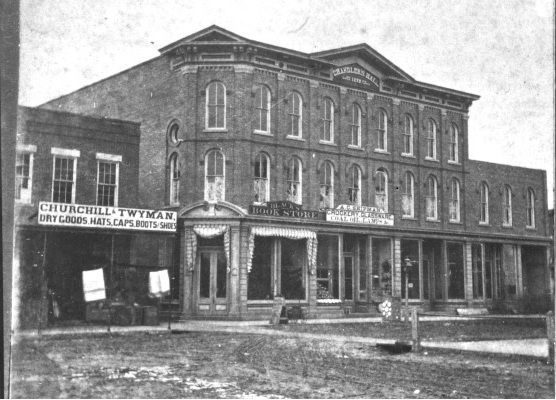
Chandler’s Opera House in Macomb, Illinois: http://www.wimuseum.org/wp-content/uploads/2015/10/chandler_hall.jpg

This was a turning point in Sosman’s career, initiating his shift from sign painting to scenic art. In regard to Harrison, Sosman could not have selected a better mentor.

This post is about the life and career of Thomas B. Harrison (1836-1895). In later years, Harrison was remembered by citizens of Clinton, Missouri, as an “erratic genius” (June 23, 1900, “The Clinton Eye”). Harrison must have greatly inspired Joe Sosman at the beginning of his career. Here was an individual who appears to have dreamed big, trying his hand at everything within reach. Harrison was also key to the later Chicago connections for Sosman, facilitating many introductions for Sosman’s later success.

I do wonder how involved Harrison was with the mechanical engineering at Sosman and Landis throughout the 1880s and early 1890s. I also wonder how much he really contributed to the firm, contributions that made Sosman so loyal to Harrison throughout his life.

Newspaper accounts purport that Thomas Benjamin Harrison was born in Hull, England, on February 16, 1836. However, I have yet to locate any definitive proof. Harrison’s baptismal records were dated less than a week later on Feb. 21, 1836, in Selby in North Yorkshire. For geographical context, the Selby is approximately 38 miles due west of Hull, with a river and canal system connecting to two. In 1840 the railway from Selby to Hull opened, expanding transportation options.

The parish of Selby where T. B. Harrison was baptized in 1836.

Thomas was the eldest of two children born to Benjamin Harrison (1804-1891) and Ann Smith (1804-?). Benjamin and Ann’s Marriage Banns, dated from May 15, 1834, in nearby Leeds.  This is the same year that the Leeds and Selby Railway was completed, further expanding transportation options for local residents. Leeds is approximately 25 miles due west of Selby. Selby is approximately halfway between Hull and Leeds. Here is a great link to an article about Selby that was published in the “Yorkshire Post” – https://www.yorkshirepost.co.uk/heritage-and-retro/heritage/history-selby-once-port-west-riding-and-reputed-birthplace-henry-i-2936178

The 1841 England Census listed the Harrison family as living in Selby. Household members included head-of-household Benjamin Harrison (35 yrs.), wife Ann (35 yrs.), son Thomas (5 yrs.) and daughter Ann (1 yr.). Sometime between the 1841 census and 1847, the Harrisons relocated south to Oxfordshire. In 1847 Benjamin Harrison was listed as a cabinet maker, located at 28 St. Aldate’s street. It remains unclear as to what prompted the move or what exactly happened to his first wife; I have yet to locate any death certificate.

The trip from Selby to Oxfordshire if one were to travel by foot.

In 1849, Benjamin Harrison married a second time. He and Sarah Schutt were wed at St. Wilfrid’s Church in Calverley on Feb. 18, 1849. Calverley is approximately six miles northwest of Leeds.

St. Wilfrid’s Church, Calverly.

Soon after their marriage, the Harrisons emigrated to the United States of America. Sailing aboard the Columbus, their arrival is documented in an Arriving Passenger Crew List, dated June 29, 1850. At the time, the Harrison family included Benjamin (46 yrs. cabinet maker), wife Sarah (41 yrs.), and four children: Thomas (14 yrs.), Ann (10 yrs.), Charles (9 yrs.) and unnamed infant. I have yet to confirm if Charles was the biological son of Benjamin and his first wife, or Sarah’s child from a previous marriage. He could have even been relative, simply traveling with the couple at the time, which may be possible as he disappeared shortly after arrival.

A view of NY Harbor at the time of the Harrisons’ arrival: https://digitalcollections.nypl.org/items/510d47e0-d305-a3d9-e040-

The Columbus sailed with 661 passengers from Liverpool to New York. Amazingly, the Harrison family is even included in the publication, “The Famine Immigrants: Lists of Irish Immigrants Arriving at the Port of New York, 1846-1851 Vil VI (June 1850-March 1851)” by Ira Glazier and Michael Tepper (Baltimore: Genealogical Publishing Co., 1985, pp. 1-150).

The Harrison family was also counted in the 1850 US Federal Census. At the time, they were living in Bloomfield, Clinton County, Iowa.  Oddly, only two of the four children from the ship’s passenger list were listed in the census report: Thomas (15 yrs.) and Anne (11 yrs.). It remains uncertain if 9 yrs. old Charles and the infant passed away, or if they were reunited with relatives. There were only a few months in between their arrival and the census report.  

Six years later, the Harrisons were living in nearby Maquoketa, Iowa, counted in the State census. The 1856 Iowa census listed 52-yrs.-old Benjamin Harrison as a cabinet maker, living with his wife Sarah (47 yrs. old) and four children: Thomas Harrison (20 yrs.), William H. (4 yrs.), Sarah J. (2 yrs.), and Mary A. (1 yr.). These were all the biological children of Benjamin and Ann, born after the couple’s arrival in America, and when Sarah was in her mid-40s; Thomas’ half-siblings. The 1850 census also listed Thomas Harrison’s occupation as a painter.  Later reports purport that Harrison’s artistic and academic training were solely obtained in England, but this would have been only until the age of 14.

The 1860 US Federal Census report listed that the Harrison family household included Benjamin (58 yrs.), Sarah (50 yrs.), William (8 yrs.), Sarah (7 yrs.) and Mary (5 yrs.), all still living in Maquoketa. By this time, Thomas was 24-yrs.-old and living on his own. I have yet to locate his whereabouts between 1857-1861. He briefly disappears from public records until 1862 when he enlisted in the Iowa Infantry. He possibly traveled as an itinerant painter, going from town to town throughout the region, as was common with many scenic artists at the time.

Harrison’s US Civil War draft registration card listed his occupation as “painter.” At the time, he was 27 yrs. old.  The US Army register of enlistments provides addition information about this young unmarried man. His appearance was listed as black, hair, black eyes, and a ruddy complexion. Harrison enlisted Sept. 30, 1862, as a 2nd Lieutenant in Co. B., 26th Iowa Infantry. He was soon discharged, however, due to constant illness. He served a second time, with the same company.  Harrison’s obituary remembered, “He saw much service and was twice severally wounded at Fort Donelson and in Arkansas, from the effects of which he never recovered. He was a true soldier and patriot.” Harrison mustered out on March 10, 1863, in Young’s Point, Louisiana. From Louisiana, he headed to New York. By fall, he sailed from New York to New Orleans aboard the Evening Star. On Oct 18, 1863, “The New York Times” listed T. B. Harrison of a steamship passenger bound from New Orleans (page 8).

From New Orleans, Harrison moved to Chicago, where he rapidly rising to the top of his profession as a scenic and easel artist. In 1864, Harrison was listed a one of several artists exhibiting their oil paintings at Jevne & Almini’s. The group included two other well-known scenic artists such as Minard Lewis and William Voegtlin. On June 17 – 20, 1864, a “Chicago Tribune” advertisement announced:

“Chicago Artist’s Sale, by Gilbert & Sampson, of Fine Oil Paintings, at Auction. We will sell on Tuesday Evening, June 21st at 8 o’clock precisely, the fine collection of Oil Paintings, by Chicago Artists, which have been on exhibition at Jevne & Almini’s, and are now removed to our salesroom, in order to accommodate those who wish to purchase and could not get admittance at the room on Washington street. All the paintings exhibited at our room will be sold without reserve. The paintings of the artists who had someone to bid on their paintings unbeknown to the others will not be put into the sale. The paintings will be on exhibition day and evening until the time of the sale (Sundays excepted.) This collection has been very much admired and are from the hands of our best artists, viz: H. C. Ford, Mrs. Nicholson, J. H. Drury, Paul Brown, P. Fishe Read, Jacob Cox, J. R. Sloan, D. F. Bigelow, Alfred Sederberger, Belden J. Woodman, Kaye E. Cameron, H. N. Gager, Mary A. Thomas, Wm. Voegtlin, Miss E. Mackway, Minard Lewis, Mrs. Hall and T. B. Harrison. The attention of all our citizens who are in want of good paintings particularly called to this sale, and are invited to call and see then while on exhibition. Gilbert & Sampson” (page 4).

T. B. Harrison listed as one of the artists in 1864.

Now, this places a few key players in the same group.  Harrison was intimately involved with the Chicago Academy of Design (CAD) and the Chicago Academy of Fine Arts. There is a fascinating article by John Dryer entitled “The Demise of the Chicago Academy of Design and the Rise of the Art Institute of Chicago (“Journal of the Illinois State Historical Society” Vol. 113 Nos. 3-4 Fall/Winter 2020). According to Dryer, “Shortly after the war ended, the CAD was founded in 1866. Its stated purpose was to offer artists a studio to rent, regular exhibitions and teaching ateliers.” By 1867, many of the organizations activities were held at the top floor of the newly constructed Crosby Opera House on Washington Street.

To place this within the history of American scenic art, Lou Malmsha (1845-1882)  was one of the scenic artists who worked at Crosby’s Opera House during this time. He initially trained with Mr. Arragon at the venue, having emigrated from Sweden in 1863. By 1866, Malmsha was also painting scenery in New York, and was listed as one of the scenic artists who delivered scenery for the original production of “The Black Cook” at Niblo’s Garden.

Thomas G. Moses trained with Malmsha in 1873, at the same time that Sosman trained with Harrison. Both Moses and Malmsha also worked at P. M. Almini’s during this time as decorative painters.  Late in life, Moses recalled the talents of Malmsha, writing, “He was a very clever man. In all the years that have passed since then, I have never found a man that could do so little and get so much out of his work, very simple in drawing and color, but very effective.”

In 1868, Harrison was listed as one of the Committee members  for a Chicago Academy of Design event, held at Crosby’s Opera House. At the time, there were approximately sixty members in the organization.

On March 3, 1868, the “Chicago Evening Post” included T. B. Harrison was listed as a Committee member or the tableaux vivant, a featured event for the Chicago Academy of Design art reception at the Opera House (page 4). The tableaux scenes that were reproduced included The Laocoon Groupe; Fighting for the Dead Body of Patrocius, as seen on the frieze of the Parthenon; Dirce; Thorwaldsen’s Apollo and the Muses; Groupings from Raphael and Murillo; and a scene reproducing the features of ancient Egyptian art.  The article reported, “The effects of these pictures, given living figures, will be indescribably beautiful and afford something that has never been presented in this city. Tickets can only be attained from the Committee, which is composed of the following gentlemen: Chas. Knickerbocker, U. H. Crosby, Conrad Diehl, H. C. Ford, Walter Shirlaw, J. F. Gookins, Louis Kurtz, Chas. H. Brower, P. Almini, Chas. Peck, J. F. Aitken, G. S. Collis, T. B. Harrison, G. A. Binkert, W. B Baird, or at Room No. 9 Opera House.”

There are a few things to note about some of the abovementioned individuals in this group. In 1865 Jevne & Almini joined with Louis Kurtz to form the Chicago Lithographing Co. Their portfolios provide great insight into the bustling city of Chicago before the great fire of 1871. Kurtz, a German emigrant, moved to Chicago in 1864 where he worked as a scenic artist at both Crosby’s Opera House and McVicker’s Theatre.

The Chicago Academy of Design held private gatherings and public events at Crosby’s Opera House prior to the great Chicago Fire of 1871. The organization’s art exhibitions were frequently featured at the Crosby Art Gallery or in The Almini & Jevne Building on Clark Street. The CAD also leased space at a new building on Adams Street by 1870.

For a little more context, after the 1871 fire, Jevne and Almini separated, each going their own way and founded two new companies: Otto Jevne & Co., 226 E. Washington Street and P. M. Almini & Co., 344 State Street.  Almini remained much more active with the CAD, constantly employing many of the artists.

Although CAD membership greatly declined after the firs, in 1872 the Council of the Chicago Academy of Design rented L. W. Volk’s building at the corner of Michigan Avenue and Van Buren Street (Chicago Tribune 18 Oct 1872, p 8). Leonard Wells Volk (1828-1895) was a sculptor and president of the CAD. This was a period of great transition for the CAD, helping prompt the rise of the Chicago Academy of Fine Arts.

Like many scenic artists after the fire, Harrison travelled throughout the country again, securing work as a scene painter, photographer, lecturer, and inventor. He sporadically appeared various directories across the country.

Keep in mind that his travels also coincide with the onset of the Long Depression in 1873, and economic downturn that and lasted until 1879. This period of financial struggle is considered the first Great Depression in the United States. The event prompted many artists to expand their services, and immediately grasp at any business opportunity that came their way.

The 1873 Chicago Directory listed Thomas Harrison as a photographer at 79 Blue Island Ave. Again, this was a common listing for many scenic artists who were very active in early photographic endeavors. They accepted a variety of projects that included, photography, interior décor, sign painting, carriage painting and illustration. Photograph was also the same occupation as Harrison’s later short-term business partner Ed Pearce.

In 1873 Harrison was likely accepting any work that came his way. It was at this time that he  painted scenery at Chandler’s New Opera House in Macomb, Illinois. Again, it was in Macomb that he met, befriended, and trained Joe Sosman. Chandler’s New Opera House opened on Monday, April 21, 1873. Constructed by C. V. Chandler as a cost of $30,000, work commenced on April 7, 1872. The theater was located on the second floor of the building, with retail occupying the first floor. The lower story was 16’ high and the second story was 24’ high. The seating arrangements were divided as follows: level floor (60×40, 850 chairs); the rear 20×60 is separated by low balustrade, the seats five in number, rising one above another to the rear, thus giving the farthest from the stage an elevated position; about 175 persons can, with ample room for each occupy this division….Dress circle, or gallery seats 225.

On April 17, 1873, “The Macomb Journal” reported, “SCENE PAINTNG. As well as the entire design and arrangements of the stage is the handiwork of the eminent artist, T. B. Harrison, of Chicago. The stage, of course, is the focal point of all the attractions of the establishment and he who took the task of its design and execution has indeed an onerous one. But the one who looks upon the work of Mr. Harrison will decide that he has in masterly manner accomplished more than was expected. In the painting he has been ably assisted by our young friend, Joe Sosman; Joe has superior abilities, and our citizens will wake up some fine morning and fin in him, that Macomb has a first-class artist” (page 3).

On May 8 and 15, 1873, “The Macomb Journal” reported, “Oh! How beautiful! A thing of beauty is a joy forever. They include nearly every scene now finished in Chandler’s magnificent new Opera House and all are for sale any size card, stereoscopic, or 8 x 10. These pictures are from the paintings by Prof. T. B. Harrison, who is a master in his profession. They can be had at Hover & Zumbro’s, East Side Square” (page 3).

Harrison continued to travel throughout the country, and briefly settled in Boston during 1874.  On Jan. 16, 1874, the “Chicago Tribune” announced Harrison’s arrival at the Sherman House in Chicago (p. 7). Despite extended travels, Harrison maintained a home with Edward Pearce in Macomb, Illinois, until 1875. On Jan. 7 and 14, 1875, “The Macomb Journal” announced, “Prof. T. B. Harrison and Ed Pearce have gone to make their home in the city of Quincy. How the band will get along without them we can’t tell” (page 3).

Pearce returned to Macomb two years later. On Oct. 25, 1877, “The Macomb Journal” reported, “Ed Pearce has returned to Macomb and opened a new photograph establishment in the rooms over Joe Adcock’s store” (page 3). He continued in this business for the next few years. On Oct 16, 1879, “The Macomb Journal” reported, “Ed Pearce having returned from taking lessons in the higher art of photography, can be found at Tom Philpot’s excellent photographic rooms” (page 3).

Harrison also returned to Macomb for various projects. In 1876 he designed “Red Man’s Room” decorations. The local newspaper described Thos. B. Harrison as  “a well-known artist of this City.” The paintings were executed by both Harrison and Jos. S. Sosman.

On June 7, 1877, “The Macomb Journal” reported the following in regard to “Proceedings of a Regular Meeting of the Macomb City Council” (page 2):

“On motion, an appropriation of $10 was made to pay T. B. Harrison for a map of cemetery, and clerk was instructed to draw order on treasurer for the amount.
 A second announcement stated, “On Motion, T. B. Harrison was instructed to make another map similar to the one just finished, the cost not to exceed $7.50.”

Later in life, Harrison’s obituary recalled that he studied in Europe, Egypt and the Holy Land. It detailed that his natural proficiency for multiple languages prompted his career to branch off in an additional direction. Harrison’s obituary recorded that he contributed magazine articles on both scientific and art subjects under a nom de plume, and publicly lectured on foreign lands.

In 1878, Harrison was still traveling as a scenic artist throughout the Midwest. On October 10, 1878, The Osceola Sun  reported, “T. B. Harrison scenic artist of Chicago is here painting the scenery for Hedrick’s new Hall. This hall when completed will be one of the best in southwest Missouri” (page 3). On Nov. 2, 1878 the Butler Bates County Record reported, “The Messrs. Hendrick, of Appleton City, are finishing one of the finest halls in the southwest. It is 25×100 feet, is provided with a stage and scenery and will be seated with chairs. The scenery and fresco work is being done by Mr. Harrison, a scenic artist of Chicago, and is as fine as that done anywhere. The Appleton Dramatic society will dedicate the hall as soon as completed, due notice of which will be given” (page 3).

Harrison purportedly helped establish the Chicago Academy of Fine Arts in 1879, later renamed the Art Institute of Chicago. Harrison was well respected as a professor at the Institute.  

On Oct. 31, 1879, “The Cass County News” reported, “T. B. Harrison, the artist-traveler, has been entertaining our people with his lectures on Foreign travel during the past three evenings, closing the season for which he was advertised on Wednesday evening, having had good audiences of a highly appreciative class during the entire course. At the close on Wednesday evening a request was made by a unanimous expression of the audience, asking him to remain longer, whereupon Mr. H. signified his willingness, and announced the three nights closing the week. Our citizens who have not attended these superbly illustrated lectures, which are in themselves of the highest order, have missed a treat, Yesterday evening the lecture embraced a tour of Holland, Denmark, Norway, Sweden, Russia, Turkey and Greece. To-night (Friday) Africa, Palestine, the Ruins of Pompeii, and Spain. Saturday evening, the Lakes of Northern Italy, Milan, Pisa, Florence, Bologna, Naples, Venice, Rome, St. Peter’s Church and the Vatican. We predict large audiences, as a lifetime may be spent without another opportunity of hearing lectures of as high an order or of witnessing as superb illustrations” (page 3).

On November 29, 1879, “The Lexington Intelligencer” reported, “Thos. B. Harrison’s Pantascope, a unique series of art illustrations, forming an epitome of foreign travel, producing with realistic effect the most beautiful, picturesque and romantic places of the world, which has been exhibiting at the opera house the past week, is an entertainment of the highest order of merit and has been liberally patronized by our citizens. The programme for the first  evening was France, Paris and Switzerland, the second evening, Germany and the river Rhine; third, England, Ireland and Scotland; fourth, the Netherlands, Russia, Turkey, Greece and Egypt, and last evening, the Holy Land, Pompeii, Africa and Spain. To-night will be Italy, Venice, Rome and the Vatican. There will also be a matinee this afternoon at two o’clock, at which will be presented Germany and the river Rhine. Mr. E. D. Graham, the advance agent and business manager, was formerly editor of the Clinton Advocate, in this state, and is a thorough gentleman, as are all those connected with the exhibition. From here they go to Richmond, and we cordially recommend them to the citizens of that ancient burg. The money expended in thus getting a glimpse of the Old World and its many historic places and buildings could not be more beneficially spent by either old or young”  (page 3).

1880 advertisement for Harrison’s Pantascope.

On February 27, 1880, the “St. Joseph Gazette” included an advertisement for Harrison’s Pantascope (p. 1). Harrison exhibited “A Unique series of Art Illustration Forming a Perfect Epitome of Foreign Travel, producing with realistic Effect the Most Beautiful Picturesque and Romantic Places of the World.” The advertisement promised, “Am entertainment of the Highest Order of Merit, universally commended by all persons of culture, taste and refinement.” Harrison’s show was performed at the Fifth Street Methodist Church every day that week for a price of 25 cents for adults and 10 cents for children. A short announcement in the “St. Joseph Gazette” on Feb 27, 1880, reported, “Harrison’s Pantascope is among the very best entertainments of the season. To-night the program is unusually attractive. It includes a ‘journey’ through the Holy Land, views of Pompeii, and scenes in Old Spain” (page 4).

On March 11, 1880, “The Macomb Journal” announced, “T. B. Harrison, formerly of this place was in St. Joseph, Mo., last week, exhibiting his pantascope” (page 2). On Oct 29, 1885, “The Macomb Journal” reported, Professor Thomas B. Harrison, a former well-known citizen of Macomb, has been in our streets the present week” (page 5).

Later that spring Harrison returned to Macomb. The “Henry County Democrat” announced, “Remember, Pantascope, City Hall, April 19” (p. 3).

Although his work with Sosman in Macomb was short-lived, the two remained close friends until Harrison’s passing in 1895.  Sosman was even mentioned in Harrison’s obituary. The “Henry County Democrat” remembered, “While painting scenes in the Macomb Opera House, he took in a young boy to mix paints and be of general utility. That boy was Joe Sosman, now senior member of Sosman & Landis, Chicago, the leading theatrical contractors, and outfitters in America. Joe Sosman made his fortune, but he never forgot how much he owed to Tom Harrison. And during all of the ups and downs of Tom’s career, Joe was his steadfast friend.”

Harrison was also an inventor, developing a series of inventions over the years that included a steam hammer, a compressed air hammer, and other improvements for both manufacturing machinery and typewriter machines.

Described as an “artist of rare merit,” he remained in Clinton, Missouri, after painting a drop curtain for the opera house, teaching both drawing and music.

While in Clinton, Harrison grew attached to Samuel J. Seifried, taking the young man on as an assistant The 1880 Census listed Harrison, Samuel Seifried, and his father, William Seifried, all living at the same boarding house on Main Street. The census report listed Harrison as a 41 yrs. old artist, Seifried as 14-yrs. old “at home,” and William as 36 yrs. old “hotel clerk

Samuel Seifried was born in 1866 in Missouri, the eldest son of William J. Seifried (1844-1935) and Amelia M. Heckler (1858-1885). His siblings included Henry C. (1872-1875), Charles E. (1875-1896), George E. (1877-1878), Willie E. (1879-1881), and Barbara (1882-1912). Amelia passed away on Feb. 18, 1885. William married his second wife Emma E. Volkman (1867-1934), about 1889, and five children were born to this union: Winfred W. (1891-1976), Louis M. (b. 1897), Alberta (1895-1979), Reinhold V. (1904-1968), and Eunice (?-1896)

Samuel’s maternal grandmother, Katherine Drach, was known in Clinton, Missouri, as “Mother Seifried.” She was born in 1818 in Unistadt, Germany, emigrating to America in 1837, and marrying Jacob Seifried (?-1899) in March 1841. The couple celebrated the birth of eight children, including Samuel’s father, William John Seifried (1844-1935).

For a little context…Samuel’s father worked as an interior decorator, who, in 1882, he was listed as a painter in the St. Louis directory, residing at 2821 Sheridan Ave.

On Nov. 1881, “The Windsor Review” in Missouri reported, “Last Weeks Spree. Four Days at the Appleton City Fair.

By the kindness of Mr. Harrison, the scenic artist, we were shown through the magnificent Durley Hall of which this town is justly proud. It is undoubtedly the finest Opera House in Southwest Missouri and stands an everlasting record to one man’s enterprise. Harry W. Grantley, the builder of this gran edifice has spare neither money nor brains in rearing it and it certainly does him great credit, Complete in every detail, any play can be realistically produced on the stage. The artist, Mr. Harrison, has done excellent work here, the drop curtain being a masterpiece of artistic originality, and all of the vast amount of scenery shows evidence of his genius.”

On April 23, 1882, The Leavenworth Standard reported, “Around the World. The unique art delineation of European life will open at the Delaware Street Opera House Tuesday evening. It is said to produce with realistic effect the most beautiful, picturesque and romantic places in the world. It is in the hands of G. W. Hutchins, of Philadelphia, and T. B. Harrison, artist traveler and member of the London, Paris, Berlin, Florence and Rome schools of art” (page 4)

On July 26, 1882, the Ottawa Daily Republic of Kansas announced, “Mr. Harrison, the scenic artist of the new Opera House had begun work on the large drop curtain, and it promises to be one of the handsomest pieces of art in the state” (page 1).

Harrison also produced stock scenery for Moore’s Opera House in Nevada, Missouri.  Harry Miner’s Dramatic Directory for the 1882-1883 season credited Harrison with 20 sets of scenery at the venue. Harrison’s scenic art was also listed in Harry Miner’s Theatre Directories, for 1884 and 1887. He was credited with stock scenery collections at the Opera House in Clinton, Missouri; L&S Moore’s Opera House in Nevada, Missouri; Lamar Opera House in Lamar, Missouri; and the New Odeon Theatre in Maquoketa, Iowa.

Here is a summary of the known stock scenery collections delivered by Harrison during his lifetime:

Chandler’s Opera House (Macomb, Illinois, 1873)

Opera House (Clinton, Missouri, 1880)

Opera House (Lamar, Kansas, c. 1882-1884)

New Odeon Theatre (Maquoketa, Iowa, c. 1882-1884)

L&S Moore’s Opera House (Nevada, Missouri, c. 1882-1884)

Opera House (Ottawa, Kansas, 1882)

Opera House (Sedalia, Missouri, 1883)

On May 13, 1882, “The Falls City Journal” of Falls City, Nebraska, reported, “Around the World. A unique series of artistic delineations of European life; by G. W. Hutchings, of Philadelphia, and T. B. Harrison, Artist Traveler, and member of celebrated art schools of London, Paris, Berlin, Florence, and Rome. A perfect epitome of foreign travel. Am entertainment of the highest order of merit, universally commended by all persons of culture, taste and refinement. At the Opera House, May 16th and 20th, Admission 25 cts. Reserved seats 35 cts. Children and gallery seats, 15 cts. Season tickets only 75 cts” (page 5).

On Aug. 5, 1882, The Ottawa Daily Republic (Kansas) reported,
“Mr. Harrison, the scenic artist at the new opera house, thinks the REPUBLICAN was premature in inviting folks to see the new drop curtain. He don’t care to be bothered by visitors and has locked the public out. So you needn’t go to see the new curtain just now.” (page 4)

1883- Sedalia, Missouri: On March 13, 1883, the “Sedalia Weekly Bazoo” of Missouri reported, “H. C. Moore, president of the opera house stockholders. presented T. B. Harrison, the scenic artist, with a fine gold headed case on which is handsomely inscribed” From W. C. Moore to F. B. Harrison, 1883” (page 5). All this time, Harrison traveled with his assistant “Sammie.”

On March 24, 1886, Harrison became a naturalized citizen in Montgomery, Missouri. This may have been prompted by a series of inventions that both he and Seifried were working on at the time. On Dec. 27, 1888, the “Versailles Republican” announced the patent was granted for T. B. Harrison’s Anderson, typewriter” (page 4).

Seifried proved to be not only a wonderful assistant, but also a fellow inventor.  Harrison later listed “Sammie” as his adopted son, leaving him everything upon his passing in 1895; an estate valued at $4000. The two repeatedly toured the European continent for well over a decade, although I have yet to uncover any travel records or passport applications. During their travels through France became interested in the Braille system, returning with information and several ideas. Upon their return, the couple developed a typewriter for use by the blind and established the manufacturing firm of Harrison & Seifried. Harrison & Seifried was located at 181 E. Division Street in Chicago. They advertised as “Designers and Builders of Light Machinery.”

Here is a link to Bi-fold brochure of Harrison & Seifried, “Sole Manufacturers of the Hall Braille Writers and the Stereotype Maker.” https://aphmuseum.org/record/hall-braille-writers-and-stereotype-maker-brochure/

T. B. Harrison and Samuel Seifried advertisement for their firm Harrison & Seifried, Chicago.
The typewriter manufactured by Harrison & Seifried.

The Hall Braille typewriter (also called a Braillewriter or Brailler) was invented in 1892 by Frank Haven Hall, who was the Superintendent of the Illinois Institution for the Blind. The Hall Braille typewriter was manufactured by the Harrison & Seifried company in Chicago, Illinois, USA. Hall introduced his invention on May 27, 1892, at Jacksonville, Illinois. It types raised Braille dots onto paper. For more information, see: http://www.enchantedlearning.com/inventors/1800b.shtml]

Here is a link to another detailed history of the machine: https://www.antiquetypewriters.com/typewriter/hall-braille-writer-1/

“In 1892, Hall had the skilled local Gunsmith and Metal worker Gustav Siebel make a prototype of his machine. Hall took Sieber’s prototype to the Munson Typewriter Company in Chicago, where superintendent T.B. Harrison and designer Samuel J. Seifried, inventor of the Munson typewriter, created six pilot models. Harrison and Seifried in seeing the great potential of this revolutionary machine, then left the Munson Typewriter Company to start their own company. They made an additional 94 machines based on the initial design for Hall. The Hall Braille-writers that followed were essentially of the same design but there were alterations to be seen, especially in the carriage construction.”

The braille typewriter manufacturer by Harrison & Seifried, c. 1892.

Previously, each was associated with the Munson Typewriter Company. On Dec. 7, 1890, the “Chicago Tribune” announced, Samuel J. Seifried, Secretary of the Munson Typewriter company, filed a certificate to record the increase of the capital stock of the company from $60,000 to $100,000”  (page 6).

Harrison’s involvement with the typewriter was detailed in an 1887 newspaper article. On April 7, 1887, “Logansport Pharos Tribune” of Logansport, Indiana, reported:

“The Pharos spoke briefly the other day of the Harrison type writer being on exhibition in the city, but if failed to mention some interesting facts connected with the history of the patent. The machine is the result of the genius of Prof. T. B. Harrison, the gray-haired gentleman who gave a series of illustrated art lectures at Dolan’s opera house last year. The Professor has traveled all over the world and is a cultured and interesting talker. After leaving Logansport he went to Anderson, and while there fell in with Father Weichtman, the Catholic minister, a whole-souled gentleman who immediately took a great liking to the aged traveler. Prof. Harrison was full of his proposed type-write patent, and Rev. Weichtman immediately set to work to interest local capitalists in the device. The result was they advanced the money to secure the model and patent, and the little machine was finally built and improved, until it was brought to the point of perfection shown in this city, the model alone costing $900. We see from the Indianapolis papers that the Anderson company has been incorporated with $10,000 capital and will soon begin manufacturing Harrison’s typewriter. It can be stated in this connection that good judges in this city who examined the machine pronounce it decided improvement over other standard typewriters” (3).

Harrison continued to invest in the performing arts and established a touring company. I have yet to track down the details, but on July 7, 1892, the “Sterling Standard” the T. B. Harrison Theatrical Co. as the employer of leading man, Thomas Alexander  (page 3).

In regard to Harrison’s extended family in America…his father, Benjamin, passed away on Oct. 8, 1891. Buried in Mt. Hope Maquoketa, Jackson, Iowa, he is buried next to several other family members, including his eldest son Thomas. Thomas B. Harrison passed away on August 13, 1895 in Chicago, Illinois. Newspapers reported that Harrison’s death was caused from “slight paralysis occasioned by excessive mental labor.” His noted occupation at the time was listed as “inventor.”

On Sept. 19, 1895, “The Henry County Democrat” of Clinton, Missouri (page &) reported,

“Death of Tom Harrison. Sketch of the Life of a Talented Artist and Genial Man.

The people of Clinton who learned to admire Tom Harrison, the artist, for his many genial qualities, will be pained to learn of his death in Chicago. Mr. Harrison painted the scenery for the Clinton Opera house and as a young man, of this city, Sam J. Seifried, has been his constant companion for years. The editors of the DEMOCRAT had a warm personal acquaintance with Mr. Harrison long before he came to Clinton. For many years he lived in Macomb, Ill., and every man, woman, and child in that city admired his abilities and excellent qualities of mind and heart.

While painting scenes in the Macomb Opera House, he took in a young boy to mix paints and be of general utility. That boy was Joe Sosman, now senior member of Sosman & Landis, Chicago, the leading theatrical contractors, and outfitters in America. Joe Sosman made his fortune, but he never forgot how much he owed to Tom Harrison. And during all of the ups and downs of Tom’s career, Joe was his steadfast friend. The Chicago “Inter Ocean” of Sept. 8th contains the following brief account of his life:

Thomas B. Harrison who died recently at his residence, No. 27 Pleasant street, of slight paralysis occasioned by excessive mental labor, was buried with Masonic and G. A. R. honors Friday, Aug. 30, at his former home, Maquoketa, Iowa.

He leaves a sister and half-brother, as well as an adopted son, Samuel L. Seifried, to mourn his loss.

Mr. Harrison came of an excellent English family and was distantly related to the family of that name which was so conspicuous in England and has been in the United States, two of the members having been presidents.

He was born in Hull, England, Feb. 16, 1836. His preliminary and academical education was obtained there and, in this country, though he was an essentially self-educated man, and his attainments in the arts, sciences and general literature were extraordinary. He has an immortality of fame in this connection and by virtue of his material achievements.

He came to this country in 1850, with his father’s family, which settled in Maquoketa, Iowa, where he lies beside his father.

At the outbreak of the war, he enlisted in an Iowa cavalry regiment, but after a few months’ service was discharged on account of constant illness. When restored he again enlisted in Company B., Twenty-sixth Iowa Infantry, served to the end of the war and obtained a captaincy. He saw much service and was twice severely wounded at Fort Donelson and in Arkansas, from the effects of which he never recovered. He was a true soldier and a patriot.

At the close of the war, he came to Chicago and entered upon a successful career as an artist, and at the time of the great fire he was in the front rank of his profession. He was one of the founders of the Academy of Fine Arts and one of its ablest professors. He lost largely in the fire, and instead of resuming his business he concluded to indulge he love for travel and adventure and gratify his professional instinct by a trip abroad.

Thereafter he was a constant traveler for fourteen years in most of the European countries, also visiting Egypt, the Holy Land, becoming familiar with the language, habits, and customs of many people. He could speak and write several languages. He was a contributor to magazine literature on scientific and art subjects, but always over a nom de plume, hence not known to the public directly. On his return to the country, he was engaged in various pursuits in connection with art and obtained favor as a lecturer on foreign lands.

He had decided genius as an inventor. Among the most useful of his inventions are a steam hammer, a compressed air hammer, various improvements in manufacturing machinery, a stereotype printing machine for making printing plates for the use of the blind. The latter is in use in all parts of the world. The last year of his life, while in partial retirement, was devoted largely to the inventing and perfecting of typewriter machines.”

Harrison lies in rest at Mt. Hope Cemetery in Maquoketa, Iowa, near many members of his biological family.

The grave of T. B. Harrison, scenic art instructor to Joseph S. Sosman.

After Harrison’s death in 1895, Seifried and his younger brother Ed developed the latest improved on the stereotype maker and created the Seifried Braille Shorthand Machine.  In the years following Harrison’s death, Seifried continued to pop up in newspapers, here and there.

On April 25, 1897, “The Chicago Chronicle” announced the following real estate transfer “North Fifty-ninth st., 112 ½ ft. w of Wright st. s.f., 25.28×124 ½, April 22 – M. A. Trainer to S. J. Seifried”  (page 21). This pinpoints a location for Seifried in the late 1890s.

In 1900, “The Clinton Eye” reflected on the town’s history, again mentioning Seifried and Harrison. On June 23, 1900, “The Clinton Eye” reported, “Sometime after T. B. Harrison, another erratic genius, came here to paint the drop-curtain for the opera house. He was an artist of rare merit. Though not learned, he was well read, cultured. He painted the curtain, taught drawing, music. Was so pleased with Clinton remained two or three years. He painted and arranged a scenic exhibition, writing the accompanying lectures, and interesting the genial Will Graham, then publishing the Advocate, the late Henry Marvin and others, put the venture on the road, with varying success. While here Harrison grew very much attached to Sammie Seifried, son of W. J. The attachment was so reciprocal that young Seifried became his protégé. They toured the continent, returning located in Chicago. The protégé proved to be a genius too, of the inventive sort, and bringing forth a typewriter of extraordinary value, and the firm Harrison & Seifried ventured into the manufacturing business, successfully. A recent production is a typewriter for use by the blind, spoken of in highest praise by the Eastern press. Harrison died a year or two since, but Sam J. Seifried revers his memory by continuing the business under his name” (page 6).

I was surprised to read about an accident involving Seifried and his sister in 1906.

On Sept. 27, 1906, the “Henry County Democrat” reported “Miss Barbara Seifried Narrowly Escapes Injury. The following from the Galesburg, Ill. Republican Register of Monday will greatly interest the many Clinton friends of Sam J. and Miss Barbara Seifried:

The second railway-automobile accident to occur I the history of Galesburg, took place Saturday night when S. J. Seifried and sister, Miss Barbara Seifried, narrowly escaped severe bodily injury at the crossing of the Knoxville road and the Peoria tracks, of the C.B.&Q., their machine being struck by a freight engine and the occupants severely shaken up. The accident occurred shortly after 7 o’clock. The machine in which the Seifrieds were riding was a light Frankly touring car and they were out for a ride to Knoxville. At the crossing of the Knoxville road and the Peoria tracks the road makes a sharp turn and crosses the tracks at a right angle.

No notice of the approach of the freight train was brought to the ears of the pair in the auto, until just as they were on the tracks when Miss Seifried noticed the engine of the train, then almost upon them. It was too late to attempt to run the car over ahead of the train and Mr. Seifried’s hastily utilized what spare moments were left in the effort to back the car clear of danger, Miss Seifried having jumped when the danger became apparent. The efforts to back the car clear of the tracks was successful and the entire front end of the machine was smashed by the pilot of the locomotive, entailing a loss of several hundred dollars.

Fortunately neither of the occupants were severely injured, although both were badly shaken up and would not care to repeat their experience. No bones were broken, Miss Seifried having sustained a sprained ankle in the jump from the car seat to the ground while the close proximity of the crash between the car and engine pilot to Mr. Seifried served to give him a severe shaking up. The nervous shock and narrow escape was unusually severe, and even as late as this morning neither of the pair had completely recovered their normal nervous state” (p. 2).

On Jan. 9, 1913 the “Henry County Democrat” of Clinton, Missouri, announced: “All persons having claims against the estate of Barbara H. Seifreid, deceased, are hereby notified to present same at once to Samuel J. Seifried, 1712 Foster Ave., Chicago, Ill.” (page 8).

Seifried passed away on Dec. 29, 1912 in Chicago, Illinois, and was buried at the Englewood Cemetery in Clinton, Missouri. He was only 45 yrs. old at the time.

“Great Loss.

Sam J. Seifried Mourned by the Blind.

The death of Samuel J. Seifried, whose funeral service was held in Clinton Thursday afternoon, will be felt with keenest sorrow in all parts of the civilized world, on account of the service his life has brought to the blind.

For many years he has devoted his energies to inventions and devices for the amelioration of the condition of the sightless. When a young man he was an intimate friend of Thomas B. Harrison, an artist well known here, and accompanied him on a journey to France. Both became much interested in the Braille system of writing for the blind, which had not made much progress in later years; and upon their return devoted much study to a plan of bringing it up to date. After Mr. Harrison’s death, the opportunity at length came to Mr. Seifried to carry out a long-cherished plan of devoting his entire time to the needs of the blind; and he added to inventive genius, a good judgement that placed the venture on a sound basis that insured its permanence. The company was incorporated and closely associated with the founder was his younger brother Ed. A practical type writing machine was invented making the Braille characters, so that books and manuscripts were easily transcribed for the use of the bind. The business so broadened so as to take care of every necessity of these afflicted ones, and it stands alone in the world today, the only one of its sort in existence. A recent triumph of his inventive genius is a stenograph or shorthand machine suited for the use of the blind; and there are stenographers and even court reporters who use these machines, indenting characters on a long tape which they can afterwards readily read and transcribe on an ordinary typewriter.

So it is that his life was one of service, too, where it was most needed. And -to-day, wherever there are those in darkness, they love this man who has gone to his reward and will long mourn him as a friend and helper.

Clinton is proud that one of her sons was permitted to achieve so much of real good in the world; and we ae also rejoiced that his work is not to stop, but will be taken up and carried on by his brother.

The funeral service was conducted at the home of his father, Wm. J. Seifried, on North Third street, on Thursday afternoon at 2 o’clock, by Rev. A. N. Lindsey, who spoke words of appreciation of the departed and comfort to the bereaved relative. The house was filled with old time friends who braved shill weather to show by their presence their friendship and extend their heartfelt.

The interment was by the Masonic fraternity, which deposited the body in mother earth with beautiful ritualism” (page 6).

On Jan. 9, 1913, “The Henry County Democrat” announced, “Ed Seifried and wife arrived last night from Chicago, to accompany the remains of the late Samuel J. Seifried” (page 3).

To be continued…

Sosman & Landis, Shaping the Landscape of American Theatre: Joe Sosman – From Soldier to Sign Painter, 1864-1874

Copyright © 2022 by Wendy Waszut-Barrett

The story of American scenic artist and studio founder, Joseph S. Sosman, begins like many other German-Americans.  “Joe” was the grandson of George Sosman (1768-1848) and Catherine Wethers (1765-1842). On July 16, 1796, George, Catherine, and their two young daughters boarded a ship in Hamburg, Germany. They arrived in Baltimore, Maryland, on October 9, 1796, and settled in Hardy County, Virginia; an area now located in West Virginia.

1794 map of Virginia.

Joe Sosman’s father, Hiram A. Sosman, was the youngest of three sons born to the couple after moving to the United States. His two older brothers were George (1797-1863) and Jacob (1800-1866).

The Sosman family moved west to Ohio in 1821. In Chillicothe, George Sosman opened a bakery on Water Street, between Paint and Walnut. His shop was located near a major shipping route. Keep in mind that the construction of the Ohio & Erie Canal occurred throughout the 1820s and 1830s. Chillicothe became a major canal port, especially for merchants, mills, and meat processors. In the midst of the town’s progress, Hiram matured to adulthood and married his first wife, Eliza Green (1804-1839). The couple was married on February 26, 1828, and soon celebrated the birth of four children:  George William Sosman (1832-1832), Mary Jane Sosman (1834-1916), William M. Sosman (1836-1912), and Maria Sosman (1838-1839). Eliza and their youngest child passed away in 1839.

Hiram married his second wife, Rachel Edmonds (1817-1896), on September 20, 1841. The couple celebrated the birth of three children, with two surviving to adulthood. Their daughter, Martha M. Sosman was born in 1844. Joseph S. Sosman arrived two years later on September 12, 1846. The same year that Joe was born, artist Henry Howe created the engraving, “Chillicothe, from the hill west.” It shows a picturesque view of the small town, with Mount Logan in the distance. Here is the link to Howe’s engraving: https://www.ohiomemory.org/digital/collection/p267401coll32/id/8264

Chillicothe, Ohio, in 1846. Engraving by Henry Howe.
The woods near the Mound City Group in Chillicothe, Ohio. 2020.
Fall foliage near Chillicothe, Ohio. 2020.

The Sosmans prospered in Chillicothe for almost another two decades. In 1850, the Sosman Household included Hiram, Rachel, and the four children: Mary J. (15 yrs.), William M. (13 yrs.), Martha (6 yrs.) and Joe (4 yrs.)  Hiram and his father, George, operated a bakery. Sadly, the building burned to the ground two years later. Their disaster was included in B. F. Sproat’s publication, “The Great Fire: Chillicothe Ohio, 1852.” Sproat wrote, “Mr. George Sosman’s bakery on West Water street was established June, 1924. His son, Frank, says that when it caught fire, his father pumped water to extinguish the flames until the pump itself caught fire” (page 17).

A map and article about the great Chillicothe fire from 1852, listing the Sosman bakery on Water Street between Paint and Walnut.
The Sosman bakery was located on Water Street between Paint and Walnut. This was right next to the Scioto River in Chillicothe, Ohio.

Joe’s older brother, William M. Sosman, followed in his father’s and grandfather’s footsteps. In 1858 he worked with his father at the Union Bakery, located on the west side of Walnut Street, between Water and Second St. Two years later, William introduced the first mechanical machine to make crackers. At the peak of his success, Civil War broke out.

Coin for William M. Sosman, the Chillicothe baker, was Joe Sosman’s older brother.
The reverse side of William Sosman’s coin, recently listed and sold at NGC Coin.

Hiram was one of many prominent Chillicothe citizens who took a firm against slavery and supported the Union. He helped organize the Chillicothe Association on March 21, 1863. This group organized to oppose rebel sympathizers and the Knights of the Golden Circle.

William was the first to enlist, joining the 54th Reg. Ohio Volunteers. William later served in Co. F, 63rd Ohio Vol. Infantry, His final commission was second lieutenant in the 106th regiment, U.S. colored troops. He made quite a name for himself during the Civil War, and continued to make news for his heroic feats and accomplishment throughout the remainder of his life. Joe was especially close with his older brother, evening hiring William’s son, Fred H. Sosman, in the 1890s.

Joe enlisted as a private in the Union Army on May 2, 1864, mustering with Co. C if the 149th Regiment, Ohio Infantry. Soldiers for the 149th were recruited from Ross and Clinton Counties. This regiment was one of several, established for a 100-day service in 1864. The veterans from these regiments were nicknamed “The Hundred Days Men.” Although short-term and lightly trained, these troop freed veteran units from routine duty, such as guards, laborers and rear echelon soldiers, allowing troops to advance to the front line for combat. The 149th Regiment was organized at Camp Dennison near Cincinnati, Ohio, and mustered in as an Ohio National Guard unit for 100 days of service on May 8, 1864. They were under the command of Col. Allison L. Brown.

Col. Allison L. Brown pictured in Perkin’s book.

On May 11, 1846, Sosman was transferred to Co. A of the 149th Regiment. He was transferred on the same day that the regiment left for Baltimore, Maryland. The regiment became attached to the 8th Army Corps. From various points along the eastern shore of Maryland in June, they moved to Monocacy Junction on July 4. They were involved in the Battle of Monocacy Junction on July 9, with 100 casualties. On July 13 they moved to Washington DC, then advanced to Snicker’s Gap, Virginia.  On July 20, they were attached to operations in the Shenandoah Valley and saw action with Mosby at Berryville on August 13. The regiment mustered out on August 30, 1864, completing their 100 days of service. On gentlemen from Sosman’s Company A, George Perkins, wrote of their return to Chillicothe:

A special train was furnished, cars with seats in them, and we sped homeward. When we arrived in Chillicothe we were met by a large outpouring of the citizens, who, to music furnished by the German Brass Band, escorted us up town. We marched up Main Street, and we stepped proudly, but were saddened as we passed the homes of James Ghormely and Edward Armstrong. We were coming home, but these, our friends and comrades, never returned. They starved to death in Salisbury, N.C. prison pen. The good people of Chillicothe had prepared a dinner for us in the market house, and we did justice to it. After dinner we “fell in” for the last time. Marched up Paint street and drew up in front of the Court House, where after a few remarks by the Colonel we broke ranks, each went to his home, and the 149th Regiment, Ohio Volunteer Infantry, became a memory” (page 38).

Here is a link to Perkin’s publication, “A Summer in Maryland and Virginia; or, Campaigning with the 149th Ohio volunteer infantry, a sketch of events connected with the service of the regiment in Maryland and the Shenandoah Valley, Virginia” – https://archive.org/details/summerinmaryland00perk  Perkins was credited as “a member of Company A, at the earnest request of his Comrades of the Regiment,” and publication was printed in Chillicothe.

George Perkins was in the same company as Joe Sosman in 1864.

At the end of the war, Hiram relocated his family to Macomb, Illinois. Only William remained in Chillicothe, where he continued to work as a baker. Meanwhile, Hiram established another bakery in Macomb.

Little is known about Joe Sosman’s artistic studies before the war. However, there was an art supplier on Second Street in Chillicothe . J.R. Whittmore placed a series of advertisements in the “M’arthur Democrat” during the 1850s. On Dec. 6. 1855, his advertisement stated,

“Artist’s Materials of every description furnished at short orders and fair process. A large supply of paints and brushes for Portrait Landscape Painters, Toy Paints and Best Water Colors on Hand” (page 3).

If Sosman dabbled in any type of painting before the war, he likely purchased supplies from Whittmore. In Macomb, Joe was recognized as a successful artist and sign painter. Newspaper articles and advertisements track both Joe’s social interests and sign painting career between 1867-1872.

Sosman’s first business partner in Macomb was fellow Independent Order of Good Templars member John B. Russell (1847-1909). John was the eldest son of Hiram Russell (1816-1893) and Elizabeth W. Vaughan (1825-1897). Russell was previously associated with the painting firm of Hail & Russell, “practical painters and paper hangers” (The Macomb Journal, 25 Oct., 1867, page 4).

Hail & Russell advertisement from 1867.
Sosman & Russell advertisement from 1868.

On Dec. 6, 1867, “The Macomb Journal” listed Jos S. Sosman as Worthy Secretary of Olive Branch Lodge, No. 165, I.O. of G.T.” (page 1).

Membership certificate for the Independent Order of Good Templars, c. 1868.

Founded in 1851, I.O. of G. T. was a temperance group, working to promote the avoidance of alcohol and other addictive substances. Other I.O. of G. T. officers in 1867 included D.M. Graves, Worth Chief Templar; S.J. Clarke Past Worthy Chief Templar; Geo. W. Hamond, Worthy Financial Secretary; Mary Hampton, Worthy Vice Treasurer; T. Bonham Worthy Chaplain; J.E. Russell, Worthy Marshal; Tillie Graves, Worthy Guard; Junior Treasurer Russell W. Sen.” In 1868, J. B. Russell was listed as the Worthy Chief Templar of Olive Branch No. 165 (The Macomb Journal, 17 April 1868, page 1). In that same issue, Russell advertised his new business venture with Sosman.

On April 17, 1868, “The Macomb Journal” reported, “Our young townsmen, Sosman and Russell, have some time since formed a partnership in the business of painting. Their shop is on south Lafayette street over McClintocks wagon shop. Those who wish any work in their line are requested to give them a call.- We hear it said that Sosman is a real fine artist, and can letter a sign equal to the best” (page 3). The accompanying J. S. Sosman & J. B. Russell advertisement included the following information:

“SOSMAN & RUSSELL,

Tender their services to the people of Macomb and surrounding country as House, Sign & Ornamental painters, paper hanger, grainers & Glaziers,

A fair share of work is respectfully solicited, Shop over McClintock’s Wagon shop, South of Square, on LaFayette st.”

Sosman & Russell continued to place advertisements in the paper later that spring and summer. I have yet to uncover how long their firm lasted, or what prompted its dissolution.

In 1870, the US Federal Census listed Sosman as a painter, still living with his father, mother, and sister. He continued to be listed as part of the Sosman household until 1880. The scope Sosman’s painting projects began continued to expand throughout the decade.  On April 12, 1872, “The Macomb Journal” mentioned Sosman’s sign painting work in “Our Chatter Box” section of the newspaper: “E. H. Black, one of Macomb’s enterprising Book Store men, has treated his establishment to a new and elegant sign; of course from the brush of Joe Sossman [sic.]” (page 3). His painting works consistently made the local news, especially after finishing a new sign for the newspaper.

On June 21, 1872, Sosman placed an advertisement in The Macomb Journal (page 3):

“Stencil Outfit for Sale at a Bargain. – a complete set of Stencil and Key-Check Dies, consisting of three sets of Dies for cutting name plates, etc. – Two sets for making key and baggage checks, and material enough for making 300 name plates and a like number of key checks; also a lot of hotel room and baggage checks, inks, brushes, boxes, etc., and all tools necessary for working. Every thing complete and ready for traveling. To aa person wishing to travel in a light and profitable business, this is a rare opportunity. Tools, etc., from S. M. Spencer & Co., the best made. For particulars call on, or address, J. S. Sosman, Macomb, Ill.”

On August 29, 1872, the “Macomb Journal” reported, “That beautiful new sign, the handsomest in town, in front of the ‘Journal Office’ is the work of Joe Sosman, of whom there is not a more artistic sign painter in the west.” This was the beginning of Sosman’s intimate relationship with the press, and soon, Sosman was called upon to paint scenery at the local opera house. Sosman’s first scenic art project was at Chandler’s Opera House in Macomb.

Years later, “The Macomb Journal” remembered, “In 1873 [Sosman] was at his home in Macomb, Ill., and had partially painted the Macomb Opera House, when the owner sent to Chicago for an expert to put on the finer finishing touches” (May 26, 1886). Sosman worked as an assistant to Thomas B. Harrison. Harrison’s permanent residence was in Chicago, but like many itinerant artists at the time, he completed projects throughout the region.

Chandler’s Opera House in Macomb, Illinois.
Chandler’s Opera House Block in Macomb, Illinois.
Photograph of the Chandler Opera House block in Macomb, Illinois.

After the opera house opened, Harrison went on his way, and returned to sign painting. On Sept. 25, 1873, “The Macomb Journal” announced, “……..New signs have been flung out at the First National Bank, Davis’ grocery store, Philpot’s photograph rooms, and Bowles grocery store; they are artistic in design, and of course the work of that excellent artist, ‘Joe Sosman.” On Oct. 9, 1873, “The Macomb Journal” reported, “Business Directory. Macomb’s talented young artist, Joe Sosman, is engaged in getting up a business directory of our city, different from any heretofore gotten up. It will be some 18×24 inches, then center of which will contain a photograph of McDonough Court House. Around this will be grouped Business Cards. Quite a number of cards will be printed, framed and hung up in the Dept, Hotels, and other prominent places of resort in the county. As an advertising medium, it will surely pay. We bespeak him a liberal patronage among our business men”(page 2).

Sosman’s success prompted him to embark on new business ventures. On April 30, 1874, “The Macomb Journal” reported, “Our enterprising and energetic fellow townsmen, C. Hamilton and Jos. Sosman, have purchased an out-fit and will travel through the states with beautiful and instructive “Sun Picture” entertainment. They have purchased entirely new pictures, and the most powerful magnifying instrument manufactured. They intend giving an entertainment in this city next week, after which we will give them a more extended notice. In the meantime we hope that every citizen of this town will turn out to their exhibition, and give them a good ‘send off’” (page 3).

I need to clarify exactly what Sosman and Hamilton were peddling. Their sun picture entertainment is not to be confused with the photographic process of using the sun to capture and image; that practice was also referred to as “sun pictures.” On October 31, 1874, “The South Bend Tribune” advertised “A Fine Entertainment. Hamilton & Sosman will give an exhibition of colossal sun pictures, representing a tour round the world at Good’s Opera House, on next Monday night, which will be free to all” (page 4). This was a magic lantern show.

Hamilton & Sosman advertisement from South Bend in 1874.

I was curious about Sosman’s second business partner, Hamilton, so did a little digging. Charles Wilson Hamilton (1853-1901) was the son of G. W. Hamilton, a hardware merchant in nearby Prairie City, Illinois. For geographical context, Prairie City is located only 10 miles northeast of Macomb. In 1870, the US Federal Census listed Hamilton as living with his family in nearby Prairie City. Sosman and Hamilton’s business venture did not last a year. By 1875, Hamilton returned to his family home. In 1880, he was listed as Dry Goods Merchant in Prairie City, a profession he continued until his passing in 1901.

The downfall of Hamilton & Sosman in 1874 may have been competition. In 1874 there were many other sun picture entertainments, including the the Tremain Sun Picture Troupe and Leslie’s sun pictures and concert troupe. These two touring shows were much more impressive and littered regions with advertisements. From a cultural context, Sun pictures” had been popular for quite a few years by this point.  Some Sun pictures blended scenic illusion with projections. On Jan. 27, 1870, “The Baltimore Sun” published an advertisement for Prof. Merchant’s Sun Pictures at the Maryland Institute (page 2). His advertisement promised, “Remarkable, exquisite, instructive and pleasing chemical dissolving diorama of cities, ruins, plains, lakes, mountains, rivers, forest and valley. Depicted with remarkable fidelity. Each picture fourteen feet square, and not hastily drawn and painted, but the combined efforts of the Best Artists in the Country. The public can form no estimate or magnitude of this singular and beautiful entertainment, unless and optical demonstration is had. Admission 25c; Reserved seats 50c. Children accompanied by parents, 15 c. Family Matinee Saturday Afternoon.

In 1874, Hamilton & Sosmans’ sun pictures entertainment competed with Tremaine’s Colossal Sun Pictures of Travel and Art. On Nov. 4, 1874, “The Times Herald” of Port Huron, Michigan, advertised the themes for daily shows: Wednesday Evening – From New York to Jerusalem; Thursday Evening  – The Splendors of Paris, the Ports of the Mediterranean and the old City of Rome; Friday Evening – “Central Europe,” Italy, Switzerland and Germany; and Saturday Evening – From Constantinople to Jerusalem – A Grand Tour through the Bible Lands (page 8). On May 7, 1874, “The Oskaloosa Herald” in Iowa reported, “The Tremaine Sun Picture Troup exhibited at City Hall some half a dozen evenings, and is highly spoken of by all who saw the exhibitions. We can recommend it to our brethren of the press” (page 2).Five years later, on May 6, 1879, “The Junction City Times” reported, “The sun picture entertainment at Centennial Hall, on Monday, Tuesday, Wednesday and Thursday evenings, next week, will be rendered by the aid of a powerful calcium light, and the views will be as plain and beautiful as the original. The entertainment will consist of views in every part of the world” (page 3). Previously, artists crossed the country with illustrated lectures featuring moving panoramas. This remained

Despite the failure of Hamilton & Sosman, Joe continued to travel. On Jan 7, 1875, “The Macomb Journal” reported, “Joe Sosman, Macomb’s artistic painter, has gone to Mount Sterling to do some fine painting on a new hall in that place” (page 4). Mount Sterling, Illinois, was approximately 40 miles due south of Macomb. 1875 seemed to be a transition point for Sosman, redirecting his focus to scenic art opportunities. His scenic art skills, acquired while assisting Harrison in 1873, became a very valuable asset on the road. Scenic art projects were considerably larger and much more lucrative than commercial signs and decorative painting.

To fully appreciate Sosman’s transition from sign painting to scenic art, I will explore the life and career of Thomas Benjamin Harrison in my next post.

To be continued…

Sosman & Landis: Shaping the Landscape of American Theatre. Employee No. 100 – A. M. Paton

Copyright © 2022 by Wendy Waszut-Barrett

This is my last Sosman & Landis employee biography – number 100!

I began this journey on March 28, 2021, with the story of Frank Landis, Perry’s younger brother and salesman for the firm. At the time, I had a few dozen names and planned to spend only a couple months researching and writing biographies.  Fortunately/unfortunately, new names continued to pop up all over the place as I read newspaper articles and searched various databases. Never in a million years could I have anticipated writing one-hundred biographies over the course of twenty months.

As planned, I have a garnered a great sense of the various personalities who passed through the studio over the course of several decades.

This last employee – A. M. Paton – ties many loose ends together. I first encountered Paton in a Sosman & Landis newspaper article while researching George Wood and Lawrence Donohue. His tale really sums up the experience of so many artists who left everything familiar and settled in the United States during the 1880s. In my opinion, this particular decade was a golden era – the perfect time to begin work as a scenic artist in America. There was a greater demand for scenic illusion than scenic artists to paint it, especially in the western United States where the construction of new theaters offered endless opportunities and high profits.

Paton, like both Joseph S. Sosman and Perry Landis, also invested in a variety non-theatrical business endeavors.  I have now encountered numerous artists who dabbled in newspapers and real estate. How brilliant, as good publicity and a good location remain key to the success for many artists and businessmen. 

From Newcastle-on-Tyne, England, to Ulysses, Kansas, in the United States, here is Paton’s tale.

Advertisement in the Ulysses Tribune. March 14, 1888, page 1.

Alexander M. Paton was born in Edinburgh, Scotland, in 1858. He was the son of Alexander Paton Sr. (1818-1894) and Margaret Russell (1820-1891). One of ten children born to the couple, his siblings included: Jane (b. 1843), Genia (b. 1844), John (b. 1845), William (b. 1847), Elizabeth (b. 1848), Mary (b. 1849), Agnes (b. 1850), Margaret (b. 1855), Robert (b. 1860) and Richard (b. 1963). Between the births of the two youngest sons, Robert and Richard, the Paton family moved from Edinburgh, Scotland, to Berwick upon Tweed, England. Berwick is a town at the mouth of the Tweed River, approximately 56 miles southeast of Edinburgh and 65 miles north of Newcastle upon Tyne. For geographical context, the Tweed River is the demarcation line between Scotland and England along the east coast of each country.

Paton came of age working for his father in Berwick. He worked alongside his younger brother, Robert, in their father’s bookstore. A. Paton & Sons, bookseller, was located at 51 High Street in Berwick-on-Tweed in England. The 1879 Post Office Directory of Durham and Northumberland listed Alex Paton as a stationer in on High St., Berwick-on-Tweed, with the Trade Section of the Directory listing Paton as a bookseller – A. Paton, High St., Berwick-upon-Tweed. Berwick’s town center is Mary Gate and High Street, placing the Paton’s in the center of town.

The 1881 England Census listed the Paton family living at 49 Mary Gate, listing Alexander Paton Sr. as a bookseller and printer. The occupations of his three sons were as follows: Alexander Paton Jr. (23 yrs., bookseller), Robert R. Paton (20 yrs., printer and compositor), Richard Paton (18 yrs., chemist and druggist). Other members of the household at the time included Alexander M. Paton Sr. (62 yrs., bookseller and printer) and Margaret R. Paton (25 yrs., housekeeper).

Sometime in 1886, or early in 1887, Alex Paton Jr. began reading the “Grant County Register,” published in Ulysses, Kansas. Possibly sent by a friend, this newspaper was first published on July 21, 1885, for a town of approximately 500 settlers. At the time, A. Bennett was the editor and proprietor, with Charles D. Majors as the general manager. Grant County’s “Register” began as an eight-page folio, with the first number printed in Lakin, Kansas; the printing press was late upon its arrival to Ulysses. For geographical context, Ulysses is located in southwestern Kansas, about halfway between Wichita, Kansas. and Pueblo, Colorado; 45 miles southwest of Garden City, Kansas.

Map showing the Kansas towns of Ulysses and Surprise in Grant County, 1887.
An early photograph of Ulysses, Kansas.

On June 1, 1887, the “Ulysses Tribune” reported, “A. M. Paton of Newcastle-on-Tyne, England, arrived in New York on the 23d ult., and is now located in Ulysses. He is an old friend of Harry King and T. D. Hind, who were glad to greet him.” Both Harry King (1858-1946) and Thomas D. Hind (1848-1940) were fellow Englishman. Hind moved with his family from England to Illinois in 1877, continuing west to settle in Kansas by 1878.  King also emigrated with his family to the United States (by way of Canada) in the 1870s, settling in Kansas and starting a family by 1880.

On June 4, 1887, the “Grant Country Register” also announced Paton’s arrival (page 5). The article detailed, “A.M. Paton arrived Monday from Newcastle on Tyne, England, and is the guest of his old friends, Mr. and Mrs. T. D. Hind, of Riverside hotel. This is Mr. Paton’s first introduction to America, and he says it suits his taste better than old England. He read the Register across the waters, and the contents of the paper induced him to make the voyage. He was disappointed at every city he visited in Kansas except Ulysses, which agreeably surprised him. Mr. Paton will make this city his future home.”

Thomas D. Hind was part of the Kansas, Land, Loan, Irrigation & Investment Co. of Hutchinson County, Kansas.

One of many advertisements placed by Hind in newspapers during 1886.

Hind was named in advertisements in 1886 attempting to entice settlers to Surprise, Kansas promising, “the benefit of good schools, churches and the best of society” (The Surprise Post, 6 July 1886, page 8). Surprise was purportedly located twenty miles due south of Hartland. In 1886, Hind not only was an official agent for the Surprise Town Company, but also was proprietor for The Prairie Queen hotel there.

Hind’s ads in “The Surprise Post” stated:

“T. D. Hind,

Agent for the Surprise Town Company,

Is empowered to offer special inducements to investors. The lots have been placed at low prices, in order to build up the town and make money for the purchasers. Come early and secure choice lots in one of the most promising towns in Southwest Kansas. Correspondence solicited. Address T. D. Hind, Surprise, Hamilton County, Kansas.” (The Surprise Post, 10 June 1886, page 8).

Although Hind initially promoted the new town of Surprise, Kansas, he soon set his sights on Ulysses, Kansas. Ulysses is located approximately 14 miles south of Surprise

On Oct. 30, 1886, the “Grant County Register” announced, “T. D. Hind, formerly town agent of the Surprise Town Co. and landlord of the Prairie Queen hotel at Surprise, has rented and taken personal charge of the Riverside hotel, Ulysses, which he is giving a thorough renovation. Mr. Hind is an experienced hotel man and will run the Riverside in a creditable manner. The table is first class” (page 1).

One of Hind’s Riverside Hotel advertisements in the “Ulysses Tribune,” 1887.
Hind remodeled the Riverside Hotel during the summer of 1887.
A. M. Paton stayed at the Riverside Hotel as a guest of Thomas D. Hind upon his arrival to America in 1887.

Interestingly, Hind was not always popular with everyone. 

I am including a few more articles about Hind to “set the stage” for Paton’s arrival in 1887. On Nov. 19, 1886, the “Garden City Daily Herald” included an article entitled “Pistol Practice” about Hind reporting:

“A shooting scrape occurred at Ulysses Wednesday between T. D. Hind and A. D. Hunt which came very near to resulting in the fatality as to the latter party.  Hunt followed Hind into the post office and commenced abusing and applying all sorts of offensive ephithels to him when Hind pulled out his revolver and fired five bullets at him.  The first two shots went into the ceiling, but the third and fourth shot struck Hunt in the right side, just under the arm, the bullet coming out of the back under the shoulder blade. Mr. Kiarney stepped in about this time and caught Hind, but was unable to control him until he had emptied his revolver. None of the shots, however, took effect. The shooting caused intense excitement. Hind was arrested by the constable, Daniel Springer, and was bound over to appear at the district court in the sum of five hundred dollars. At last accounts he had not succeeded in securing bonds and will probably have to go to jail. Mr. Hind has a wife and two children and is running the hotel at Ulysses. We are informed that he has but few friends in the community. It is thought that with good care Mr. Hunt will recover, although his wound is very painful and only missed the heart a few inches” (page 1).

On Feb 12, 1887, the “Grant County Register” reported, “We were glad to see T. D. Hind return to Ulysses Sunday. Mr. Hind was bailed out by the Ulysses Town Company” (page 8).

In the spring of 1887, Hind was living at his Riverside Hotel, but began to expand his real estate acquisitions. On April 16, 1887, the “Grant County Register” reported, “Joseph Bittiker’s house has been rented by T. D. Hind, of the Riverside, who will use it for sleeping accommodations for his numerous guests” (page 5).

Although Hind lived at the Riverside hotel, he was building a large home on the outskirts of town. During construction, his wife and children lived in a “shanty” at his land claim. On April 20, 1887, “The Garden City Sentinel” provided a little glimpse into Hind’s shanty (page 3):

“T. D. Hind went out to his claim with a covered hack to bring his family into town, and on arrival at the shanty he found his wife and children in a sad predicament owning to the water running into the house. The house is five feet in the ground. It was not made waterproof. Mr. Hind is building a fine residence on the southeast corner of the claim, in full view of Ulysses, Cincinnati and Surprise.”

A few months later, Paton was Hind’s guest at the Riverside Hotel. After deciding to stay in the area, Paton placed an advertisement for work in the “Ulysses Tribune.”On June 11, 1887, Paton’s advertisement listed that he was a “sign painter, decorator, and artist in oil colors [who] undertakes all kinds of work in this line. For moderate estimates apply at the Riverside Hotel.” His advertisement was also mentioned on the front page: “Read the advertisement of A. M. Patron, artist, in this issue.” There are a few things to consider. The first is that when Paton arrived in Ulysses (at the age of 29), he advertised himself as a painter. I highly doubt that he embarked on an entirely new career at this time. In other words, his advertisements as an easel artist, sign painter and decorative painter suggest some training and past experience in England.

On July 23, 1887, the “Grant County Register” reported, “Mr. A. M. Paton, who lately arrived in Ulysses from England, is in receipt of several letters from his father, who cannot for the life of him, in merry England, conceive how a habitable house can be built here for ten pounds. To give Mr. Paton’s inquiries, his surmises and doubts, would fill an interesting column. We ask him to address a letter to the Register.” This was the same paper that Paton first read in England, likely the same newspaper that was still being sent to his father’s bookstore. It indicates that his family knew where he was and stayed in contact.

Nineteenth-century photograph of frame houses in Ulysses, Kansas.

Some of Paton’s earliest painting projects in the area were contracted by Hind. On June 15, 1887, the “Garden City Sentinel” reported, “A. M. Paton, a new arrival in Ulysses, from England, has a painted picture of the Riverside hotel and is at present engaged on one of Dr. C. B. Core’s new residences. Mr. Paton will also paint the signs for the new Edwards hotel.” Hind also owned and managed the Edwards hotel in Ulysses. He remained associated with the property until the fall of 1887, when “The Grant County Register” reported, “T. D. Hind has withdrawn from the management of the Hotel Edwards, his successor being G. S. Hoffecker.”

Paton’s name continued to appear in local newspapers, providing insight into not only his past life, but also his current activities in Kansas. On October 12, 1887, the “Ulysses Tribune” reported, “At the literary Wednesday evening, Mr. A. M. Paton read ‘Tam O’Shante’s Tale’ in the Scotch dialect. Mr. Paton is a native of Edinburg, and his rendition of this popular poem was easy and natural and the dialect perfect.” Here is a link to “Tam o’Shanter” by Robert Burns: https://www.scottishpoetrylibrary.org.uk/poem/tam-o-shanter-tale/

By the fall of 1887, Paton began to diversify his employment and investments in the region.  On Nov. 9, 1887, the “Ulysses Tribune” announced, “Mr. A. M. Paton has accepted a position with this paper in the capacity of business manager, and will lend his time and labors toward increasing the patronage and circulation of the Tribune.”  This was only six months after the newspaper was founded by George W. Perry, providing Paton with a wonderful opportunity to promote both himself and his various activities.  

A, M, Paton listed as the business manager for the Ulysses Tribune in 1888.

In addition to the newspaper position, Paton began investing in local business enterprises.  On Dec. 21, 1887, the “Ulysses Tribune” reported, “A. M. Paton and Wm. Brown will erect a building on Central Avenue to be used as a barber shop and bathroom. Work is to be commenced at once.” The bathhouse opened, listing Paton as the sole proprietor. He placed a series of  advertisements in the “Ulysses Tribune” for several weeks.

An advertisement placed by A. M. Paton for his bathhouse in Ulysses, Kansas.

By the beginning of 1888, Paton began to travel throughout the region. On Jan. 21, 1888, the “Garden City Register” announced, “H. G. King, A.M. Paton and W.B. Rorick were in Garden City this week” (page 5). All the while, he continued to paint. On March 7, 1888, the “Ulysses Tribune” announced, “A. M. Paton has painted a very handsome sign for H. G. King’s real estate office” (page 1). By this time, Paton, King, and Hind were all investing in land. In the end, however, they failed to pay the necessary taxes and were subsequently listed as delinquent tax payers.  This prompted a swift relocation for all parties involved.

By the fall of 1888, Hind and Paton had left town. In October, Paton put his house up for sale and moved west to Kansas City, Missouri. He placed advertisements for his frame house, measuring 12×16,  in the “Ulysses Tribune”. The advertisement listed – “House for sale. A 12×16 frame house for sale belonging to A.M. Paton. House now located at the east end of Prospect Avenue, Ulysses. Will be sold cheap for cash. Apply at this office.”

Similarly, Hind moved from Ulysses to Hutchinson, Kansas.  On Nov. 23, 1888, “The Larned Eagle-Optic” reported, “Mr. T. D. Hind, of Hutchinson, a professional dresser and trimmer, who learned the business in London, England, and subsequently followed it to New York and Philadelphia, spent last week in this city dressing the show windows and decorating the interior of the Boston Store, and completed the work in genuine metropolitan style, displaying rare genius in the artistic arrangement of draperies and the harmonious blending of colors. The Boston Store in consequence presents a most beautiful and attractive appearance, equal to anything that can be found in our largest cities. Mr. Hind, we are informed, will pay this city another visit shortly before Christmas and dress the Boston Store in its holiday attire” (page 3). There is absolutely no mention of his stay in Surprise, Ulysses, or any past land investments.

As for Paton, by the spring of 1889 he was living Kansas City, Missouri. Paton was listed in the City Directory as working at 124 Commercial block, and rooming at 717 Penn. He continued to take out advertisements, marketing himself as a Scottish artist.

On April 7, 1889, he advertised in the “Kansas City Times”:

“Personal – Alec Paton, artist, from Edinburgh, Scotland, gives lessons in oil painting morning or evening, 50 cents per lesson. Visitors are invited to the studio. Room 124, 1108 Main st.” For geographical context of the location, the W. W. Findlay art store was located a few doors away at 1112 Main. Findlay ran a well-known establishment, originally founded in 1870. 

Advertisement in the Kansas City Directory for W. W. Findlay.

Paton continued to run advertisements that spring, each with a little variation:

April 16, 1889, “Kansas City Times” – “Aleck Paton, artist, teaches drawing and oil painting in a few lessons; 50 cents a per lesson, room 124, 1108 Main.”

May 15, 1889, “Kansas City Star” – “Aleck Paton, artist, gives lessons in painting daily; pupils always successful; exhibition of work shortly; visitors invited. Studio 1108 Main st.”

May 18, 1889, “Kansas City Star” – “Enlarge your own photographs life size – Crayon, pastel or oil portraiture taught in 5 lessons: proficiency guaranteed. Paton, artist, 1108 Main st.”

May 31, 1889, “Kansas City Star” – “A. Paton, artist, gives lessons daily in drawing, painting and art decorating; 3 hour lesson 50c; materials provided. Studio 1108 Main st.”

Paton did not remain in Kansas City for long, and moved to St. Louis, Missouri by the fall of 1889. Paton traveled quite a bit during his time, advertising in many other newspapers across the country, including the “Tarborough Southerner” in North Carolina, always listing his home residence as 1114 Olive Street.

Advertisement by A. M. Paton in 1891.

In addition to offering art lessons, Paton began advertising “crayon portraits,” rapid sketches in pencil or charcoal. Paton’s new home and studio was located at 1114 Olive. He advertised in both St. Louis and St. Joseph newspapers. On March 16, 1890, the “St. Louis Globe-Democrat,” mentioned A. M. Paton performing as “the crayon artist” as part of the Arcade Club Entertainment at West St. Louis Turner Hall, located on the corner of Beaumont and Morgan streets (page 8). Paton’s artistic performance was listed alongside musical entertainment for the evening.  His title as “crayon artist” changed to “lighting artist” the next month. On August 6, 1890, the “St. Joseph Herald,” listed Mr. A. M. Paton as a “Lightning Sketch Artist” who was part of Ideal Mandolin Club Plays program (page 7). Lightning artists were very popular at the time, recognized as stage performers who entertained crowds with quick sketches. Their performance often includes narrations by the artist and funny tales, while drawing, painting, or sculpting clay.

It was likely his Lightning artist act that brought him into contact with P. J. Toomey of Noxon & Toomey, St. Louis.  Paton soon began representing the firm as a scenic artist and decorator.  On April 6, 1891, “The Kearney Hub” reported, “Decorators Here. The opera house decorators did not arrive Friday as expected, but are here now. A. M. Paton, representing Noxon & Toomey, scenic artists, of St. Louis, and Messrs. Parquette and Coldewe arrived last night, The latter gentlemen were melting glue and grinding colors to-day, and to-morrow will begin the work on the ceiling. The foreman will be here ton-night” (page 3). He returned with Toomey for opening night at the Opera House and was again mentioned in “The Kearney Daily Hub” on May 2, 1891 (page 1): “In the other box of the second tier were seated P. J. Toomey, of Noxon & Toomey, the scenic artists, A. M. Paton, their representative here, and Miss Helen Harney.”

Interior of the Kearney Opera House on opening night, 1891.

This is quite significant and indicates the value that Toomey placed on Paton’s work. It is unusual for a studio owner to very publicly attend an event with an employee unless that individual is a great asset to the firm.  By 1901, Paton is still working with Toomey, listed as the Secretary of the Toomey & Volland Co. However, Paton’s employment as a scenic artist in America tales many twists and turns before that.

In 1892, Paton partners with another artist named Keller to establish Keller and Paton. The two place the following advertisement in the “St. Louis Globe-Democrat” on July 10, 1892 (page 20): “Keller & Paton, artists, studio, 307 Hagen Opera House, Specialty – Fine Portraits; inspection invited.”

There were quite a few Midwestern artists who shared he last name of Keller. However, the likeliest candidate seems to be Jacob Keller, a German-born artist who worked in St. Louis from 1880-1915. In 1880, Keller was listed as a fresco artist in the St. Louis Directory. He remained in St. Louis, working as an artist until his passing in 1915. Both of Keller’s son’s, Arthur and George, followed in their father’s footsteps and were listed as “sign writers” in the 1900 US Federal Census. In 1892, Jacob Keller was 45 years old, and Alexander Paton was 34 yrs. old.

A month later, the “St. Louis Globe-Democrat” mentioned Keller and Paton transparency paintings in an article entitled “Panorama of Light” –

“The illumination test last night was a magnificent success, and the down-town thorough-fares looked like street of Candy Town in Fairyland. Thousands upon thousands of many-colored globes shed their mellow lines upon the enchanted crowds that thronged to see them; electric lights almost without number flashed in gorgeous festoons from every meeting of the vast network of wires on Broadway, Twelfth and Olive streets, Washington and Franklin avenues; and dozens of colossal set pieces told in pictures of flame the story of the nation’s discovery, growth and prosperity. The beauty and colossal proportions of the display outrivaled anything ever before attempted in the world. For without electricity competition would be in vain; and the present is the most costly and extensive electric illumination ever contracted for.

The ‘test’ display of last night was begun a few moments before 7 o’clock and lasted until 8:30. The arches, gas and electric, on Broadway, Olive street, Washington and Franklin avenues were first turned on, making the several streets light as noon. The green arch of the Presidents on Broadway, between Pine and Chestnut, the transparency of the sailing and landing of Columbus on Broadway and Locust street and the accurate likeness of Washington at Broadway and the avenue of his name all inspired unbounded admiration. The Columbus portrait at Thirteenth and Olive streets looked natural as life. The painting of the transparencies was executed by Keller and Paton, and are really admirable from an artistic stand-point. The greatest terrestrial globe at Broadway and Olive was somewhat tardy in lighting up, but at 7:45 it began to whirl on its axis, and the oceans, islands and continents, sprung out in bold relief. The globe is the Kohinoor of the illumination. The Santa Maria arch at Twelfth and Market streets, vying for supremacy with the great globe in point of beauty, created a decided sensation when finally lit. The quaint old-style ship, riding over gloriously tinted waves- and waves. Too, that seemed to swell and heave in brisk gale – was a sight certainly unique. The statue of Liberty in a new dress of bronze lifted her blazing beacon to the world as patiently and proudly as during the last year.

“Owing to the fact that the final touches had not been put on the star of the Western World set piece at St. Charles and Twelfth streets and the Grants flags, these two prominent designs were not illuminated. The electric power was found to be more than enough on the ‘Globe’ at Broadway and Olive, many of the small incandescent burning out completely and a large rent being made in the surface of the miniature earth. When the grand affair began to hiss and sputter threateningly the big jam at the intersection of the streets below resolved itself into a panic-stricken mob. The wife of a real estate man fainted and fell to the pavement. But for the timely assistance of Officer N. C. Vaugn the lady would have been trampled to death by the throng. She was revived at a drug store and was none the worse for the experience. Two little boys were knocked down by horses on Twelfth street, near Olive, but neither were injured on account of the slowness of the beasts.

“It is estimated that fully 80,000 people were on the streets last night. Nothing like the throng has been seen since last year’s Veiled Prophet’s parade, and it is doubtful if the thoroughfares were more ‘jammed’ then. The next illumination will be given on September 1.

“The illumination was the occasion of a large number of visitors to the new Globe-Democrat building, while waiting the grand display of electric lights and gas-jets, took advantage of the opportunity to inspect the largest and most perfect newspaper establishment in the world. They were shown through the mammoth building and viewed with interest the complicated machinery and latest appliances of modern invention to be found in an office building, as well as the intricacies of the interior workings of a great newspaper” (August 16, 1892, page 12).

In St. Louis, Paton purchased a home. On Jan. 17, 1893, He was listed in “St. Louis Globe-Democrat” when he purchased a home from the Tuxedo Park Land improvement Company for $500 (page 5). With a St. Louis home, Paton became subject for other civil duties in the cities, including jury duty. In the end, he was excused as he was not a US citizen.  The article “St. Louis Post-Dispatch” from April 24 announced, “Are Not Citizens.” The article continued, Alexander M. Paton, an artist living at 10 South Sixth Street, and John T. Mooney, clerk at Scruggs, Vandervoort & Barney’s, residing at 2215 Sidney street were summoned to act as jurors in the Criminal Court this morning, but were excused on the ground that they were not citizens of the United States.”

Article announcing Paton’s excuse from jury duty on the grounds of non-citizenship statues, 1893,

He continued to work as an artist, and became secretary of the St. Louis Sketch Club (18 Feb 1896, St. Louis Globe-Democrat, page 4). Paton continued performing on the stage too. A very interesting article about his sculpture work made newspapers across the country. On Dec. 11, the “Albany Democrat” in Oregon described Paton’s latest performance:

We hear a great deal about mud slinging during a political campaign. The St. Louis Republic tells of a case of genuine mud slinging that is very interesting and beats politics at every corner. At am entertainment the unique feature of the program was a surprise sprang by Mr. A. M. Paton, the well-known artist. He was down on the program for lightning sketch and modeling, and after the usual display of rapid picture making he had his assistant bearing forward a table covered with about 50 balls of mud. Standing in front of the platform he began throwing the balls at the surface of his modeling board, and before the audience quite understood the meaning of the queer proceeding, he had shaped the conglomerate mass of clay into the shape and features of a human head and face. With a few rapid strokes of his deft fingers a wrinkled face appeared, with hollow cheeks and sunken eyes of old age, the sweep of a comb, and a matted beard and mustache was there on an aged face, leering from the board. The artist was greeted by surprise applause, and without removing the clay changed the plastic mass, into the typical faces of all the races of men. The Scotman, Irishman, negro, Englishman and Chinaman, gave way to the American Indian, and them to the well-known face of Uncle Same. The face presented was the common in the end to all, the grinning skull.”

Paton continued to return to England and appears on the Outward passenger lists from the UK and Ireland on Jan. 5, 1901; sailing on the Umbria. Paton continued to live and work in St. Louis where he remained associate with P. J. Toomey’s scenic studio. Remember that in 1891 he represented Noxon & Toomey.

On May 10, 1901, Paton was working for Toomey & Volland at the Stone City Opera House in Bedford, Indiana. On May 10, 1901, “The Bedford Weekly Mail” reported, “Mr. A. M. Paton, Secretary of the Toomey and Volland Scenic Co., of St. Louis, has for several days been placing the scenery upon the stage of the new Stone City opera House, for its approaching opening and future mission. By courtesy of Mr. Paton we were permitted to view the splendid array of scenery, and were lead into a full detail of its arrangement, which owing to the complete and modern construction of the house, the gentlemen claim, will make a most satisfactory showing when completed – which we were informed will be about the last of this week – will constitute one of the most elegant and perfect working stages in Indiana.

“The Toomey and Volland Scenic Co., of St. Louis, enjoys the distinction of being the first in scenic art and stage equipment, and the management of the new Stone City has been very fortunate in securing work of their execution, and their personal services in dressing the stage.”

There is a little backstory that will provide context for Paton’s work at Noxon & Toomey and Toomey & Volland in St. Louis. All of the players really shape Paton’s scenic art experience. Patrick J. Toomey (1851-1922) was born in Limerick, Ireland and immigrated to St. Louis with his parents as an infant. He apprenticed himself to Thomas C. Noxon at Deagle’s Varieties. The two established Noxon & Toomey in 1869, with Ernest Albert joining them in 1881 to form Noxon, Albert & Toomey. Although it was a short-lived firm, it shows indicates the high quality of scenic artists passing through the studio doors at the time.  At the time of his death, the “St. Louis Post-Dispatch” reported that Toomey was “considered one of the pioneer scenic painters of St. Louis” (St. Louis Post-Dispatch, 13 March 1922, page 14).

Studio stencil for Toomey & Volland.

Noxon passed away in 1898, but the firm of Noxon & Toomey continued for the next threeytears. In 1901 the name changed to Toomey & Volland, reflecting the new second partner, Hugo R. Volland. Volland rose through the ranks in a similar fashion to Thomas G. Moses at Sosman & Landis. Both Moses and Volland eventually took over the running of each firm. Toomey was a close friend of Thomas G. Moses of Sosman & Landis. Prior to the death of Toomey in 1922, the two studios shared both projects and artists over the years. So, when Paton begins working for Noxon & Toomey in 1891, it is under the leadership of senior partner Noxon.  Toomey was the junior partner who frequently traveled for the firm, hence why he attended the 1891 opening of the Kearney opera house with Paton.  Noxon & Toomey become Toomey & Volland after Noxon’s passing in 1898, but it takes a few years. At this point, Toomey becomes the senior partner, and Volland is the junior partner. The dynamic of the studio shifts. After Toomey’s passing, Toomey & Volland is immediately renamed Volland Scenic Studio.

Portrait of PO. J. Toomey from 1896.

The studio’s namesake, Hugo R. Volland, was born on May 6, 1866 in Großenbach, Germany. He was first listed as a St. Louis resident in 1888, living with his brother Otto Volland, and advertising as a painter. He first worked for Noxon & Toomey as a scenic artist and later secretary for the firm by 1892. By 1901 be was listed as vice-president of Toomey & Volland, with Paton stepping in as Secretary for the firm.

Volland Studio Stencil.

In regard to scenic projects that occurred during Paton’s time at both Noxon & Toomey and Toomey & Volland, it greatly varied as in many studios at the time. However, Toomey was best known for his electrical floats, and excelled in this line for over 25 years, placing his studio staff at the forefront of many projects. Paton likely gained much of his electrical knowledge from Toomey in the 1890-1891. This was immediately before he partnered with Keller on the Panorama of Light project in 1892.

In 1902, Paton briefly works with Sosman & Landis on a project in Bowling Green, Ohio.  Although the newspaper misprints the initials of his first name, this is the same guy.  On August 6, 1902, “The Daily Sentinel-Tribune” of Bowling Green, Ohio, reported, “F. A. Paton, representing the Sosman & Landis company, scenic artists of Chicago, was here yesterday making arrangements for the scene and curtain painting for the new Chidester theatre. The work will be handsome and attractive when done.” (page 5).  The venue opened Dec. 19, 1902.

Sosman & Landis studio project pictured in the “Chicago Tribune, 2 Feb 1902.
Sosman & Landis catalogue, 1894.

In 1904, Paton again relocates his home and business, heading west with many other scenic artists who recognize the untapped potential of the West Coast. In addition to an abundance of work, California’s temperate climate was ideal. Many Chicago scenic artists moved to the west coast, after apprenticing in Chicago. On Nov. 27, 1904, Paton sells his Tuxedo Park home at a loss, receiving $100 less than he originally paid for it (St. Louis Globe-Democrat, page 32). He journeys we where he purchases several properties from the Jacob Heyman Co. in San Francisco (San Francisco Chronicle and San Francisco Examiner real estate transactions, July 1905). He also buys property in Los Angeles from H. W. Wilson (Los Angeles Herald, 4 Nov. 1905, page 7). 

Paton is listed in both the 1905 San Francisco Directory and the 1906 Fresno Directory, working as a scenic artist and living at 609 Jones.  Other scenic artists listed in these two directories included:

Barr, A. L., 426 Eddy

Bell, George R., 660 Castro

Brooks, Joseph M., 361 Geary

Cutler, Frank E., 522 Van Ness Av.

Duran, Edward C., 8 Gough

Dye, Clarkson, 1418 California

Englander, Edward, 536 O’Farrell

Engwer, Charles F. 1117a Filbert

Fest, Oscar L., 1616 Turk

Grabach, Charles, 631 O’Farrell

Porter, W. T., 507 Mason

Rose, Charles F., 1117 Filbert

Sheppard, Arthur F., 676 Hayes

Williams, Edward S. 1281 O’Farrell

By 1910, Paton was listed in the San Diego Directory as a scenic artist at the Garrick Theatre, 1614 Front Street. The Federal Census confirmed Patron’s employment as a scenic artist, working on his “Own Account.” At the time, Paton was living as a boarder at 1614 Front in San Diego. He was boarding with a 40-yrs.-old widow, Maude M. Kelly, and her two teenage sons,  John R. Kelly (son, 18), and James H. Kelly (son, 16).  The census report listed Paton’s date of immigration as 1890, and that he was a naturalized citizen.

During the fall of 1910, Paton sold his Los Angeles property at the northwest corner of W 10th and Fedora Street. In the real estate transaction listing, he again listed his business residence as the Garrick Theatre in San Diego. Between 1911 and 1912, Paton also sold several of his San Francisco properties. This was likely to finance a new business venture with stage carpenter Thomas B. Wylie.  The two established Paton & Wylie scenic studio in 1911. The 1911 San Diego Directory listed that the Paton & Wylie (AM Paton and TB Wylie) was located at 203 5th. In 1912, Wylie was listed as the stage carpenter for the Isis Theatre in San Diego, living at 1329 8th.

This partnership did not last for long. In 1912 Paton was listed solely as a scenic artist at the San Diego’s Savoy Theatre, living at 1431 First. He continued to reside at the same addressfor the next few years. By 1913, Paton partnered with fellow scenic artist, Frederick Rickeman (1874-1951) to form Paton & Rickeman. At the time, Rickeman was living in the Point Loma neighborhood of San Diego. In 1914, Paton & Rickeman, listing their studio as the Empress Theatre. Rickeman was listed in the 1915 San Diego Directory as living at 715 10th. By 1916, Paton & Rickeman listed Spreckels Theatre as their new business address. Interestingly, Spreckels Theatre was constructed in 1912 to commemorate the opening of the Panama Canal.

Rickeman was the son of German immigrants who had moved to California by 1911. Born in Phillipsburg, New Jersey on July 29, 1874, Rickeman worked as a scenic artist all over the country before heading west. His US Passport applications from 1890 and 1900 describe him as 5’-8” tall, with blond hair, blue eyes, Roman nose, round chin, oval face, fair complexion, and a moustache.  A trip to France in 1903 resulted in marriage to his first wife Gabrielle. The two returned to the United States were Rickeman worked in New York as a decorator by 1905. In 1918, Rickeman married in second wife, Eva Minosa Forneri (b. 1890 in Minneapolis, Minnesota). The Rickeman’s celebrated the birth of two sons, David E. (b.1919, Indiana) and Donald J. (b. 1929, San Diego). After ending his partnership with Paton, Rickeman moved to LA where he continued to work as a scenic artist. At the time of his passing in 1951, Rickeman’s obituary identified him as a “film studio scenic artist.”

Paton remained in San Diego for the remainder of his life, continuing to work as a scenic artist on various projects. Unfortunately, Paton’s projects seem to dwindle in the post WWI years. The last mention of his work that I have located to date is from 1924; this is just one year before his passing.  On Feb, 22, 1924, the “Weekly Times-Advocate” announced that Paton was one of two scenic artists working on the Escondido Fruit exhibit for San Diego County at the National Orange Show in San Bernardino, California. The article reported, “A. M. Paton and E. E. Knight, San Diego artists, were put in charge of the construction, and the exhibit was built there and taken in sections to San Bernardino, where the finishing touches were applied by Mr. McLean, Mr. Knight, and M. E. Salsberry, horticultural inspector at Escondido, who had charge of the mechanical end. C. E. Bell, assistant manager of the San Diego-California club, is now at the orange show, distributing San Diego literature and ‘selling’ the city and county to interested inquirers” (page 2).

Paton died the following spring on April 28, 1925. I have yet to locate any obituary or gravestone.

To be continued…

Sosman & Landis: Shaping the Landscape of American Theatre. Employee No. 99 – Lawrence E. Donohue

Copyright © 2022 by Wendy Waszut-Barrett

The biography for Lawrence Edward Donohue (professional name L. E. Donigan) is connected to Sosman & Landis employee No. 98, George Pat Wood. They were relatives.

Here is the link to George Pat Wood’s biography: https://drypigment.net2022/11/27/sosman-landis-shaping-the-landscape-of-american-theatre-employee-no-98-george-pat-wood/

Wood’s mother was Bridget “Della” Donohue/Donigan, the sister of scenic artist Lawrence E. Donohue/Donigan. Both Donohue and Wood worked as scenic artists in St. Louis and Chicago, as well as many other cities across the country. In 1913 they were associated with Sosman & Landis, painting stock scenery together for the Empress Theatre in Des Moines, Iowa.

Postcard of the Empress Theatre in Des Moines, Iowa.

Tracking down the Donohue family history was nigh impossible due to the spelling variances of their surnames. Donohue, Donahue, Donaghue and Donigan were all used by members of the same family over the decades. For more information about Irish Emigrant name changes, here is a link to a fascinating article: https://irishamericancivilwar.com/2019/06/27/leaving-off-the-o-insights-into-irish-emigrant-name-changes-in-1860s-america/

I have been unsuccessful in my attempt to track down Donohue’s early theatrical career in either the 1870s or 1880s. This is not unusual if he were working as a scenic artist assistant or at a scenic studio during this time. Such is the case for many itinerant scenic artists who went from town to town looking for work.  For example, when Sosman and Landis began their partnership in the mid-1870s, the continually traveled before selecting a permanent residence.

By 1890, Lawrence E. Donigan changed his name to Laurence E. Donohue. He was listed in the 1890 and 1891 Chicago Directories as an artist, residing at 20 Gurley. He remained in the region for the next few years, marrying Chicago-native Mary Muir Dinnervell on June 25, 1894. Interestingly, Mary’s maiden name also varied from Dinnervell to Drimervell, Dennerwell, and Dinnerville. The surnames were certainly a challenge this time! Their wedding announcement was published in Chicago’s “Inter Ocean” on June 26, 1894 (page 8).

Shortly after marrying, the couple relocated to St. Louis, Missouri and celebrated the birth of Lawrence Edward Donohue Jr. (May 1895).  At the time, the small family was living at 1302 Sidney St. Lawrence. Lawrence was listed as an artist in the St. Louis City Directory in 1895 and 1897.  The following year he celebrated the birth of a second son, James P. Donohue.  Their stay in St. Louis was short-lived and the small family soon returned north.

By 1899, the Donohues were back in Chicago where their third son, Walter J. Donohue, was born. The couple celebrated the birth of at least two more children over the next several years. Mildred Donohue was born in 1901, with Mary Florence Donohue following in 1906. It is likely that more children were born, but did not survive infancy.

By 1900 the Donohue residence was located at 20 Vernon Park, Chicago; they would remain at this location until the 1930s.

It was also at the onset of the twentieth century that Lawrence E. Donohue changed his professional name to Lawrence E. Donigan. I have yet to find any official records which explains why census reports consistently listed Donohue or Donahue, but all newspaper references listed L. E. Donigan; they were the same person. Even his death certificate lists both names, suggesting that Donigan was simply an alias for work.

Lawrence E. Donigan continued to work as an itinerant scenic artist, traveling across the country for work.  He was listed as the scenic artist for the Grand Opera House in Memphis Tennessee, during 1900. For a year, he was even listed in the Memphis Directory, rooming at 441 ½ Main. Scenic artists frequently listed themselves in local directories, despite having a permanent residence and family in another city. The key is “rooming, “boarding,” or just listing the address of a theater.  This was to ensure that they were able to receive mail during extended absences from their permanent residence.

By 1902, he was working at the Academy of Music in Chicago, placing an advertisement in the “Chicago Tribune” on July 20, 1902: “WANTED FRESCO PAINTER: Must draw and paint ornaments. Academy of Music. L. E. Donigan.” This also foreshadows his transition to the decorative arts during the Great Depression.

Want Ad in the Chicago Tribune from July 20, 1902.

In Chicago, Lawrence also began working at Sosman & Landis, later securing a position for his nephew, George Pat Wood. Wood likely started with the firm about the same time as John Hanny and Art Oberbeck, c. 1905-1907.

Donohue continued to work for the Chicago-based firm under his professional name, L. E. Donigan.  On July 8, 1913, both Donigan and Wood were mentioned in the “Des Moines Tribune” while working at the Empress Theatre in Des Moines, Iowa. The article reported, “…the elaborate settings that will adorn the stage of the new theater and three scenic artist, L. E. Donigan [Lawrence E. Donahue], George Wood, and Arthur Overholt [Arthur Oberbeck] are rapidly transforming the white canvas of the wings and drops and borders into surfaces of colored beauty.”

Over the years, the Donohue family remained at their house on Vernon Park Place in Chicago, although the renumbering of streets shifted their house number from 20 to 857. Donohue/Donigan continued to work as a scenic artist until the 1920s, eventually drifting toward the decorative arts. The last mention that I have located of Lawrence’s scenic art work is in 1922. That year Lawrence E. Donigan was credited with painting the scenery for the Oliver Player’s production of “The Barrier,” an adventure melodrama. On April 29, 1922, “The South Bend Tribune,” reported, “L. E. Donigan, scenic artist for the Oliver Players, has endeavored to reproduce the actual atmosphere of the mining country with the aid of Mr. Burham, who has himself sent many months in Alaska” (page 6).

The Market Crash of 1929 changed everything for many scenic artists, including Donigan.  John Hanny described the shifted in a letter to Dr. John Rothgeb: The depression of 1929 just about stopped the production of stage scenery – at least in Chicago. Road shows, musical, etc. if any were being produced in New York and Hollywood. At this point the studios disappeared but the scene painter couldn’t disappear and had to become freelancers. There was no such thing as a steady job and the boys were hard put to find a day’s pay.”

The 1930 US Federal Census reported that Lawrence Donahue was working as a painter in the building industry. I have yet to locate any newspaper reports for L. E. Donigan at this time. This is not unusual as scene painters gradually began to fade from the public notice.

During the 1930s, the Donahue family home moved from Chicago to Oak Park, the same western suburb that had housed many other scenic artists since the 1890s, including Thomas G. Moses and Joseph Landis (Perry’s older brother).

The 1940 US Federal Census listed the Donahue residence as 829 South Cuyler, Oak Park. The household included: Lawrence (head, 76 yrs.), Mary (wife, 68 yrs.), Marie (Mary Florence) Krbec (daughter, 33 yrs.) and Marcelle Krbec (grandson, 9 yrs.). Their son James P. Donohue, who had continuously lived with his parents since birth was missing that year. James P. Donohue’s 1942 draft registration card listed that he was working for the U. S. Army Signal Corps in Chicago. However, his home residence was still listed as 829 South Cuyler, Oak Park.

Both Lawrence E. and Mary Donahue passed away in 1944, within weeks of each other. Their two children, James P. Donohue and Mary Florence Krbec inherited the house, remaining in the Oak Park family home for at least another decade.

On Feb. 13, 1944, Mary Donahue’s obituary was published in the “Chicago Tribune” (page 18). It announced:

“Mary Muir Donahue, of 821 S. Cuyler avenue, Oak Park, beloved wife of Lawrence, fond mother of Lawrence E., James P., Walter T., Mildred M. Cotey and Mary F. Krbec, sister of Walter Dinnerville, Ina Frank and Louise Humphries. Resting at funeral home, 17, Madison street, Oak Park, Funeral notice later.”

Ten days after the announcement was published, Lawrence passed away on Feb. 23, 1944. The Illinois Death Index lists both surnames for Lawrence on his record: “Lawrence E. Donigan or Donahue.” 

On March 2, 1944, the Oak Park Leaves announced,

“L. E. Donohue Dies;

Scenic Artist

Lawrence E. Donohue of 821 South Cuyler died on Wednesday, February 23, at his home after suffering from an ailment of two years standing. His wife, the late Mary Muir Donahue passed away on February 12 of this year. Mr. Donahue (known as Lawrence Donigan, professionally) was a scene painter and in years past painted scenery in the theatre throughout the United States, including New York Civic Opera House, Detroit Opera House, and Civic Opera House in Chicago and Ravinia. He was a business agent for the Scenic Artists’ union 350 for a number of years and was active until a few weeks before his death, despite poor health.

Born in Alton, Illinois, in 1864, Mr. Donoahue has resided in the village for the past fifteen years. He was the father of Lawrence E., Walter J., and Mirs, Mildred M. Coty of Chicago, and of James PO., and Mrs. Mary Krebec who live at home, and brother Peter J. Donigan and Mrs. Mary Berry of Chicago. Services on Saturday were conducted at Ascension church with burial at All Saints” (page 50).”

Sosman & Landis: Shaping the Landscape of American Theatre. Employee No. 98 – George Pat Wood

Copyright © 2022 by Wendy Waszut-Barrett

George Pat Wood (left) and Victor Hubal (right) in 1912.

Victor Hubal & George Wood are pictured together in a 1912 photograph; each working as a scenic artist in Winnipeg at the time.  The caption written on the photograph reads, “Dad [Hubal] in 1912 at Winnipeg, Canada, Scenic Studio. His Pal Scenic Artist George Wood.”  At the time, Hubal was 24 and George was 21 yrs. old; both were associated with Sosman & Landis. As with many artists at the Chicago-based firm, they traveled all across North America, rapidly painting scenery as they journeyed from one venue to the next. Although Sosman & Landis was known for shipping scenery to distant locations, many of their projects still continued to be painted on site. Much had to do with the fact that despite the large size of their main studio and additional paint spaces at various annexes, some projects were still completed on site.

It has taken me quite a while to track down George Patrick Wood, as there are several George Woods who worked as artists from the mid-nineteenth century to the mid-twentieth century, including his father, George Wood Sr.

George Patrick Wood was born in Chicago on April 10, 1891, although his birth was not registered with the State of Illinois until July 31, 1891. Later in life, he would go by George Pat Wood in newspaper article. He was one of three sons born to George Wood (b. abt. 1854) and Della B. Donohue (also erroneously listed as Donahue/Donaghue/Donigan in many historical records), Della Bridget Donohue was born about 1870 and named after her maternal grandmother Bridget (McDermot) Donohue.

Wood had two younger brothers: Arthur Francis Wood, born in Feb. 1893, and Walter James Wood, born in Feb. 1895.

I have uncovered very little about their early childhood, or the Wood family’s activities between 1895-1900. However, sometime between the birth of Walter Wood in 1895 and the US Federal Census in 1900, the Wood family moved from Chicago to St. Louis, Missouri. They likely followed Della’s older brother, Lawrence E. Donohue, who worked as a scenic artist and moved from Chicago to St. Louis in 1895. L. E. Donohue was listed as an artist in the St. Louis Directory from 1895-1897. Two of his younger children were born in St. Louis, suggesting that his family also relocated from Chicago to St. Louis.  By 1899, however, Donohue returned to Chicago where another child was born that fall. He continued to work as a scenic artist throughout this entire time.

It remains unclear as to whether Della Wood returned with her brother to Chicago at the same time. However, by 1900, neither George Wood nor Della Wood were living with their three children in St. Louis. They both appear to have vanished from public records, with George Sr. never reappearing in the lives of his wife or children.  My gut instinct says that George Sr. passed away, Della became a single parent, and could not provide for her sons, leaving them at an orphanage. My theory is based on the 1900 US Federal Census.

St. Louis Home of Refuge where George Pat Wood, Arthur Wood and Walter Wood lived as “inmates” in 1900.

In 1900, George, Arthur and Walter Wood are all listed as “inmates” at the “St. Louis Home of Refuge.” The term “refuge” is a little misleading, as the home was well known as an abusive penal institution for juvenile offenders, as well as orphans. It remains unclear as whether all three boys were arrested for delinquent acts or committed by a family member, but their young ages suggest the latter. The ages of the three boys were listed as 9, 7, and 5 yrs. old.  I have no idea how long they stayed at the St. Louis Home of Refuge or remained in the St. Louis area. They, like their parents, disappear from public records for about a decade.

By 1913, George and Arthur are again living with their mother, now in Chicago. I have no idea when they returned to the Windy City, or where their youngest brother Walter during this this time. 

Newspaper accounts from 1913 indicate that George Wood worked as a scenic artist with his maternal uncle, Lawrence Donohue. Both painted scenery for the Empress Theatre in Des Moines that year; a Sosman & Landis project.

The Empress Theatre in Des Moines, Iowa, became the Pantages Theatre.

On July 8, 1913, the “Des Moines Tribune” reported:

“Rushing work for Empress Theatre.

Work on the scenery and stage settings for the new Empress is being rushed preliminary to the opening of it season on Sept. 14. Several carpenters, under the supervision of Master Mechanic D. E. Bradish and assistant A. Brubauer, are turning out the elaborate settings that will adorn the stage of the new theater and three scenic artist, L. E. Donigan [Lawrence E. Donahue], George Wood, and Arthur Overholt [Arthur Oberbeck] are rapidly transforming the white canvas of the wings and drops and borders into surfaces of colored beauty.”

I am going to pause here as newspapers are rife with misspellings, especially last names.  As this was a Sosman & Landis project, Lawrence Donahue would have been the head scenic artist, with his tow assistants – George Wood and Art Oberbeck.  This was very common for the studio at the time; a master artist and two assistants on site. In many ways it was cheaper to put up three staff members, than painting and shipping scenery from Chicago, especially during busy periods.

The Des Moines article continued:

“All is activity in the Elbert & Getchell building studio. More than thirty house sets of scenery will be provided for the Empress stage in addition to the settings that are carried by larger acts on tour. The management promises that there will be no better dressed stage in the country than that of the new Empress. Elbert and Getchell leave that latter part of the month for New York and other eastern cities, where they have many of next seasons musical comedy company for the Princess tentatively under contract. It is their purpose to complete the company on this trip and to bring the members back with them about Aug. 10   when stage director Wedgewood Nowell will be here to begin rehearsals. The new company will number fifty and the management promises a surprise when the roster is announced.” The Empress Theatre opened in September 14, 1913. It was located at the intersection of 8th and Locust Street.

From 1913 to 1914, George, Arthur, and Della Wood were listed in the Chicago Directory, living at 736 Wrightwood. Della Wood was listed as the widow of George Wood, and her sons, were each listed as an “artists.”

George Wood divided his time between Chicago and New York while working for Sosman & Landis. In August 1915, he left the firm’s New York branch to take a design an painting position at the Grand in Fargo North Dakota in 1915. On Aug. 14, 1915, The Fargo Forum and Daily Republican listed George Woods in a list of individuals secured for the upcoming season (page 8). The article announced, “The scenery will be designed and painted by Geo. Wood, who comes direct from the Sosman & Landis studio, New York City.”

By the onset of WWI, however, Della and her sons all returned to St. Louis, Missouri. In St. Louis, George, Arthur and Walter all registered for the WWI Draft.  Walter joined the Navy, and Arthur served in the Army for both WWI and WWII. It doesn’t appear as if George was ever drafted into the military.

The gravestone of George Pat Wood’s younger brother Arthur F. Wood.
The gravestone of George Pat Wood’s youngest brother, Walter J. Wood.

Wood registered for the WWI draft in St. Louis eleven days after his wedding, listing his wife and mother as a draft exemption. His draft card listed that he was living at 2215 Benton in St. Louis, MO, working as a scenic artist for himself. Wood also requested a draft exemption to “support wife and contribute to mother.” In regard to his occupation, Wood listed his present trade as “scenic artist” and current employer as “himself.” He was described as medium height, medium build, light brown hair, and grey eyes.

George Pat Wood’s WWI Draft Registration Card, dated June 12, 1917.

It was on June 1, 1917, that George P. Wood married Alice V. Chalfont (1898-1981) in Jackson County, MO; he was 25 and she was 19 yrs. old. Their marriage was announced on Sept. 21, 1917, in the “St. Louis Star and Times” – “George P. Wood, 1825 North Garrison avenue; married June 1” (page 3). George and Alice Wood celebrated the birth of their only daughter the following year. On August 29, 1918, Joy Patricia Wood was born in Kansas City, Missouri. Unfortunately, their marriage was extremely short lived, ending in divorce by 1920.  The 1920 US Federal Census listed Alice and Joy Wood living in St. Louis, Missouri, with Alice’s parents, Julian O. Chalfant (1857-1932) and Virginia “Dolly” Wetzel Chalfant (1857-1931). In 1920, George was again living with his mother.

Della Wood married her second husband, Rudolph Luedewink, by 1920. The census that year listed George Wood and Arthur Wood the Luedewink’s step-sons. At 48 yrs. old, Luedewink was also a painter, employed at the J. W. O. C. Painting Co. The same census listed George as an artist and Arthur as a paperhanger.

George’s ex-wife Alice also remarried. The first name of her second husband remains a mystery, but his last name was Knox. I have yet to locate a marriage license or anything else that indicates when Alice V. Wood and Joy P. Wood became Alice V. Knox and Joy PP. Knox, however they began using the last name of Knox by 1921. In 1930, Alice V. Knox and Joy Knox were still with Julian and Virginia Chalfant in St. Louis, Missouri.

George continued to work as an itinerant artist, going from one project. In 1921, he was working at the Orpheum Theatre in Montreal, Canada. On Sept. 24, 1921, “Billboard” announced, “George Pat Wood is again at the Orpheum Theatre, Montreal. Mr. Woods went there at the end of last season, and after a short vacation resumed work for the coming season” (page 21). This means that he arrived in Montreal during the spring of 1921 and stayed until the spring of 1922.  By 1923, he relocated to Cincinnati, Ohio, and was listed in the City Directory as a scenic artist, rooming at 3422 Ibsen Av. There was no mention of his wife, but it was common for itinerant scenic artists to list themselves in a directory when working in one area for an extended period of time.

In Cincinnati Wood became associated with the Stuart Walker and his touring company. It was a successful working relationship that would last for six years. On August 26, 1924, “The Post” (Covington, Kentucky) listed Wood as the scenic designer and artist for Alice M. Bradley’s new play “Three Roses” at the Cox Theater, produced by Stuart Walker. The article reported “the scenes are designed and executed by George Pat Wood.” Peggy Wood starred in the three roles -Rose Lovejoy, Rose Payne and Rose Frely. The article reported, “Peggy Wood, guest player, who portrayed each of the three Roses …has a certain vitality, and intensity, which is of great assistance to her in interpreting the high courage and independence of the various Roses. She as in addition a charming personality, and in her acting is quite free from theatricalism.” On July 2, 1921, the “Indiana Daily Times” announced that “Mr. Walker has engaged Peggy Wood herself, to appear in her own play ‘Artist’s Life.’” (page 7). I have yet to locate that George was related to Peggy Wood in any way.  However, George did remarry in the 1920s. I have no idea what her first name was or when they were married.

On July 2, 1926, an amazing article was published in the “The Kentucky Post and Times-Star that indicated BOTH George Pat Wood and his wife were working as scenic artists (page 30). It also discusses the importance of lighting on stage scenery.

I am including the article in its entirety as female scenic artists were seldom mentioned in the press at this time:

“Only three or four people were sitting in the theater Monday morning when Stuart Walker called a scene rehearsal of ‘The Swan.’ Painters, carpenters, property men, and others were rushing around putting on finishing touches or checking over lists. When on the day of an opening performance Walker orders all scenery set and the stage arranged for the various acts, nothing must be missing.

These scene rehearsals usually constitute Walker’s first view of the settings. He has conceived what they should look like, for he himself has drawn the designs, selected the furniture and properties and visualized the whole play.

He walked in, looked over the first sets, approved it with some minor suggestions and ordered the second scene put up. The work began. Two men carried out a superfluous piano. Two others dragged in a throne chair which they stood against the back drop in the banquet scene. Two others lugged in great tall pillars, apparently of black Italian marble. These they handled easily. There were six of them in all.

Then came the banquet table, covered with lacy cloths, brilliant silver candelabra and so on. A man walked in with two enormous champagne collers which caused sarcastic remarks from everybody on the stage.

Then a spontaneous touch of realism was added when the chef from the Havlin Hotel, in cap and white apron walked upon the stage with two huge platters, on which were the broiled salmon and the salad needed in the dinner scene. He proudly submitted these ‘properties’ for inspection and the praise he received delighted his artistic soul. Then he brought out the bullion and set the 10 or 12 cups on the table.

Boyd Again, property man and actor, practical person that he is called to ‘Jack,’ a stage hand, and said, ‘Put this soup some place where it won’t get dusty. Jack grinned and obeyed.

Finally, the beautiful scene, which throughout the week has evoked applause from the audience, was ready for inspection.

‘Somebody call Mr. Walker,’ directed Again and everyone stood about in expectancy mixed with some anxiety. Finally Walker, appearing from somewhere, walked down the aisle of the theater. A moment of silence, then,

‘Where’s Mr. and Mrs. George Pat Wood?’ The call was taken up by those standing at the rear of the stage. Finally it reached the place where the Woods, scenic artists, happened to be.

A droll figure walked out and stood before the footlights. It wore a cap pushed back over short hair. Its body and legs were covered with paint smeared overalls, much too large. The bottoms dragged on the floor, concealing what appeared to be very small feet. But under the visor of the cap were two very alert, if startled eyes.

The figure looked like a larger edition of Jackie Coogan. Seeing it, Walker said in a somewhat positive tone, ‘Mrs. Wood, that is not the set I designed. It is nothing like it.’ So, the little figure was a woman, it seemed.

Mrs. George Pat Wood went one step forward and said quietly, “I’m sorry. I’ll come down where you are.’ And she scrambled into the darkness of the auditorium. There was something in her bearing which suggested a shattered dream, a keen disappointment.

A few moments later two bobbing heads were seen near one of the boxes. Then the petite Mrs. Wood scrambled back onto the stage and disappeared thru a door at the rear. After that came a readjustment of the lights, a softening of the tints, a mellower effect generally. And finally the voice of Walker again.

Oh, Mrs. Wood.’ The call again was repeated and Mrs. Wood, very feminine despite her overalls, came forward.

‘I spoke too soon, much too soon,’ said Walker generously. ‘It’s lovely.’

Mrs. Wood executed a sprightly little jig, just a few steps which indicated immense relief and pleasure.

And that was that, and all of it. But it showed that Walker makes his amends just as publicly as he does his criticisms.

The whole episode was just one of those little things which are a happening constantly around a repertoire theater but which not many people see.”

Portrait of Pat Woods in the article “Born to Blush Unseen,” 1927.

On July 31, 1927, Cincinnati Commercial Tribune featured Pat Woods in an article entitled, “Born to Blush Unseen” (page 33).  The article reported:

“This story is about one of those romantic persons dubbed ‘powers behind the throne’ – the people who pull the strings while the puppeteers who were Kings and Queens walked and talked and made what was called history.

From such tales it may fairly be deduced that it is not always the people who are the most in the spotlight of wield the most influence or who contribute most largely to the success of any project. All of which is a roundabout way of saying that one of the factors in the excellence of the Stuart Walker Company productions at the Grand Opera House are the effective stage sets designed and painted by George Pat Woods, scenic artist of the organization.

Charming as are the feminine members of the Stuart Walker Company, they would appear less charming were their graces of manner and daintiness of costume obscured by ugly or uninteresting settings. Clever as are the men whom Cincinnati audiences have come to regard as great actors, there would have been less force to their performances if the stage sets did not produce accurately the environment in which type of character they represent is supposed to move.

And so this George Pat Woods who splashes merrily away in the paint-bedaubed smock away up in his aerie among the roof girders at the Grand Opera House, is a ‘power behind the throne’ in the fortunes of Stuart Walker Company.

Observe the settings and painted scenes in ‘Alias the Deacon,’ the Stuart Walker Company attraction opening tomorrow night, and you will realize what an important role the stage settings have in any production. Or recollect the mystic beauty and atmosphere secured in ‘The Road Yesterday’ by the settings. Another prime example would be the gorgeous beauty and realism of the Orient in evidence in ‘Kismet.’

‘Pat,’ as he is known by members of the Stuart Walker Company got his start in the scene-painting business when he visited his uncle in Chicago. This uncle, one Peter Donegan, is a sort of scenic baron in the Windy City, doing the stage sets for the Chicago Opera Company and for most of the large theaters. His studio proved a fascinating place to hang out, and presently the nephew began dabbing in paint. Soon he was a regular member of the force. And so he began, rather far up the line as scenic artistry goes, by designing stage sets for the Chicago Opera. Following other successful positions, Pat was retained to assist in fashioning stage sets for Max Reinhardt’s first production of ‘The Miracle,’ the most stupendous and magnificently stages spectacle the American stage has ever seen.

In between these high-light occurrences, Pat was for two seasons with the Metropolitan Opera Company. He was with Stuart Walker when Mr. Walker had the Portmanteau Theater and made all the original sketches for the company one season.

Between times he has taken jaunts to Europe to provide him with inspiration for his work; there have been visits to old world museums and cathedrals where he has studied color and technique and gained experience which he had been able to translate into renewed efficiency when he has returned to his duties.”

George Pat Wood pictured in the “Cincinnati Commercial Tribune” in 1928.

On July 15, 1928, a portrait of Wood accompanied an article in the “Cincinnati Commercial Tribune” entitled, “Busy Building Italian Scenes For First Play on New Stage” (page 38). The article reported, “While members of the entire Stuart Walker forces are busy preparing to move to their new home at the Taft Auditorium at Fifth and Sycamore street, one member, George Pat Wood, artist of the Stuart Walker Company, is particularly busy at the Taft designing and painting the settings for ‘The Firebrand.’ For the past few weeks Mr. Wood and Stuart Walker have been panning the final arrangements for the scenery for this lavish production.

‘We have studied many old books and looked through volumes of Renaissance art to get the correct details for the production of ‘The Firebrand.,’ said George Pat Wood. ‘We really started brushing up on our early architecture last spring, when it was decided ‘The Firebrand’ would be one of the plays to be presented in Cincinnati this summer. In designing a setting there are many details that must be perfectly worked out. Color schemes must be in harmony with the spirit of the play as well as with the costumes that will also blend with it. In a play of a period, such as ‘The Firebrand,’ arches, windows, vases, lights and all very small trinkets that are seen from the audience must harmonize with each other.

‘In a period play the exact date of the piece will determine its architecture, naturally, but all the other articles, naturally, but all the other articles in the room must also be of the same period and keep the unity. There must be no anachronism, nothing that will break the illusion.’

When asked if he ever ran out of ideas in designing stage settings Pat Wood merely replied: As no two homes are ever alike, so no two stage sets are ever alike. If we study the spirit of the play we will know very nearly how the characters think, and with a little imagination we can picture their homes. That much accomplished, all there is left to do is to execute it. So you see it isn’t so very bad.

‘The scenery for ‘The Firebrand’ is dated about the early fifteen hundreds, and as the locale is Florence it calls for some very rich settings at the time when Medicis were in all their glory. The scenery must express the feeling of age, the romance and gayety of the Court of Florence, and the richness of the beautiful city. All this must be brought out without making the audience realize that they are being told all this as the curtain goes up and brings them into a new atmosphere. We hope that the settings for ‘The Firebrand’ will do all things.’

The beautiful stage settings of the Stuart Walker productions have been one of the charmingly distinctive features. Already this season the productions have brought forth no end of favorable comment on each play. Particularly attractive sets this year have been in ‘The Jest,’ a charming costume play presented earlier in the season, ‘Interference,’ ‘Crime,’ ‘Her Cardboard Lover,’ ‘The Baby Cyclone,’ and last week’s revival of ‘The Dover Road.’

All of these sets owe their beauty and charm to the combined work of Mr. Stuart Walker, George Pat Wood, and George Kinsey, the stage manager” (page 38).

George Wood and Stuart Walker enjoyed a very successful run. I have not uncovered any additional information about Mrs. George Pat Wood at all.

However, George Pat Wood continued to work for Stuart Walker. Their working relationship was the subject of a newspaper article on Jan. 29, 1929, published in the “Cincinnati Post” (page 2):

“Venice.

Although Stuart Walker still clings to house slippers and a chair by the  fire because of his flu failings, he calls his players to his house every day for rehearsal. And he has worked out in his characteristically elaborate setting for the Venetian scene of the first act of “The Big Pond” for next week.

One sometimes suspects that his sets cost Dr. Walker more beads of hearts blood than do his artists. A performer can be tossed a script early in the week, then whipped, cuffed and cussed toward steady improvement. If he or she looks deplorable on Wednesday a director can strive for a better appearance by diligent application of the lash, so that a presentable portrayal may be forthcoming by the following Monday.

But a set is different. Once “cast,” it’s done. You can’t expect it to grow doggier or any worse.

Consequently, the aesthetic Mr. Walker ties himself 18 knots every time he evolves instructions for a stage scene.

When [Stuart Walker] and his artist, George Pat Wood, conferred in the Eden Park mansion of the producer it must have been almost terrifying, considering the fury with which Mr. Wood blasts smoke and sparks from his pip even when calm and the zeal with which Dr. Walker flagellates his soul when thinking up eyeful settings.

The two of them wrestle beauty for every show, almost always turning out something convincing. One of the very few times when they have felt they missed their mark came in the set for “Treasure Island” which showed an English quay. Somehow that did not look exactly British and it seemed a trifle too lovely in a Latin way for the situation.

But since Dr. Walker knows more about scenery that your deacon ever will dream of, we take it that his quay set had in it something artistic which passed quietly over our brow. The Venetian scene for the next week is to show a palace in which lives a bizarre American family. The set must be persuasively imposing to bring out the artistic shortcomings of the Ohio people moving through it. It is exactly the thing on which Dr. Walker likes to cast up wave on wave of devotion.”

After years of existence, the Cincinnati Stuart Walker Company was incorporated on July 1, 1929, in Cincinnati. It only lasted a few years, and was dissolved on Dec. 29, 1931; it did not survive the economic downturn.

The last article that I have located about George Pat Wood as a scenic artist is from the fall of 1930. On Nov. 16. 1930, “The Cincinnati Enquirer” reported, “George Pat Wood, scenic artist at the Taft, designed and painted his settings for “Monna Vanna” from color plates used in Stuart Walker’s earlier production of the Maeterlinck play here three years ago” (page 71).

This is the last reference that I have found citing Wood as a scenic artist. As with many theatrical scene painters at this time, it is likely that Wood sought work as a decorative painter to keep afloat during the Great Depression.

At some point, Wood returned to his remaining family, as Rudolph and Della Luedewink were still living in St. Louis. His move may have been prompted by aging parents.  

In regard to Wood’s mother and stepfather …

Rudolph Luedewink was still listed in the 1931 St. Louis Directory as a painter a 4245 St. Louis Ave. This is about the time that George Wood returned home.

His mother passed away in 1934, with her obituary published in the “St. Louis Post-Dispatch” on March 7, 1934 –

“Luedewink, Della (nee Donahue) – Entered into rest Mon. March 5, 1934, 4:20 PM, beloved wife of Rudolph Luedewink, dear mother of George Pat, Arthur F. and the late Walter J. Wood, our dear grandmother and aunt. Funeral from Arthur J. Donnely’s Parlors, 3840 Lindell bl. Thurs., March 8, 9 a.m., to Notre Dame Church, Interment Calvary Cemetery. Alton (Ill) and Chicago (ILL) papers please copy.” 

Her son Arthur was listed as the informant on her death certificate when she passed away from pneumonia. At the time of her passing, Della was living with her son Arthur at 1328 Annie Ave. By 1930 Arthur F. Wood was employed as a mail carrier, a profession that he continued for the remainder of his life. He married Mabel Eppley late in life, celebrating the birth of a son late in life, James A. Wood. 

George Wood’s WWII Draft Card listed him as running his own Interior Painting & Decorating business. His wife was listed as Frances Wood and the two were living at 5645 Summit Place, St. Louis. I have yet to locate another other significant mention or further information about the couple.

George Patrick Wood died in Dec 1980 and is Buried at Calvary Cemetery and Mausoleum in St. Louis. His first wife, Alice V. Chalfant Wood Knox, was laid to rest in the same cemetery a year later. Their daughter, Joy Wood Knox MacKinnon (1918-2007), is also buried at Calvary Cemetery and Mausoleum.

The gravestone of scenic artist George Patrick Wood.

To be continued…

Sosman & Landis: Shaping the Landscape of American Theatre. Employee No. 97 – Victor Hubal Sr.

Copyright © 2022 by Wendy Waszut-Barrett

Victor Hubal was associated with Sosman & Landis between 1905 and 1917. Hubal began working as a scenic artist at the age of 17 in 1905, starting with the firm about the same time as John Hanny and Art Oberbeck. Like Hanny and Oberbeck, Hubal’s scenic art career spanned for decades. His scenic art appeared in a variety of venues across the country.

Victor Hubal (right) pictured with George Wood (left) in Winnipeg, 1912.

Hubal’s employment at Sosman & Landis was mentioned in a Kentucky newspaper at the beginning of 1912. At the time, Hubal was painting scenery for the Garside  Stock Co. at the Kentucky Theatre in Paducah, Kentucky. On January 12, 1912, Paducah’s “News-Democrat” announced, “Mr. Victor Hubal, of the Sosman-Landis studio, Chicago, has been engaged to paint all scenery and is now hard at work at the Kentucky on the first production. ‘The Devil’s Kitchen.’” Two days later, the same newspaper reported, “Mr. Victor Hubal is the scenic artist, and has been connected for several years with the Sosman & Landis Studio in Chicago – which is proof positive that theater-goers of Paducah will have an opportunity of seeing some beautiful scenery twice a week at this popular playhouse” (page 6).

This meant that in 1911 Hubal was selected from the Sosman & Landis staff to paint the new scenery for the Garside Stock Company. Operated by James S. Garside, the company secured a a fifty-week engagement at Paducah’s Kentucky Theater, performing two plays each week. Hubal painted much of the stage settings on site  The Garside Stock Company’s 1912 repertoire included “The Devil’s Kitchen,” “Love and Honor,” “Dora Thorne,” “In the Rogue’s Gallery,” “Driven From Home,” “A Soldier’s Sweetheart,” “The Bowery Girl,” “Thorns and Orange Blossoms,” “The Queen of the Ranch,” “To Be Buried Alive,” “A Romance of Fort Riley,” “Brother Against Brother,” “A Struggle of Life,” “Her Cowboy Visitor,” “The Power of Woman,” “St. Elmo,” “The Embezzler,” and others. On Dec. 1, 1912, a picture of Hubal’s painted setting for “The Embezzler” was published in the “News-Democrat” of Paducah, Kentucky (page 6).

Victor Hubal’s scenic art in 1912.
1912 advertisement for the Garside Stock Co. in Paducah, Kentucky,

Another article about Hubal’s scenic art for Garside was published on January 15, reporting, “Each play will be a production from a scenic point of view, as Mr. Vic Hubal, of the Sosman & Landis studio, Chicago, has been engaged to paint all the scenery, and is now hard at work at the Kentucky on the first production of ‘The Devil’s Kitchen,’ which will be the bill for the first three days, Monday, Tuesday and Wednesday.”

Throughout 1912, newspaper articles provide a glimpse into the scenery carried by the Garside Stock Co., as well as Hubal’s career. On March 28, 1912, the “Dubuque Telegraph Herald” reported, “Car Load of Scenery Arrives – The Burlington passenger train from St. Paul brought a carload of stock scenery for the plays to be presented by the Garside Stock company. The company will produce two new plays next week and return to the road tour, returning here for the summer season at the Airdome in June. Mr. Victor Hubal, the scenic artist, who made all the scenery for the Airdome productions has been with Mr. Garside all winter and will return here for the summer” (page 5). On July 29, 1912, the “Dubuque Telegraph Herald” review of Garside’s “The Heart of Arizona” production, reporting “Victor Hubal, the scenic artist of the company is deserving of praise for the scenery” (page 8).

On June 8, 1912, “The Dubuque Telegraph Herald” heralded Hubal’s scenery for “St. Elmo” at the Airdome, produced by the Rosenthal Summer Theatre. The article reported, “Victor Hubal, the scenic artist of the company outdid himself in making new embellishments for this play, and included a beautiful church interior setting showing the full figure of Christ in stained glass with lighting effects to make it stand out beautifully in the act” (page 5). He also painted special scenery for “An American Girl” at the Airdome that summer (“Dubuque Telegraph Herald” 11 July 1912, page 2).

As most Sosman & Landis scenic artists, Hubal crisscrossed the country, even venturing into Canada. Family photos picture Hubal with Fellow scenic artist George Wood, both painting for the Winnipeg theatre. At the time, Hubal was 24 years old (see first photo in this post).

Victor Hubal (left) and fellow scenic artists in front of an ad drop. No definitive date, but my guess is 1906-1909. From the family album.
Victor Hubal (sitting left) and fellow scenic artists in front of a stage set. No definitive date, but my best guess is 1920. From the family album.

Although I have written quite a bit about Hubal in past posts, here it is again…

Victor J. Hubal was born in Chicago on May 10, 1888. His father, Felix Hubal (b. Nov. 1861), was a Czech immigrant and baker. His mother, Theresa Mary Koranda (b. 1864), was born in Illinois and worked as a seamstress. By the age of 22 yrs. old, Victor Hubal was still living with his mother and two siblings, Otto (20 yrs.) and Lucy (18 yrs.). Their address was 3528 W. Cortland St.

The 1910 census report listed that Hubal was an “artist”; he was actually working as a scenic artist. His sister worked as a stenographer, while his brother was unemployed that year.  Although Hubal’s scenic art career began in 1905, little is known of his early work, but this is understandable since he was apprenticing to older artists at the time. As the Paducah newspaper article suggested, Hubal had worked at Sosman & Landis for “several years” by 1912.

Hubal continued to live in Chicago until 1917, when he married In 1917, Hubal met a married Eloise L. Strenlund (1897 – 1984). The couple’s first address was 5030 Hutchinson St. This was the same address listed on his WWI Draft Registration card. Hubal’s draft registration card listed that he was as scenic artist. Although currently unemployed, Hubal listed that he was planning to work for the Joy & Cannon Scenic Co. in St. Paul, Minnesota. He also claimed exemption from the draft due to “kidney trouble.” On August 20, 1917, Hubal’s name and address were part of the draft list published in the “Chicago Examiner” (page 12).

It was likely familial ties that prompted the Hubals to move from Illinois to Minnesota. Eloise grew up in Minnesota, daughter to a Swedish immigrant. Her father, Anton Strenlund, emigrated in 1887 at the age of sixteen. He gradually made his way west, working as a carpenter and finally settling in Minnesota where he married Alise Oberg on August 21, 1897. The couple celebrated the birth of Eloise on November 12, 1897.  Two more children followed: Arthur (1900) and Ernest William (1903). By the age of 17 yrs. old, Eloise moved to St. Paul where she began working as a clerk, residing s at 1010 Euclid Ave. She was listed in the 1915-1917 St. Paul Directories.  Immediately after marrying Hubal, the couple set up house in Chicago where Hubal continued to work and travel as a scenic artist.

In Minnesota, Hubal worked at three scenic studios in Minnesota – Joy & Cannon Scenic Co. (St. Paul), Universal Scenic Studio (St. Paul), and the Twin City Scenic Co. (Minneapolis). I’ll start with the obscure and short-lived firm, Joy & Cannon Scenic Co. of St. Paul. This is the firm listed on Hubal’s WWI Draft registration card.

Joy & Cannon Scenic Co. stamp on backside of roll drop at Triune Lodge in St. Paul, Minnesota, c. 1916.
Joy & Cannon Signature on backside of an ad drop, now at the Anoka County Historical Society.

Joy & Cannon was established by Boyd Phelps Joy and Gerald V. Cannon, scenic artists during 1916. Their shops were located in the Metropolitan Opera House in St. Paul. Although relatively short lived, the firm was still being advertised in the “Film Yearbook of 1922-1923.” Despite the firm appearing active, the two founders went their separate ways, with Cannon working as the first United States Marine Corps. camouflage artist and Joy founding Universal Scenic Studio. Joy’s firm was first founded in Sioux Falls, South Dakota, in 1919. However, by 1920, Joy moved his operation back to Minnesota by 1920, again appearing in city directories and was listed the president of Universal Scenic Studio, Inc. in the St. Paul City Directory. Joy later opened a branch in Milwaukee, Wisconsin. A catalog from the Milwaukee branch of the Universal Scenic Studio was found among the personal belongings of Victor J. Hubal, Sr.

Hubal also worked for Joy and Cannon’s competitor, the Twin City Scenic Co.  In fact, three of  Hubal’s designs are part of the Twin City Scenic Co. Collection at the University of Minnesota Libraries Performing Arts Archives. The collection contains almost 2,000 items produced by the Twin City Scenic Studio, including designs for backdrops, leg drops, cut drops, borders, tormentors, painted curtains, olios, picture sheets, sample interiors, model pieces, sales books, business records, and company scrapbooks.

Here is the link to the entire Twin City Scenic Co. Collection: https://umedia.lib.umn.edu/search?facets%5Bparent_collection_name%5D%5B%5D=Twin+City+Scenic+Company+Collection+%28PA043%29

Scene Design by Victor Hubal for the Twin City Scenic Co.

The best summarization of Hubal’s later contribution to American scenic art and theater history is his 1972 obituary. Victor J. Hubal Sr. passed away on Feb. 15, 1972, and was buried at Union Cemetery in Maplewood, Minnesota.  On Feb. 20, 1972,  the “St. Paul Dispatch” included a lengthy article about Hubal and reported, “His work graced some 50 productions of the St. Paul Civic Opera, as the organization was then known, from the initial one, ‘Samson And Delilah’ in 1933, to ‘The Merry Widow’ in 1963. He also did the decorations and designs for a number of the International Institute’s, “Festival of Nations” at the Auditorium and was responsible for the mounting of major productions at Andahazy Ballet Borealis.” Hubal’s numerous stage settings for Lorand Andahazy and Anna Adrianova included “Slavonic Scenes,” “Les Sylphides,” “Swan Lake,” “Spectre de la Rose,” “Aurora’s Wedding,” “The Miraculous Stag” and “Scheherazade.” A 1954 article from the “Star Tribune” provides additional detail about Hubal scenery for “Les Sylphides” –

“The setting, a woodland glade, by Victor Hubal, had a spacious, semi-transparent effect which enhanced the quality of the ballet.”  The article also noted that the ballet company was composed of 40 dancers and

In regard to Hubal’s “Swan Lake” scenery, an entertaining tale was later published in the “St. Paul Dispatch.” Purportedly, Andahazy accidentally upset a pail of dye onto the canvas when Hubal was painting “Swan Lake.” Andahazy immediately apologized and Hubal responded, “Never mind.” The article reported, “with deft strokes he converted the dark blotch into a rocky formation and balanced the composition by converting some trees into more rocks on the other side.”  The “Dispatch” article also described Hubal in detail – “A man of artistic sensitivity and great skill and accumulated knowledge of his craft, Hubal labored largely in obscurity, for he was shy and retiring by nature and had no talent for self-promotion. But the contributions to the community to which he made in his self-effacing way for so many years were great, and they can be remembered with respect and gratitude.”

Another article about the St. Paul Civic Opera’s production of “Rigoletto” mentions Hubal’s brief work for film –

“When the curtain rises Wednesday it will be on the work of a man who might have been prominent in his field in motion pictures as Wallace Beery and Charlie Chaplin are in theirs, had it not been for the fact that he found black and white too monotonous. He is Vic Hubal, scene designer for the opera association. When the motion pictures were in their infancy, Hubal, already an accomplished scene designer for some of the largest production and road shows in the country, wandered into the old Essanay Film company’s lot in Hollywood. There he went to work on designing backgrounds against which Charlie Chaplin, Ben Turpin and Beery were to cavort. But the backgrounds were all black and white, because those were the only colors to film well. There were relieving incidents once in a while, as he when he would be called down from his scaffold to take the part of a cop, or when he was called into the dressing room to make up Turpin for his monkey roles, but on the whole, black and white was too confining for a true scenic artist.”  The article also noted that Hubal trained with Fred Scott, Ansel Cook and Fred Lewis, all who worked at Sosman & Landis when Hubal was associated with the firm.

Hubal’s obituary in the “St. Paul Dispatch” mentioned Hubal’s work for the Josef Meier Passion Play, both the touring productions and the permanent one at Spearfish, S.D.” Of the Black Hills Passion Play, a 1944 article in the “Queen City Mail” noted “Victor Hubal of St. Paul, scenic artist, was in Spearfish last week redecorating the play scenes for the winter performances” (Spearfish, SD, 21 Sept. 1944). Over the years, Hubal was repeatedly connected with the production as the sets were repaired and new elements were added.

Passion play postcard that shows details of Victor Hubal’s scenic art for the Black Hills Passion Play.

Meier brought his Passion Play to the United States in 1932. Born in Lünen, Germany, he was the seventh generation of his family to portray Jesus in the biblical drama. Meier translated the production from German to English and brought a small company to the United States, premiering the show in New York and then taking the production on tour. By 1939, Meier found a permanent home for his production in Spearfish, South Dakota, building a 6000-seat amphitheater.  Even after settling in Spearfish, later toured the United States and Canada until 1964. The production was performed in more than 650 cities over the years, becoming an annual event for many cities. Meier remained part of the production until 1991, when he retired after performing in 9000 performances. Meier passed away eight years later at the age of ninety-four. The Black Hills Passion Play outlived its founder, lasting until 2008 when the summer performances finally ended. For more information about the show, there are amazing photographs available to peruse online, part of the Fassbender Collection. Here is the link: https://www.historicblackhillsstudios.org/keyword/Black%20Hills%20Passion%20Play/

Interestingly, no one in the Spearfish Community seems to recall what happened to any of the Passion Play scenery…

My own life intersects with Hubal’s on many fronts. He first came onto my radar as an undergraduate at the University of Minnesota. Prof. Lance Brockman recommended me to repair some of Hubal’s work at a local ethnic hall.  In 1917, Hubal painted stock scenery for the Česko-Slovanský Podporující Spolek (C.S.P.S.) Hall in Saint Paul, Minnesota. His work includes roll drops, wings, flats and profile pieces. The roll drop curtain depicting Praha (Prague), and stage settings include street scenes, landscapes, woodlands, rustic interiors and fancy interiors. The interior box sets had interchangeable flats, being double painted to provide endless variety for a number of shows. 

Roll drop by Victor Hubal for the CSPS Hall in St. Paul, Minnesota.
Scenic art detail by Victor Hubal at the CSPS Hall in St. Paul, Minnesota.
Roll drop and cottage by Victor Hubal for the CSPS Hall in St. Paul, Minnesota.

Theatre was an integral part of the Minnesota Czech community. A third floor was added to the 1887 building in 1917, featuring a stage and auditorium/gymnasium.

The CSPS Hall with gymnasium and stage. 2016.

The auditorium/gymnasium is still primarily used for gymnastics and general physical fitness; this is part of the Sokol mission “a sound mind in a healthy body.” On the stage, Czech plays continued to be performed, preserving the language and heritage of this immigrant community.   For more information on Sokol origins, please visit www.american-sokol.org/history/.”

Hubal and his family were members when he painted the beautiful roll drops for the Hall. Over the decades, many of the drops fell into a state of disrepair from constant use. During the 1990s, I restored Hubel’s roll drops, first encountering Hubel’s grandson, Victor J. Hubel, Jr. (1923-2012). Over the years I have periodically returned to repair any new damage.

Repairing damage to the bottom fabric and roller in 2016.

Hubal’s scenery is well loved and well used to this day. The drops always make an appearance at social activities, concerts and plays. However, as with many stewards of historic backdrop collections, it is difficult many members to understand the historical significance of these painted scenes. In regard to Hubal’s legacy, gymnastic equipment often brushes the delicate scenery, and this constant contact takes a toll on the longevity of each piece. The edges of roll drops fray as performers brush by during set-up and teardown of a band. Cups of beer are tipped over during musical performances, damaging the fabric and wood on the bottom roller. This is a similar scenario across the country in Czech halls. Often the well-loved scenes are treated as standard stage scenery and not large-scale artworks created by nationally recognized artists. When historic backdrops are regarded as “old backings”, their artistic value and cultural significance is diminished; their repair may seem optional. In the end, these historic artifacts are roughly handled and damage continues to occur over time. In 2016, I repaired fabric damage and re-attached rollers. When I examined Hubal’s scenery a few years ago, I noticed that much of the collection was was rapidly deteriorating from excessive contact. In fact, many of the drops were in far worse shape than when I first examined them in the 1990s.

There are things to consider when pondering the value, cultural significance, and use of historic scenery. First of all, you need to think about the creator and artistic provenance.

An entire scenery collection produced by a scenic artist is remarkable in its own right. Most scenery collections were painted by many scenic artists, with multiple hands creating the various scenes. When a piece of scenery, or entire collection, is created by a single individual, it adds to the rarity and provenance of the artworks. When that person is well-known, having enjoyed a long and successful career, especially one that is integrally linked to a variety of nationally-recognized productions, there is an added culturally significance. 

Hubal was very important in the scope of American theatre history, as well as several regional histories, including Minnesota and South Dakota. His scenery at the SOKOL Hall in St. Paul may be some of the last examples of his scenic art.

Although scenery can last for decades, even centuries, the eventual deterioration is based on both environment and continued use; both are currently working against Hubal’s painted legacy in St. Paul.

Make a point of visiting the hall now to see Hubal’s scenic art. It will not survive the test of time.

To be continued…

Sosman & Landis: Shaping the Landscape of American Theatre. Employee No. 96 – James R. McNair

Copyright © 2022 by Wendy Waszut-Barrett

James R. McNair was a scenic artist at Sosman & Landis during the late nineteenth century. On March 12, 1895, “The Standard-Herald of Warrensburg, Missouri, reported, “Mr. McNair was formerly with Sosman & Landis, Chicago, and has probably furnished more scenery for country opera houses than any man of his age in the business.” Little is known of McNair, beyond a few directory listings and a handful of newspaper articles that mention his scene painting projects from 1888-1911.

By 1887, James McNair was working as a scenic artist in Kansas City, Missouri, at L. R. Close’s firm. Both the 1887 and 1888 City Directories listed McNair’s employer L. R. Close & Co. The only difference was that McNair roomed at 516 Broadway in 1887 and 117 w. 5th in 1888. 516 was actually a studio address. Itinerant artists would designate a permanent mailing address for the year, often with their employer to ensure that their mail was delivered. Otherwise, their names were constantly listed in the uncollected letter sections of newspapers across the country.

Throughout 1886 and 1887, L. R. Close’s studio was located at 514-516 Broadway, with former Sosman & Landis scenic artist, Lemuel L. Graham’s studio at 525-527 Main. For context, the Main St, address was Close’s previous studio address in 1884, This was before his firm moved to the Broadway studio space. 1884 was also the same year that Graham left his scenic art position at Sosman & Landis to establish a studio in Kansas City and managed Sosman & Landis’ Kansas City Branch. They were all dipping into the same scene painting labor pool.

Sosman & Landis, Graham, and Close frequently employed the same scenic artists, as well as subcontracted work to one another. Again, there was a greater demand for theatre scenery than a supply of scenic artists to paint it.. Work was abundant and the profit margin quite high. In later years, Perry Landis would recall that the profit margin for theatre scenery in the 1880s was often 45% or more.

This is where McNair fits into the Kansas City scenic studio puzzle. Scenic artists employed by a firm home-based out of a studio, and also contracted individual projects. Sometimes it is hard to determine whether the artist was representing himself or the studio on the project. Many communities heralded the arrival of a scenic artist, frequently mentioning their skill and artwork in local newspapers.

Two of McNair’s 188 projects were for small opera houses in Broken Bow, Nebraska and Tombstone, Arizona. This was also considered a Sosman & Landis territory, managed by their western offices. On April 26, 1888, the “Custer Country Republican”, of Broken Bow, Nebraska, announced, “J. R. McNair a scenic artist is engaged in painting a drop curtain for the new opera house. It is the finest piece of work of that character ever done in Broken Bow and is a credit to Mr. McNair and adds much to the appearance of the scenery in the opera house” (page 8).

On July 21, 1888, the “Tombstone Weekly Epitaph” reported, “Jay McNair, a scenic artist of Kansas City, is at present at work on a new drop curtain for the Elite Theatre. It is very handsome, and will contain a number of advertisements”  (page 3). The Elite Theatre was originally known as the Birdcage, built by William Hutchinson in 1881. Hugh McCrum and John Stroufe were the next owners, who in turn, sold the venue to Joe Bignon in 1886. Bignon refurbished the building and renamed it the Elite Theatre. It was during this period that McNair painted and advertising curtain for the stage. The venue closed only four years later in 1892.

Tombstone’s Bird Cage Theatre was briefly known as the Elite Theatre when J. R. McNair painted scenery for the venue.

These two projects could have been contracted by either Sosman & Landis or L. R. Close & Co. Studio artists were often sent on site for a variety of projects, with the individual artists receiving press and not their employer. This was a practice that shifted by the early twentieth century, as more and more work was completed at a metropolitan studio and shipped across the country.

Also, when the main studios were booked solid, and an adjacent annex was either cost-prohibitive or unavailable, employees and supplies were simply shipped to the venue.  

In regard to McNair’s Kansas City employer in 1888…

Close operated a scenic studio in Kansas City for a full decade. Establishing his firm in 1883, Close did not remove to Chicago until 1894. In the Windy City, Close remained associated with Sosman & Landis until his passing in 1901. At Sosman & Landis, Close was listed as their agent, traveling salesman, and scenic artist over the years. His association with the firm likely started when the firm opened their Kansas City Branch Office in 1884. Close, McNair, and many other Kansas City scenic artists were often subcontracted by Sosman & Landis throughout the 1880s and 1890s.

The firm’s main studio also transported scenic artists from Kansas City to Chicago during busy periods, especially leading up to the 1893 Columbian Exposition. After the close of the World Fair, dozens of Sosman & Landis employees found themselves out of work and on their own. This was likely when McNair began working on his own, traveling as an independent scenic artist. In 1894, McNair was painting at a small theater in Kentucky.

On June 12, 1894, the “Hopkinsville Kentuckian” announced, “A traveling scenic artist, J. R. McNair, painted last week a beautiful and appropriate banner to be used in decorating the Union Tabernacle for the commencement exercises of the Hopkinsville Public Schools. The manner in which this work was executed shows him to be an artist of more than ordinary ability” (page 5). By the 1890s academic theaters representing a growing clientele. As new schools opened, their designs included theatrical stages.

By 1895, McNair was credited as a former Sosman and Landis employee, now associated with the Grand Opera House in Dallas, Texas.

On March 12, 1895, “The Standard-Herald of Warrensburg, Missouri, reported, “ The Scenery Arrives. The special scenery to be used in the production of ‘Pinafore’ at the Magnolia Opera House on April 19, arrived Monday. It consists of a backdrop, ocean horizon, with a view of Portsmouth in the distance: a cabin, bulwarks, mast and wings, and all the necessary surroundings for the proper production of the opera. It was painted by Mr. James R. McNair, one of the finest scenic artists in the country, of the Grand Opera House, Dallas, Texas, and is an everlasting credit to that gentleman’s ability. Mr. McNair was formerly with Sosman & Landis, Chicago, and has probably furnished more scenery for country opera houses than any man of his age in the business. The special setting of “Pinafore” gotten up by him for the company, which is to produce the opera in this city, will add greatly to its success, besides being a piece of work of which he may well be proud” (page 1).

McNair painted scenery for Warrensburg’s Magnolia Opera House in 1888.

On April 30, 1897, the “Centralia Fireside Guard” of Centralia, Missouri, reported, “J. R. McNair, a scenic artist of rare ability and great skill is engaged in painting a new drop curtain for the opera house. His workmanship cannot be surpassed. The curtain will be beautiful in design and a credit to the city” (page 5).

McNair’s arrival was mention in the “Centralia Fireside Guard” on April 16: “A first-class scenic artist will be here next week to paint a new advertising drop curtain for the Opera House. Mr. Rodemyre has made special arrangements to bring him here from the east” (page 5).

McNair never seemed to settle in any one place for long, but roamed throughout the country. In 1904, however, he listed Denver as his permanent residence. On March 25, 1904, “The Bainbridge Search Light” of Bainbridge, Decatur County, Georgia, mentioned McNair in an article entitled, “Opera House Improved” (page 1). The article reported, “Mr. J. R. McNair, and expert scenic painter of Denver, is now at work here on the drop curtains. He is reputed to be a very skillful artist and his work on curtains will be watched for with interest. Theatre goers have gazed upon the impossible nymphs and distorted cherubs engaged in the delightful pastime “swinging in the grape vine swing” adnauseum and will no doubt enthusiastically welcome a change of scenes. The work will be completed early April, and then perhaps some summer attractions will be put on.”

I have yet to locate him in the Denver City Directory during this time. Early twentieth-century scenic projects, however, continued to lure McNair east. On September 30, 1905,  the “Bluefield Daily Telegraph” of Bluefield, WVA, reported, “J. R. McNair, a scenic artist of note, is here remodeling the interior of the opera house and when finished it will be one of the most modern and up to date playhouses in Southwest Virginia or Southern West Virginia” (page 6).

Then there appears to be a five year gap, where I have yet to locate McNair’s residency or any theatre projects.  He resurfaces in 1910. On May 6, 1910, “The Mobile Daily Item” of Mobile, Alabama,  reported, “Painter J. R. McNair is busy painting the new curtain for the stage in the high school. It will be completed before the commencement exercises are held” (page 12). The following year, McNair was “of New York,” suggesting that he relocated east. On April 5, 1911, the “Keowee Courier” of Pickens, South Carolina” announced, “J. R. McNair, scenic artist, of New York, is here to paint a drop curtain for the high school auditorium” (page 1).

I have yet to discover any other information about McNair until his passing in 1924. Sometime between 1911 and 1924 McNair returned to the south, relocating to Louisiana. I have yet to determine whether this was a permanent move, or just another temporary residence. He passed away mid-project, while working on scenery for the Goldonna High School.

On Jan. 29, 1924, “The Times” of Shreveport, Louisiana, announced his death: “J. R. McNair. Lake Charles, Jan. 28 – J. R. McNair, 60 years old, a scenic artist and interior decorator, dropped dead in a restaurant here Saturday night” (page 12). The Louisiana Death Index listed his birthdate as “abt. 1854,” suggesting that he may have been actually 70 yrs. old.

McNair’s 1924 obituary published in Shreveport’s “The Times” is the only one that I have located to date.

McNair’s possessions went into probate, and provide a little more information about this itinerant artist. On April 17, 1924, Louisiana Wills and Probate records state, “To the Honorable Judge of the Fifteenth District Court of the state of Louisiana, in and for the parish of Calcasieu:

The petition of E. C. House Clerk of said Court, respectfully represents that on or about the 26th day of January, A.D. 1924, one J. R. McNair, departed this life, in the City of Lake Charles, Calcasieu parish, Louisiana. That deceased was a resident of Calcasieu parish, Louisiana, and that so far as is known, said deceased left no heirs, relative or kindred to inherit his estate or to administer same; said estate consisting of personal property, to the value of about two hundred dollars and described as follows, to-wit:-

(1) Check of Goldoma [sic. Goldonna] High School, P. A. Griffon, Principal, on Peoples Bank of Natchitoches, LA, dated April 3, 1924, – for $108.20

(2) Miscellaneous lot of tools, brushes, paints, etc., per list attached, value at about $100.00”

The probate record continued with McNair’s debts:

“That said estate of J. R. McNair owes the following debts and accounts to-wit:-

To H. B. Barnes, 526 R. R. Ave., Lake Charles, La., For expenses connected with drop at Goldoma High School, per statement, $21.92

To Gill & Trotti, Undertakers, Balance due account of funeral expenses, per statement, $29.80

To Robert Dalovisio, 2 mos. Rent, 526 R. R. Ave, @$15,00 Total $30.00.”

McNair’s probate file details all of his worldly possessions, including his scenic art supplies.

List of McNair’s scenic art supplies that was included in his probate file from 1924.

The list provides an amazing snapshot into an itinerant scenic artist’s work in 1924.

Here is the transcribed list of his work supplies:

Oil stove, $1.00 [for making hide glue]

6 water buckets, $1.50

87 brushes, $10.00

2 boxes charcoal, 25 cents

7 closed pkgs color, $2.50 [dry pigment]

6 sponges, 90 cents

33 open pkgs color, $5.00  [dry pigment]

1 saw, $2.00 

32 new brushes, $5.00

16 new brushes, $2.00

9 bits and braces, $2.00

1 square, 50 cents

1 hammer, 50 cents

1 chisel, 50 cents

1 cold chisel, 50 cents

1 broom, 75 cents

26 oz Bronze, $3.00

2 dividers, $15.00

2 pliers, 50 cents

1 trunk, $2.00

6 pencils, 25 cents

5 large brushes, $9.00

Package stationary, private

48 stamped envelopes, 96 cents

42 used brushes, $4.20

1 lot lumber, $3.00

5 Strips of cloth, 32 ½ yds, $28.00

Lodge banners, $5.00

bundle strips, $1.50

1 movable ladder, $3.50

Rollers, screws, rope, nails, saw benches, $2.50

1 used drop, $10.00 [possibly the old drop from Goldonna HS that they were replacing]

I am absolutely fascinated with his 182 brushes (42 used) and 40 packages of dry pigment.  It makes me fill a little better about my own supply, and less like a hoarder.

“The Lake Charles American Press” also published the probate notice for McNair for seven days, beginning, April 23, 1924. Much of the handwritten list from the probate records was submitted, with the addition of clothes and other personal sundries.

When McNair passed away in 1924, he was working with fellow scenic artist H. B. Barnes. They were painting a new drop curtain project for the high school in Goldonna, Louisiana. This also gives some sense of the scenic artist’s onsite expenses at the time. Barnes submitted a request for payment by the probate court, expenses owed to Barnes at the time of McNair’s passing.  Specifically, Barnes requested McNair’s estate to pay for the following debt:

Travel (railroad fares to and from Alexandria, Louisiana), lodging in Goldonna, meals, and project supplies. In the end, Barnes also submitted a bill for “Keepers fees,” as he held onto McNair’s possessions long after his passing, from Feb 1 to May 17, 1924. These items were eventually sold at auction, with Barnes hoping for some of the proceeds to pay his project expenses.

I tried to track down a little more information about Barnes, hoping that it may shed light onto his colleague’s life and scenic art career. Hiram P. Barnes was the son of Solomon D. Barnes and Susan O. Joslin. Born in New York on April 20 1862, Hiram Barnes moved to Indiana with his parents as a child. The 1870 US Federal Census listed the Barnes Family living in Union, LaPorte, Indiana. Barnes would return to LaPorte, Indiana later in life, continuing to work as a scene painter until his passing on Nov. 10,  1935. His cause of death was listed as multiple sclerosis and respiratory paralysis.

Neither Barnes, nor McNair, made the history books. Their work is only mentioned in a handful of newspaper accounts, yet they represent the vast majority who worked as scenic artists during the late-nineteenth century and early-twentieth-century. Communities across the country received many traveling scenic artists as them as heroes, raved about their artistic skills. As they passed through many left small communities a little better than they found them. Painting large-scale artworks that helped transport many to distant locations. There was something new to gaze upon each time they attended the theatre. Unfortunately, many of their artworks have failed to stand the test of time, and once celebrated artists were quickly forgotten.

To be continued…

Sosman & Landis: Shaping the Landscape of American Theatre. Employee No. 95 – Max Greenburg

Copyright © 2022 by Wendy Waszut-Barrett

Max Greenburg was a scenic artist who worked for Sosman & Landis at the turn-of-the-twentieth century. I recently stumbled across his name while cross-referencing studio projects from 1900.

Max Greenburg was the middle of three children born to Joseph Greenburgh (1833-1908) and Frances Scherek (1847-1925). His parents were both Jewish immigrants who initially settled in New York. The 1900 US Federal Census listed Joseph Greenburg’s birthplace as Poland. Frances’ was “born at sea” with her parents from German. In later years, their children simply listed “England” as their parents’ birthplace.

Of the three Greenburg children, Gilbert (1871-1931) was the oldest, born in Brooklyn in 1871. Max arrived the following year and was also born in New York. Their younger sister did not arrive until after the family relocated to Maine. Pearl Greenburg was born in 1888 in Lewiston, Androscoggin County.

I have yet to track down when, or where, Max entered the theatre industry. However, by the time Greenburg was 23 yrs. old, he moved from Maine to Massachusetts. In 1894 “Max Greenburg of Boston,” was mentioned in his brother’s wedding announcement (“Sun-Journal” on Nov 22, 1894, page 8). Sometime between 1894 and 1899, Max moved from Boston to Chicago. His move to Chicago likely coincided with his first working for Sosman & Landis.

In 1899, Greenburg married Mary “May” Higgins in Saint Joseph, Berrien, Michigan, on August 12, 1899. Both Max and Mary listed Chicago as their permanent residence on their marriage certificate. Mary was the daughter of Charles “Charlie Higgins (b. 1845) and Delia A. (Cowers) Higgins (b. 1859), both still living in New York at that time. Mary appears to be one of twelve children born to the couple in New York. I have yet to locate any further information about Max’s first wife – at all.

Shortly after marrying Mary, Greenburg began assisting Sosman & Landis scenic artist, Fred McGreer, at the firm’s Cincinnati theatre space. Sosman, Landis & Hunt were a theatrical management firm that managed Cincinnati’s Pike Theatre and Indianapolis Grand Opera House. Sosman & Landis staff painted the necessary scenery for not only the two venues, but also the touring stock companies. This was in addition to their various regional branches in Kansas City, Detroit and New York City.

During the spring of 1900, Greenburg painted stock scenery at the Pike Theatre. On April 15, 1900, McGreer and two of his fellow scenic artists (Fred and Robert McGreer) were pictured in “The Cincinnati Enquirer” (page 12). In 1900, Greenburg was listed as a scenic artist in the Cincinnati Directory, boarding at the Burnet house; the same place that housed McGreer. At the time, McGreer was working as the chief scenic artist for the Pike Theatre, having first started working at the venue in 1898 under the supervision of Thomas G. Moses. When Moses left, McGreer became the head scenic artist, with Greenburg assisting him.

Max Greenburg is pictured painting on the drop. Fred McGreer, and his little brother Robert are discussing the design.

After completing his work at the Pike Theatre, Greenburg ventured east to visit his brother in Naugatuck, Connecticut. On April 27, 1900, the “Naugatuck Daily News” reported, “M. Greenburg, a scenic artist in the employ of Sosman & Landis of Chicago, is visiting his brother, G. Greenburg of Church Street. He is a clever painter, and judging from the samples of his work shown to a News man today, is sure to acquire fame as a scenic artist. Mr. Greenburg is a young man of 27 years but he is old in experience in scene painting. He always had a fondness for painting and at the age of 12 commenced the study of scene painting. His drop curtain work is especially fine and he has painted some very realistic street scenes for some of the large theaters. He recently finished painting some of the scenery for a large theater in Cincinnati. After spending a few days with his brother, Mr. Greenburg will return to Chicago where he will resume work with the brush”  (page 4). Greenburg left Naugatuck by the end of April. On April 30, 1900, the “Naugatuck Daily News” reported, “Max Greenburg, who has been visiting his brother G. Greenburg of Church street, left this morning for Chicago.” (page 4).

As with most scenic artists. Greenburg was one the road a lot, bouncing back and forth from one job to the next, going wherever his skills were needed.  That summer, Greenburg painted scenery for the “Great Ruby” at the National Theatre in Rochester, New York. On June 14, 1903, the “Democrat and Chronicle” reported, “the scenic investiture that distinguished the original production of this melodrama will be richly reproduced at the National. Mr. Max Greenburg, the scenic artist, has been working on the place for several weeks” (page 16). In 1904, Greenburg was listed as a scenic artist in the Rochester Directory, boarding at 261 Lyndhurst.

He remained associated with Sosman & Landis in 1903, but was also the primary scenic artist for the Cleveland Theatre. He was credited with painting scenery for Nance O’Neil’s production of “Jewess;” her version of “Leah, the Forsaken.” On Nov. 7, 1903, Chicago’s Polish newspaper “Dziennik Chiogoski” reported, “Cleveland’s new theater – Wabash av. and Hubbard Court for next charter week on Sunday evening, November 8, Miss Nance O’Neil in the delicious and rich production of ‘The Jewess.’ This is one of the strongest and most popular plays in Miss O’Neil’s repertoire, and it is everywhere by all classes of amateur theater enthusiasts. Miss O’Neil won the greatest triumphs in the personification of the ‘Jewish woman’. Ms. E. J. Ratcliffe and the whole community will help her Cleveland Theater. Mr. Ralph E. Cummings will also perform for the first time as a member of this troupe. Scenery will be brand new and under the brush of Misters Sosman and Landis, and Max Greenburg, the stage artist of this theater. The entire production will be under the personal director Mr. McKee Rankin” (page 5).

By 1905, Greenburg was credited as the “Forepaugh scenic artist.”  This was the Forepaugh Stock Company of Philadelphia, managed by George F. Fish. On Oct. 23 1905, the “Cincinnati Commercial Tribune” reviewed “Twelfth Night,” starring Miss Viola Allen, at Robinson’s proclaiming it to be “A Hit”  (page 7). The article reported, “Mr. Max Greenburg, the Forepaugh scenic artist, with his assistants, produced results in pictorial embellishment of the play that exceeded in beauty and real artistic value anything ever before exhibited at Robinson’s, and it would be difficult to recall any stock mounting of a Shakespearean drama that fairly equaled this Forepaugh achievement.” Greenburg maintained a residence in Cincinnati from 1906-1907, listing, “Greenburg, Max artist bds flat 9 n e c 7th and Central Ave.”

By1908, Greenburg became associated with the Vaugh Glaser Stock Co. On April 16, 1908, the “Detroit Times” reported “Theodore Johnston, who has directed the Vaughn Glaser productions for the past four years, will still direct the stage for this company during its coming engagements in the Lyceum Theatre, while the scenic artist will be Max Greenburg, recognized as the foremost scene painter now engaged in stock work in America” (page 5). He was still with the company in 1909. On October 2, 1909, “The New York Dramatic Mirror” listed Max Greenburg, as the scenic artist for the Vaughan Glaser Stock Co. in Cleveland (page 21). He remained in Cleveland until 1911 when he temporarily relocated to St. Louis, Missouri, establishing his studio in the Princess Theatre. His focus shifted to movie screen improvements.

On July 16, 1911, the St. Louis newspapers announced, “A new picture-screen invented by Max Greenburg, formerly scenic artist at the Cleveland Hippodrome, said to be the first of its kind ever used in St. Louis, has been installed at the Princess. It brings out facial expressions and the high lights of photographs in a remarkable manner”(page 20).  On August 6, 1911, the “St. Louis Star” published a detailed description of his invention (page 52).

Advertisement for the Princess Theater when it opened in 1910.

Unfortunately, the digitized copy was damaged, so much of the information is missing. What I was able to decipher notes that Greenburg was formerly the scenic artist at the Hippodrome in Cleveland. His new picture screen allowed projected images to remain visible when all of the auditorium lights were on, maintain an unprecedented clarity to the projected image. That summer, Greenburg was arranging a series of exhibitions at his studio for local moving picture exhibitors to see his new invention.

Fellow Sosman & Landis scenic artist William M. Minor also took an interest in movie screen development. On Sept. 14, 1910, the “Salt-Lake Herald-Republican” reported:

“Moving Picture Screen.

William M Minor, scenic artist at the Salt Lake Theatre, has applied for a patent on an invention which he calls Minor’s Wonder Moving Picture Screen. It is a cloth screen with a burnished metallic surface that adds distinctness to the picture that is thrown upon it. Last evening at the Orpheum theatre, preceding the regular performance, a test was made of the invention which impressed a score of invited spectators favorably. Seven by twelve feet of the entire scene was of the new material, and the remainder was the usual cotton cloth. This arrangement afforded opportunity for comparison between the two surfaces, and the mirror-like distinctness of the pictures on the metallic surface argued well for the success of the invention. Mr. Minor has experimented with the screen for about three months and since he received a receipt from the patent office, on Saturday last, has been testing the invention before private audiences. On Monday night it was tried at the Murray opera house.”

Although Greenburg purportedly filed for a patent in Missouri, he soon returned east and was living in New York by the end of the year.

In regard to his personal life, Greenburg’s first marriage failed. Sometime between 1900 and 1911, Greenburg divorced his first wife, Mary. After returning to New York in 1911, Greenburg married his second wife, Ethel Hooper. On Dec. 14, 1911, the “Baltimore Sun” reported, “Ellicott City. – Max Greenburg, of New York city and Miss Ethel B. Hooper, of Boston, were married at the parsonage of Emory Methodist Episcopal Church, this city, on Tuesday by Rev. Vernon N. Ridgley” (page 13). Miss E. Hooper was a Canadian immigrant who sailed from Halifax to Boston in 1902. At the time, she was listed as single and 19 yrs. old. By 1911, Ethel was 28 yrs. old. The couple would not celebrate the birth of a child for another decade though. In 1922, the one and only daughter, Helen Hooper Greenburg was born in Boston on Nov. 20.

Greenburg continued to bounce from one project to the next after his second marriage. In 1913, Greenburg and his wife briefly relocated to Winnipeg, where he accepted a scenic art position at the Winnipeg Theatre. On Aug 12, 1913, the “Winnipeg Tribune”  reported, “Stage Director Johnston still occupies his old position with credit, and is assisted this season by John Daly, Max Greenburg is the new scenic artist, and Augustus Hughes, the music director, exploits agreeable orchestral music as usual between acts.” (page 6). The couple did not stay in Canada for long, and soon returned to  New York where Greenburg became quite successful.

In 1918, his work caught the eye of Maude Fulton.

Maude Fulton, ca. 1914.

On Dec. 22, 1918, the “Oakland Tribune” announced, “Max Greenburg, the scenic artist who has been brought from New York by Maude Fulton to supervise the scenic department of the Fulton playhouse has done himself proud with the sets for ‘Sis Hopkins,’ and it is promised, that they will be a revelation” (page 43). Greenburg remained in California for about three years.

March 14, 1919 “Oakland Tribune” – “The Scenic Artist. We come now to the wizard of the paint brush, Max Greenberg, the scenic artist whose remarkable skills is in evidence each week in the painted scenes that make the frame work where shine the stars of the Fulton company. Much of the credit for the distinction of the Fulton productions belongs to Mr. Max Greenberg. Miss Fulton brought him to Oakland from Boston, where he was deemed the peer of scenic artists. His name in Boston and New York, in his line, is one to conjure with. It is a unique art – scene painting – and Max Greenberg is a master of that art” (page 10).

The Greenburgs were still living in California during the 1920 US Federal Census. At the age of 44 yrs. old, his occupation was listed as scenic artist in the theatre industry. By 1921, the Greenburgs returned to the East Coast. On July 2, 1921, “The Billboard” announced, “Max Greenburg was in New York City last week. He is working on the Plymouth Pageant to be held in August. Mr. Greenburg is planning on having several boys on from Boston, as well as several more on from New York, to form his crew when production gets to that point.”  

By 1922, the Greenburg’s were again living in Boston, where his daughter Helen was born. She would also become an artist. Her 1989 obituary listed her profession as “commercial artist” (“Indian River Press Journal,” Vero Beach, 22 Feb 1989, page 3).

Helen H. Greenburg married Joseph L. Ferano in 1944, becoming Helen G. Fermano.

In the 1924 Boston Directory, Greenburg was listed as residing at 376 Riverway.  His reason return east may have been partially prompted by his aging mother. In 1925, his mother, Frances Scherek Greenburg passed way in Lawrence, Massachusetts. At the time, she was living with her daughter Pearl. On August 20, 1925, the “Sun-Journal of Lewiston, Maine” reported, “Obituary. Mrs. Frances Greenberg. Funeral services for Mrs. Frances Greenberg, widow of Joseph Greenberg, formerly of Lewiston, were held in Auburn Wednesday from the Congregation Beth Jacob Synagogue. Rev. S. Segal officiated the service and interment was at the Congregation Beth Jacob Cemetery. Mrs. Greenberg died suddenly in Old Orchard on Monday. She had been in rather poor health for some years but her condition was not considered serious and so her death was a distinct shock to her family and friends. For the last 10 years she has made her home with her daughter, Mrs. James D. Brown of Lawrence, Mass. Previous to that she had made her home in Lewiston and with her husband was among the best-known and most highly respected residents of the city. She leaves two sons, Gilbert Greenberg, Naugatuck, Conn.; Max Greenberg, Boston, Mass; four grandchildren, Adrian Greenberg, Hollywood; Mrs. Clarence Leventhal, Jamaica, Long Island; Helen Greenberg, Boston; and Ruth Brown, Lawrence, Mass,” (page 12).

The following year, Max was listed as a scenic artist in the Quincy Directory, living at 160 E. Elm in Quincy, Massachusetts. For geographical context, Quincy is about ten miles south of Boston. Meanwhile, the three children closed their mother’s estate in Lewiston, Maine. In 1927, Max’s siblings, Pearl and Gilbert, sold their interest in Lewiston land and buildings to Max (Sun-Journal, 11 Feb 1927, page 15).

By 1930, the US Federal Census listed Max, Ethel and Helen Greenburg living in Boston at 36 Burroughs. St., Jamaica Plain. This would remain their permanent address for the rest of their lives. Greenburg continued to be listed as a scenic artist in the Boston Directory until his passing in 1934. On Dec. 13, 1934, “The Boston Globe” announced, “Greenburg – In Boston, Dec. 11, Max Greenburg of 36 Burroughs St., Jamaica Plain, husband of Ethel Hooper Greenberg. Services from the chapel of Jacob H. Levine, 200 Washington St., Dorchester, Thursday, Dec. 13 at 2 P.M.” (page 35). Ethel Greenburg continued to live at their home on Burroughs St., even after Helen married Joseph L. Ferano in 1944.  On Feb. 12, 1952, “The Boston Globe” announced, “GREENBURG – In Jamaica Plain, Feb. 10, Ethel B. (Hooper), widow of the late Max Greenburg; Mother of Mrs. Joseph Ferano. Funeral Service from her home, 27 Burroughs St., Wednesday at 1:30. Visiting hours 2-4 and 7-10 pm. Relatives and Friends invited.”

There is one other interesting tidbit to add to the life and career of Max Greenburg. His nephew became a well-known Hollywood costumer and fashion designer.   I encountered the connection while tracing the lives of Max’s siblings. While looking for information about Gilbert senior, I stumbled across his son’s passport application. On the passport application, Greenburg listed that his professional name was “Gilbert Adrian.” 

His older brother, Gilbert Greenburg, had two children: Beatrice (b. 1895) and Gilbert A. Greenburg (b. 1903). Gilbert Sr. ran a milliner’s shop in Naugatuck, where both of his children worked while growing up in Connecticut. Adrian was the costumer for “The Wizard of Oz.”  Many books have been written about “Gowns by Adrian” and his legacy. Adrian passed away in 1959, his obituary reporting, “Adrian, a native of Naugatuck, Conn., was head designer at Metro-Goldwyn-Mayer for many years. He designed gowns for such stars as Great Garbo, Norma Shearer, Joan Crawford, Myrna Loy, Hedy Lamarr and Rosalind Russell. In 1942 he opened his own custom dressmaking salon in Beverly Hills and the label “Gowns by Adrian” became internationally famous. He won a number of awards, including the coveted American Fashion Critic’s award for excellence in design. Adrian studied art in Paris and got his start in the designing field when Irving Berlin asked him to create costumes for the Music Box Revue in New York. His creations, in subsequent shows, caught the eye of Mrs. Rudolph Valentino, who hired him to design costumes for Valentino’s pictures. While at M-G-M he met Miss Gaynor, winner of the first Academy Award in 1928. They were married in 1939. Adrian and Miss Gaynor abandoned Hollywood in 1952 and went to live on a frontier ranch they purchased in Brazil. For five years they divided their time between apartments in New York and Beverly Hills” (Oakland Tribune, 14 Sept, 1959, page 13)

For a short read…There is a very interesting article entitled “Adrian: The Costume Designer Who Made Hollywood High Fashion. Here is the link: https://www.lofficielusa.com/fashion/costume-designer-adrian-hollywood-fashion-impact). The article reports, “After getting his start at New York City’s Parson’s School of Design, Adrian moved to Hollywood at the height of the Golden Age. He briefly worked for film director Cecile B. DeMille’s  independent film studio before signing on as chief costume designer at MGM…From 1928 to 1941, Adrian designed costumes for over 250 films, collaborating with some of the biggest Hollywood icons of the time…screen credits usually read as ‘Gowns by Adrian.’”

For a long read…Here is a link to Howard Gutner’s book, “Gowns by Adrian: The MGM Years 1928-1941 (2001): https://www.amazon.com/Gowns-Adrian-MGM-Years-1928-1941/dp/0810908980

To be continued…


Sosman & Landis: Shaping the Landscape of American Theatre. Employee No. 94 – Charles C. Craig

Copyright © 2022 by Wendy Waszut-Barrett

Charles C. Craig worked as a stage carpenter at Sosman & Landis in 1895. He was part of the firm’s regional branch in Kansas City, Missouri. Craig’s association with the firm was mentioned in the “Kansas City Times” on February 20, 1895 (page 2). Charles Craig and Rufus Brainer were credited with constructing “A Day in the Alps,” described as “an attractive spectacle in miniature at the Gillis Theatre.”

The “Kansas City Times” article reported:

“Of the various side attraction at the World’s fair none were more popular than the miniature representation of cities on both sides of the ocean. Since then, some of these attractive little shows have been exhibited in various parts of the country, and always with widespread popular favor.

Mr. Charles C. Craig of this city, who has been for some time an attaché of the studios of Sosman & Landis, scenic artists of Chicago, and Mr. Rufus Brainerd, electrician at the Gillis Opera House of this city, have been spending their spare time during the past two months in constructing one of these spectacles, which is now completed and is being exhibited to their admiring friends at the Gillis.

It represents a Swiss Village in the Alps and is a marvelously beautiful work of art. The traditional cathedral and the ever present castle are there with the lofty mountain peak, the babbling brook, the dwellings, the bridge, and all accessories. By the manipulation of the electric lights they represent sunshine on the mountain, storm clouds, rain, and finally stars. During the day processions move over the bridge, and the whole comprises a panorama of rare excellence.

It is entitled a Day in the Alps, and so far as the casual observer can figure it out there is nothing missing to complete the picture.”

Before I explore the life and career of Craig, I am going to share a little information about electric scenic theaters produced by Sosman & Landis at this time. The firm initially produced “A Day in the Alps” in 1893 for the Columbian Exposition. Located in the Midway Plaisance, the alpine setting transitioned from day to night for each performance, and was purportedly seen by 300,000 people during the fair (“St. Louis Post-Dispatch” 13 Oct, 1894, pg. 2). The concessionaire for the Electric Scenic Theatre was Mr. Arthur Schwarz. Placards placed outside the theater’s entrance advertising, “Every phase of an Alpine Day is produced with startling realism,” “The Most Intellectual, Absolutely Interesting Spectacle of the Midway Plaisance,” and “Do not miss this chance of a lifetime.”  World Fair guidebooks reported, “The stage picture is a beautiful Swiss Alpine scenery, depicting in a realistic way every change of nature shown from dawn to night, as each gradually appears, and representing some of the most wonderfully realistic light effects ever produced by electric lamps. It is almost beyond belief that the visitor is not looking at a marvelous production of nature itself, instead of a picture created by an ingenious and artistic display of electric lights. The scene represents ‘A Day in the Alps.’ Tyrolean warblers perform on their various instruments, and sing their tuneful lays. Their renowned ‘yodels,’ as sung at each performance, are applicable to the scenery. The entire scenic effects are produced by about 250 electric incandescent lamps, operated from in front of the stage, in full view of the audience, by switches. The interior of the theatre is handsomely furnished with comfortable chairs. There are nine electric fans, producing a permanent current of fresh air, keeping the whole room at a low temperature and as refreshing as a sea breeze, it matters not how hot it may be outside.”

Other description noted, “The scenic production begins with sunrise, and over the mountain top appears the ruddy glow of early sunlight. Then, as morning advances, and the volume of light increases, the beauties of the mountain become more apparent until their full glory flashes upon the beholder. The shepherd boys and girls are seen with their herds, and every feature of Alpine life is faithfully portrayed. Then a storm arises, and the effects here produced by electricity are surprisingly beautiful. After the storm dies away and the clouds vanish Nature smiles again. Then the day begins to fade, and at last it is night, with the stars brooding over all.”

A “Western Electric” article described that the mechanical apparatus used red, blue and white lamps that were arranged alternately (vol. 12, pg. 322). The article reported, “Each color and each locality in the setting was wired on a separate circuit, so that, by the introduction of resistance, it only becomes a question of skillful manipulation to give light of any shade or intensity desired. Of course, none of the lamps are visible, as they are arranged in the footlights and wings as well as overhead and behind the setting. The motion of the moon is produced by a tiny motor.”

A Day in the Alps at the Columbian Exposition, 1893.

So popular was “A Day in the Alps” that the attraction was immediately replicated, appearing in numerous venues across the country. On Oct. 13, 1894, the “St. Louis Post-Dispatch” published an advertisement for “A Day in the Alps,” featured in the Small Hall for Wheelman’s Day at the Exposition (page 2).

When the Columbia Exposition closed, Sosman & Landis leased the Masonic Temple Roof Garden in Chicago and constructed two new electric scenic theaters for the Masonic Temple Roof Garden in Chicago. At the same time, Sosman and Landis played integral roles in establishing the American Reflector & Lighting Co. (Chicago). They had a vested interested in manufacturing a variety of lighting equipment. During this period, C. D. Baker was identified as the firm’s master electrician and responsible for the electrical engineering at the Masonic Temple Roof Garden.

The Masonic Temple roof garden was described in a “Scientific American” article entitled “A City Under One Roof,” (Feb 10, 1894). The article reported, “The twenty-first story is properly the roof. It is a roof garden, and is devoted to purposes of observation, and may be used for commemorative or festival occasions. It forms a great platform, enclosed by walls and ceiling of glass, with oak panels, steam heated, and capable of accommodating 2,000 people at one time. It is the highest point of observation in the city, and gives grand views in all directions.”

On June 9, 1894, and article in “Western Electrician” further detailed “Electric Scenic Theaters in the Masonic Temple, Chicago (Vol. XIV No. 23). Pictures accompanied the article, showing the settings for each stage.

The 1894 Electric Scenic Theaters manufactured by Sosman & Landis for the Masonic Temple Roof Garden, 1894.

“The love of the American people for anything that is novel and pleasing to the eye was abundantly exemplified last year at the electric scenic theaters at the World’s Fair. These places of amusement were among the most popular places at the exposition, and they have since been widely imitated and reproduced, sometimes with extended improvements and with more attention paid to detail. Those in Chicago who did not enjoy the opportunity at the fair of seeing the scenic effects which were produced upon stage pictures by the aid of electricity, and who were not able to avail themselves of the chance offered by Steele MacKaye’s spectacle, the “World Finder,” at his suddenly terminated venture in the “Scenitorium,” may gratify their tastes for amusement of the sort in the recently opened summer garden on the roof of the Masonic Temple. The garden in itself, 302 feet from the ground, is a sufficient at traction to draw crowds. Interest, however, centers in the two scenic theaters which are located in small houses, reminding one/forcibly-in style of decoration of the general idea of the World’s Fair buildings. Each theater is designed to accommodate about 75 persons comfortably, and opera chairs to that number are provided. In the first theater an Alpine scene is presented, the scenery of which, although very pretty, recalls too forcibly the theaters which were made familiar last summer. A mountain stream forms the motive of the picture. Upon its banks the houses are built; a church stands nearby, while a mill in the foreground presents an opportunity for a waterfall, after the water has passed over the mill-wheel. A bridge spans the stream, over which villagers pass to and fro; upon a mountain side stands a castle ,while snow-capped peaks stand out in relief against the sky. The scene is called ‘A Day in the Alps’ and begins with midnight, by the tolling of the bell. The break of dawn and the heralding of day present a faithful resemblance to the original and is particularly well done. After the day has been begun, a thunder storm approaches and passes over, accompanied by vivid flashes of lightning and the roll of heavy thunder. The evening is accompanied by the lighting of the street and house lights, and the moon rises, until the clock again announces twelve…Back of the scenes a complicated mass of electrical apparatus explains many of the pretty atmospheric changes. It is not the intention of this article to describe in detail any of the devices employed, for many of them were devised to suit the requirements of this particular case, and the others have been already mentioned in the columns of this journal. Focusing lamps, rheostat boxes, switches, reflectors and many devices of a similar character are present in abundance and are confined in an extraordinarily small space for the many effects produced. The second theater presents as a stage setting the view of the Court of Honor at the World’s Columbian Exposition, looking northwest from the west end of the agricultural building, and is most perfect in point of detail. The scene is introduced in the morning, and the sunlight illumines the buildings, including the Palace of Mechanic Arts, Administration Building, Electricity Building, as well as the MacMonnies and the two Electric Fountains. The lagoon is well supplied with gondolas and electric launches, which, although stationary, add much to the scene. In detail the scene is perfect. The statues are faithfully reproduced, and one has but to close one’s eyes and listen to the music which accompanies the scene, to imagine that the band in the band-stand really is playing and that the crowds are not mere paste-board fancies, but are living beings admiring in a wondering way the beauties of the departed White City. The approach of evening presents the finest opportunity for a display of the resources of electricity in the presentation of this scene; as dusk advances the lamps scattered throughout the grounds are lighted, the stars begin to shine, now one building after another is illuminated, and soon the border of cornice lights, which extended around the Court of Honor and which was so much admired at night, adds its long lines of light to the scene.”

The two electric scenic theaters were still drawing crowds the next year. However, in the spring, the Masonic Temple Roof Garden venue was slightly rearranged. On May 20, 1895, the “Chicago Tribune” reported “TEMPLE ROOF GARDEN REOPENS.

Several Novelties Provided for Visitors to the Lofty Amusement Place.

The Masonic Temple roof garden reopened last night under the management of George A. Fair. Everything connected with the roof garden is new, and the visitor last night saw but little to remind him of the same place last year. The electric scenic theater still remains, but the other stage has been moved around to the northeast corner of the roof. The present location affords a good view of the entertainment from every part of the roof. Directly In front of the stage are 3,510 opera chairs. while the rest of the floor space is given up to refreshment tables. A new feature of the garden is the concrete walks built around the dome of the roof, where an excellent view of the city and surrounding country can be obtained. It is the intention of the management to remove part of the glass roof, affording the opportunity of enjoying the view and listening to the entertainment going on below. A large crowd gathered in the garden yesterday afternoon to listen to Brooks’ Second Regiment Band. and last night an excellent vaudeville entertainment drew another large crowd. The second part of the program is aimed to attract the after-the-theater crowd, as the roof garden expects to have its largest patronage after the regular places of entertainment have closed.”

Early in 1895, Sosman & Landis began manufacturing electric scenic theaters for other venues and events. 

On March 29, 1895, “The Times-Picayune” of New Orleans reported that “A Day in the Swiss Alps promises in itself much that is interesting. Such was the subject portrayed last night in the little electric scenic theatre opened at the old No. 156 Canal Street, near Baronne. The theatre cannot be well described, as it is unique in its way. The proscenium is very handsomely arranged, with an opening 10×9 feet in size. The set scenery occupies a space some 15 feet deep, and a specially designed drop curtain gives it the appearance of a regular theater, which, in fact, it is. A view of the Swiss Alps is presented, the mountains rising abruptly into snowy peaks. In  the foreground a village nestles beside a mountain stream, There is an antique Gothic bridge, battlemented, and with heavy castellated tower at one extremity. At the other rise the clustered roofs and steeples of the town. A purling brook leaps from the heights and falls into the main street, turning a millwheel as it goes. The action opens and hour before dawn, and the dim and heavy mists of night gradually brighten as the sun rises. The sky reddens; the cheerful day begins; people appear in the street, and a company of soldiers march over the bridge. A circus comes into town, and the crowds gather. The morning advances rapidly, and soon the clocks chime noon. A cloud appears on the horizon, a storm approaches and the reverberating thunder is speedily followed by a heavy rain. This, in turn, dies away among the heights, accompanied by very realistic lightning among the hills. The afternoon again grows bright. By-and-by evening comes on; the lights appear in the windows of the village; the busy millwheel stops. Soon the moon rises over the purpling heights, and the presentation closes in the mild light of the silvery orb. The scenery is effectively painted, and is artistic in the highest degree. It is the work of Sosman & Landis, of Chicago, and formed part of the electrical exhibit at the Columbian Exposition. The mechanical and electrical effects are manipulated with ample appreciation of the rare importance of light and shade, and the varying changes are each consummated in their proper order, producing an entertainment which is well worth seeing” (page 9).

On May 23, 1895, the “New Bern Weekly Journal” of New Bern, North Caroline, reported “At a meeting of the Committee on Privileges and Concessions, of the Cotton States and International Exposition, on last Friday, Messrs. Sosman & Landis, of Chicago, were granted the privilege of operating an electric theatre in the Terraces. They will erect a beautiful building if their own, in which will be reproduced, by electricity, a magnificent scenic panorama of a day and night in the Alps. There will be a fine perspective, showing the various moving features of the landscape, the trains in motion, sunrise, daylight, sunset in succession, by electrical effects. It will be one of the most beautiful features of the Exposition” (page 4).

1894 Advertisement for “A Day in the Alps,” St. Louis, Missouri.
“A Day in the Alps” advertisement in New Orleans, Louisiana.

“A Day in the Alps” was still being featured as an attraction in 1908.  It was listed in an advertisement for Kansas City’s Big Winter Garden at the Hippodrome (Kansas City Star 27 Dec 1908, page 21). Over the years Sosman & Landis continued to manufacture electric scenic theaters, including “A Day in Japan.” In 1908, it was featured at the Exposition in Pittsburg, Pennsylvania. Prior to the close of the exposition, Sosman & Landis listed the attraction for sale in “The New York Dramatic Mirror.”

On October 3, 1908, Sosman & Landis advertised:

“Electric Scenic Theatre For Sale.

A Beautiful entertainment called “A Day in Japan,” now one of the features of the Pittsburgh, Pa., Exposition. Can be seen there until October 24th. Suitable for an Amusement Park or Exposition of any kind.

Sosman & Landis Co.

236-238 So. Clinton St., Chicago. Ill.”

This provides a little context for Craig and Brainerd’s project at the Gillis Theatre in 1895.

Craig was born on Nov. 15, 1863, in Palmyra, Marion County, Missouri. For geographical context, Palmyra is located about 13 miles northwest of Hannibal, Missouri (or 120 miles northwest of St. Louis). He was the son of Charles H. Craig and Mary Agnes Stewart. I have yet to discover any information about Craig’s childhood or his introduction to theater. However, by 1880 Craig was living in Kansas City, about 200 miles east of Palmyra.  Craig was listed in the 1880 Kansas City Directory as a laborer, boarding at 405 E. 6th St.  Sometime between 1880 and 1887, Craig became a stage manager.

In 1887 he had relocated to Wichita and was working as a stage manager at the Main Street Theatre. It was in Wichita where he met his future wife – actress Genevieve Lowell. On Jan. 6, 1888, “The Weekly Eagle” of Wichita announced, “Charles Craig, the stage manager, and Miss Minnie Lowell, a soubrette, both of the Main Street theater, were married yesterday” (page 6).

Genevieve Lowell as Mercedes.

Another wedding announcement was published on Jan. 8, 1888, in Wichita’s “The Democrat”:

“Mrs. Genevieve Lowell, leading lady at the Main Street Theatre, and a great favorite with the patrons of this popular resort, was married Thursday to Mr. Charles Craig of this city. The Growler joins with the many friends of Mr. and Mrs. Craig in wishing them much joy and happiness” (page 5).

Years later, their meeting was described in Lowell’s obituary, published in “The Kansas City Star” on Nov. 3 1932 (page 2):

“[Craig] met Genevieve Lowell at Wichita in 1885. The road company she was with was deserted in that city by the manager, and Genevieve Lowell was befriended by Craig, stage manager for another theater. They were married that year. Genevieve Lowell was the daughter of a country doctor living near Hannibal, Mo. She was born in a summer cottage on an island in the Mississippi River near Hannibal. She married young and lived for a period in California. Her husband died and she arrived in New York a young widow in 1876, seeking a career on the stage. After months of work she became the understudy to the leading lady in a road show. Her first big chance came as Lady Audley in “Lady Audley’s Secret” and later she played Lady Isabel in “East Lynne.” Those were the days when actresses were correctly termed “leading ladies,” in the handbills and publicity.

Genevieve Lowell was Lady Mercedes in “The Count of Monte Cristo” and wore tights on the American stage for the first time as Queen Titania [sic]  in “The Black Crook.” In Chicago she played with Joseph Jefferson in “Rip Van Winkle.”

Historical records and newspaper accounts paint a slightly different picture of Lowell’s life before marrying Craig in 1888.  “Genevieve Lowell” was her stage name. Her maiden name was Isabella “Bella” Atherton Lyon. She was the daughter of Dr. John W. Lyon (1816-1866) and Sarah Heald (1828-1881). Dr. Lyon married his first wife, Julia Ann Dobbins, in Putnam County, Indiana, 1836, but I have yet to discover when she passed away, or when he remarried.

In 1850, however, John W. Lyon (37 yrs.) was living with his second wife, Sara B. Lyon (23 yrs.), and children Sugen Lyon (10 yrs., son) and Isabel Lyon (6 yrs., daughter). The Lyon family was living in Greencastle, Putnam County, Indiana. Isabel/Isabella (Genevieve) was the eldest of three girls; her younger sisters were Emma Douglas Lyon and Amanda Lyon. She also had a younger brother, Montiville “Mont” Adair Lyon. To recap, there are five Lyon Children: S. B. Lyon, Genevieve Lowell, E. D. Lyon, Amanda Lyon, and M. A. Lyon.

By 1861, the Lyon family moved from Indiana to Croton, Iowa, where John W. Lyon enlisted in the Union Army. As part of the 3rd Calvary,. Mustering out on Jan. 8, 1962.  He returned to his family in Iowa, but passed away by 1866.  Shortly after his passing, Sarah Lyon remarried Joseph Hassler, becoming Sarah Hassler (also recorded as Hasler or Hesler in some records).  By 1870, the US Census listed that Sarah Hassler was living with two children from her first marriage (Emma and Montiville), her second husband and six step children in Farmington, Iowa. By the way Farmington was only 5 miles upstream from Croton, Iowa where Dr. John Lyon enlisted in the Union Army in 1861. The Hassler household included: Joseph (54 yrs.), Sarah (41 yrs.), Joseph (19 yrs.), Frederick (15 yrs.), John (13 yrs.), Charles (11 yrs.), Lewis (7 yrs.), Christie (4 yrs.), E. D. Lyons (“Emma” 15, Iowa) and M. A. Lyons (“Mont” 9, Illinois).

The 1880 Census listed the Hassler household included: Joseph Hassler (64), Sarah Hassler (50), Joseph L. Hassler (30 yrs.), John Hassler (24 yrs.), Charles Hassler (21 yrs.), Louis Hassler (17 yrs.), Christie Hassler (15 yrs.), Emma Lyon (24 yrs.) and Amanda Lyon (18 yrs.). By this time, their brother Montiville Lyon was living with his maternal uncle, William Heald, in Scotland County, Missouri.

Meanwhile, Genevieve married her first husband, Henry O. Derr, on June 15, 1862 in Clark County, Missouri. She was 15 years old. They celebrated the birth of a son, George W. Derr, three years later, on June 24, 1865 in Carroll County, Illinois. Birth records list his parents as Henry O. Derr and Bella Atherton Lyon, suggesting that her first name was Isabella. Again, “Genevieve Lowell” appears to be simply a stage name. When Genevieve Lowell planned for her passing in 1927, she built a mausoleum in Elmwood Cemetery, Kansas City. The “Kansas City Times” reported, “The mausoleum already contains the body of George W. Derr, a son by former marriage, who died Nov. 23, 1923, Mrs. Craig personally inscribed the tablet on his vault. Mrs. Craig is the wife of C. C. Craig, a stage mechanic at the Newman theater, who was a stage mechanic with road shows until his wife’s health failed” (5 Oct 1927 pg. 6.).

Back to the 1860s…

Henry, Bella and George Derr temporarily relocated from Illinois to California during the latter part of the decade. Henry Derr was last mentioned in the “Sacramento Bee” in 1869. By 1870, however, US Census records indicate that the Derrs had returned to Illinois and settled in Metropolis, Massac County.  That year, the Derr household included: Henry O. Derr (41 yrs.), Bella (25 yrs.), George (6 yrs.), George Taylor (24 yrs.) and S. B. Lyon (29 yrs.). S. B. was likely Bella/Isabel/Genevieve’s older brother, first listed in the 1850 census as 10-yrs.-old Sugen Lyon.

I have yet to discover when Henry Derr passed away, but it was likely during the early 1870s. His name was listed in “The Promulgator” on 19 April 1873 (pg. 1) for his Massac addition property; 1872 taxes were due and unpaid. By 1873, Bella and Geo. W. Derr had relocated to Cairo, Alexander County, Illinois. On April 4, 1875, the “Cairo Bulletin” announced, “Mrs. Derr, proprietress of the Railroad House, corner of Eighteenth Street and Commercial avenue is desirous of obtaining the services of a first-class colored cook. For particulars, apply to her.” They were still in town five years later. The 1880 US Federal Census listed that Bella and George W. Derr were still living in Cairo and boarding at 638 Cedar Street. By now, she was listed as 34 yrs. old. This remains consistent with an 1846-1847 birth date.

The last mention of her son in a Cairo newspaper was from Feb 4, 1882; George W. Derr was part of the Letter List from Jan 28, 1882. He later moved to Kansas City, marrying in 1898.

I have not located any records of Genevieve Lowell an actress before 1885. It makes me question whether she was performing under another name. Although later biographical accounts suggest that she moved to New York in 1876 and immediately began an acting career, I have no proof of that stage career. The earliest newspaper account that I have encountered is from 1885. That year she appeared in “Hazel Dell,” starring Helen Desmond, at the Dime Museum in Richmond, Virginia (Richmond Dispatch, 25 Jan 1885 page 2). By that summer, Lowell was touring with “Leah, the Forsaken,” starring Joan Cravan. The show at the Opera House was mentioned in the “Evansville Journal” of Evansville, Indiana on June 4, 1885 (page 5).

By 1886, Miss Genevieve Lowell, actress, was listed in the Kansas City Directory, rooming at 907 Wyandotte.  On August 13, 1886, the “Concordia Times” of Concordia, Kansas, reported that Genevieve Lowell, of the Simon Comedy Co. was joining a troupe in Kansas City (page 3). The new company that Lowell joined was the Little Duchess Combination Co., starring Matie Williams. Also billed as the Williams Company, in 1886 Lowell appeared in the combination company’s productions of “Little Duchess,” “East Lynne,” “All Fool’s Day,” and “Ten Nights in a Barroom.” Stops on their 1886-1887 tour included Fredonia, Howard, Ashland, Kansas, and Fort Scott, Kansas. By the summer, Matie Williams was reportedly struggling with throat and lung troubles (Fort Scott Daily Tribune and Fort Scott Daily Monitor 4 June 1887, page 8). At some point in 1887, Lowell became associated with the Main Street Theatre in Wichita, Kansas. On August 28, 1887, Wichita’s “The Democrat” announced, “Mrs. Ponteix in Naval Engagement at the Main Street Theatre” (page 5).  Lowell met her second husband Charles C. Craig at the Main Street Theatre, where he worked as the venue’s stage manager. At the time of their wedding in January 1888, Craig was 25 yrs. Lowell was fourteen years his senior, at 41 yrs. old This age gap greatly decreased over the years, with few ever knowing the actress’ age. At the end of her life, Lowell told reporters, “There won’t be any date of birth on the vault. The only persons who care about us when we’re dead are our friends, and they will know all of that. The inscription will simply say “Genevieve Lowell, died (date).”

The year before her marriage to Craig, Lowell received her first big break. By the fall of 1887, Lowell was performing in a supporting role in “Lady Audley’s Secret,” starring Mamie Earles, at the Main Street Theatre (Wichita Beacon 17 Oct 1887 page 4). On Dec. 10, 1887, the “Wichita Beacon” announced, “Miss Genevieve Lowell takes the leading roles, giving great satisfaction during the temporary absence of Miss Mamie Earles, at the Main Street Theatre.” This seems to have been Lowell’s transition to star status. On June 16, 1888, the “Wichita Star” announced that Lowell was relocating to Kansas City, leaving Wichita’s Main Street Theatre (page 4). Interestingly, Lowell soon returned to Wichita to star in “Outcast” at the New Musee (Wichita Star 10 Nov 1888, pg. 1).

By the beginning of 1889, both Lowell and Craig were working in St. Louis at different venues.  Lowell was part of the Pope’s Theatre company, while C. C. Craig became associated with People’s Theatre. Despite making St. Louis news, marital difficulties made Wichita news. On April 19, 1889, the “Wichita Eagle” reported, “In the district Court Genevieve Lowell Craig prays for a divorce from Charles C. Craig on the grounds of neglect and failure to provide” (page 8). In 1889, Charles C. Craig was still listed in the 1889 Wichita Directory, his residence listed as 214 S. Fern. Neither Craig nor Lowell were listed in the 1890 Wichita directory

The next few years remain a bit of a mystery. This is likely when Lowell made a name for herself. Both Craig and Lowell end up in Kansas City. By 1893, Genevieve Lowell is listed as an actress in City Directory, living at 522 East 12th St.  By 1894, both Lowell and Craig were listed in the 1894 Kansas City Directory, living together at 520 East 12th St. They would continue to appear in the City Directory, often living at the same address for over the next three decades. Lowell was consistently listed as an actress, while Craig shifted occupational listings from carpenter to stage carpenter to machinist to stage mechanic to electrician to stage manager. The couple’s addresses included 1301 Troost (1896-1897), 1815 Independence Blvd (1898-1900) and 1219 Denver Ave. (1901). Their final home was the Denver St. residence, each residing there until their respective deaths in 1932 and 1934.

Lowell’s health declined over the years. By 1927, she received bad news that prompted her to plan for the worst. Newspapers across the country published similar stories. On October 5, 1927, Ohio’s “Portsmouth Daily Times” reported, “Actress prepares for death; distributes souvenirs to friends.” The article continued:

“Kansas City, Oct 5.- Accepting the verdict of surgeons that she has but a short time to live, Mrs. C. C. Craig, stage star of 50 years ago under the name Genevieve Lowell, has started distribution of souvenirs of her actress days to friends. Included in the memoranda of her appearance in New York five decades ago, are several life-size paintings showing her as the queen in ‘The Black Crook.’

‘That was the only time I ever wore tights,’ Mrs. Craig explained. One of her favorite paintings shows her as Mercedes in ‘The Count of Monte Cristo.’ A scrap book recording events of the year she played opposite Oswald Tearle, father of Conway Tearle, motion picture actor, was sent to the movie star. While she was not finished classifying gifts for her friends at her home here, she has completed a mausoleum in Elmwood cemetery over which a bronze reproduction of the picture of Mercedes has been places. He husband, a stage mechanic with stock companies until his wife’s health forced her retirement continues to follow his trade at a local theatre” (page 5).

Meanwhile, Craig continued to work. The 1930 Kansas City Directory listed his occupation as property man at the Midland Theatre, still living with Lowell at 1219. Lowell’s listing as an actress continued to appear in the Kansas City Directory until her passing in 1932. C. C. Craig was listed as the informant in his wife’s death certificate. She passed at 10:10 PM on Nov. 2, 1932. Oddly, her father’s surname (Lyon) was listed, but no birthplace nor maiden name were provided. The primary cause of her death was reported to be “cancer of the uterus.” No known birthdate was provided.

On Nov. 3, 1932, newspapers across the country mourned her passing and carried similar articles of her meticulous preparation for the afterlife:

Portrait of Genevieve Lowell that accompanied many articles in both 1927 and 1932.

“Kansas City, Nov. 3 – One grand finale, and then the last curtain for Genevieve Lowell, star of “The Black Crook,” the famous production that entertained and shocked theatre-goers in the nineties.

Lying in the research hospital here, Miss Lowell issued the stage directions for her exit, and died, last night, as she desired.

“All the world’s a stage to Mrs. C. C. Craig, famous half a century ago as Genevieve Lowell, the star of America’s first musical comedy, “The Black Crook,” leading lady with Joseph Jefferson on “The Count of Monte Cristo” and Gretchen in “Rip Van Winkle.”

And a stage she would have at the very end.

“I’m ready. It will be my final role. All the plans are made – the stage is set,” she peacefully replies to doctors who warned of impending death.

Daily an intimate friend went to her bedside to dress her hair, to attend the details of the “makeup” for the final “Appearance.” Mrs. Craig selected the costume she would wear; chose pallbearers and honorary pallbearers, and notified them.

And in Elmwood cemetery she has built a monument, over which is a bronze figure of Mercedes, the part she played in “Monte Cristo” at the height of her career when she was 40 years old.

“There won’t be any date of birth on the vault,” she told friends. “The only persons who care about us when we’re dead are our friends, and they will know all of that. The inscription will simply say “Genevieve Lowell, died —.”

“The Daily Northwestern of Oshkosh, WI, announced her passing and added, “She was 85 years old.”

The gravestone of Genevieve Lowell Craig in Kansas City, Missouri.

The “Kansas City Star” named her active pall bearers as James A. Raily, Louis W. Shouse, Ray Severance, Roy Severance, Frank E. Benson and George B. Denzel. Lowell’s honorary pallbearers were Dr. W. J. Frick, Anthony P. Nugent. Joseph McCormick, B.N. Simpson, Joseph Walton, Otto Doide, Walt Filkin, W. A. Repp, W. H. Tindall, D. Austin Latchaw, Dr. A. R. Greenlee, and M. P. Yates. Of the latter list, Missouri Poet, Walt Filkin wrote the passage for her gravestone. Although I am unable to transcribe the entire epitaph in a www.findagrave photo, the last portion reads:

“She sees the golden footlights shine

Beneath the stage of his playhouse divine

And then she will arise, again appear

To fill each soul with joy as she did here

To add her share of light, she knew the way

To make one’s earthly pathway smooth and gay.

-Walt Filkin.

The 1940 Us Federal Census listed Charles C. Craig as 76 years old, living with his 50-yrs. old housekeeper, Julia Perria, at 1219 Denver Ave. Craig passed away on Dec. 9 1944 at KC General Hospital. The cause of death was reported to be bronchopneumonia due to benign hypertrophy of prostate.  At the time of his passing, Craig’s occupation was listed as “stage employee.”

Gravestone of Chas. C. Craig.

To be continued…

Sosman & Landis: Shaping the Landscape of American Theatre. Employee No. 93 – Chas. H. Szcesney

Copyright © 2022 by Wendy Waszut-Barrett

Two Sosman & Landis employees were listed as guests at a Chicago Commerce event in 1914. They were J. C. Johnson and Chas. H. Szcesney. At the time, Johnson was listed as the firm’s secretary. Szcesney likely worked in the office with Johnson.

Charles “Charlie” Herman Szcesney was the son of Frederick “Fritz” Sczesney and Emilie Zilke. Both were European immigrants who left their homeland to start a new life in America. Illinois marriage records list that Fredrich Sczesny and Emilie Zihlke were married in Chicago on June 5, 1886. Born on October 31, 1893, Charlie was one of five Szcesney children to grow up in Chicago. By the way, the spelling of their surname varies from Szcesney to Szcesny to Chesney.

The 1900 US Federal Census listed the Szcesney household as including:

Frederick (b. Aug 1855, head)

Amelia (b. June 1862, wife)

Martha (b. Feb 1887, daughter)

George (b. June 1889, son)

Emma (b. Aug 1891, daughter)

Charles (b. Oct 1892, son)

William (b. March 1898, son).

That year the Szcesney home was located at 527 Melrose, Chicago. I have uncovered very little about Szcesney’s childhood in Chicago. However, for geographical context, Melrose St. was located halfway between Lincoln Avenue and the Chicago River. In other words, they lived a little northwest of what we consider the Lincoln Park Neighborhood today.

A decade later, the Szcesneys were still located on the same street, but their address was listed as 1821 Melrose. Amazingly, this old home is still standing.

The old Szcesney home in 1910, Chicago.

In 1910, the Szcesney household included Fred (57 yrs.), Emily (48 yrs.), George (20 yrs.), Emma (19 yrs.), Charles (16 yrs.), William (12 yrs.), Mamie (7 yrs.). Charlie was working as an office boy that year, with his father employed as a RR flagman and his eldest brother George as a machinist in the auto industry.

Sometime between 1910 and 1914, Charlie began working in the Sosman & Landis office. His time at the studio only lasted a few years though. Only his father, Frederick Sczesny was listed in the 1917 Chicago Directory, working as a gateman and living at 1821 Melrose St.  However, Charles Szcesney, was still listing Chicago as his home in 1918.

His WWI Draft Registration Card listed the home address of Charles Herman Sczesney as “Y.M.C.A. Chicago, Illinois.” At the time he was working as an accountant, listing “himself” as his employer. Szcesney’s physical appearance was described as medium height, medium build, brown hair and brown eyes.  By the end of 1918 he was living in to Boston, Massachusetts and working as an accountant. Szcesney remain an accountant for the rest of his life, and possibly worked as an accountant at Sosman & Landis. 

Szcesney continued to work as an accountant over the years, although he shifted from one industry to the next. When Szcesney moved east and married, he changed the spelling of his name from Szcesney to Chesney. His name change is understandable; “sz” really confuses Americans. I say this as my own name – Waszut – always makes people stop and wonder about the correct pronunciation. Changing your last name from Szcesney to Chesney simply helps people pronounce it correctly – shchez-nee.

It also changed his perceived nationality, making it sound a little more Norman, French in origin. This may have helped fit in with his future in-laws.

Charles Herman Chesney married to Bernadette “Blanche” P. Boucher (1893-1974) in Fitchburg, Massachusetts in 1923. Blanche was the only child born to French-Canadians Frank and Josie Boucher. The couple’s wedding was announced on September 5, 1923, in the “Fitchburg Daily Sentinel:

“Chesney-Boucher

Miss Bernadette Blanche Boucher 85 Holt street and Charles H. Chesney of Boston, were married Tuesday at Christ Episcopal church by Rev. Arthur J. Gammack, rector. They were attended by Mr. and Mrs. Ellsworth O. C. Hill of Whalom and Mrs. Sarah Dyson of this city. Mrs. Chesney has been employed at the downtown bank of the Fitchburg Bank & Trust Co. and Mr. Chesney is a public accountant. Mr. and Mrs. Chesney will make their home at 380 Riverway Street, Boston.”

By 1930, the Chesneys relocated to New Jersey, settling in Teaneck. They would continue to live in the township for the remainder of their lives. For context, Teaneck is due east of Hackensack, just across the Hackensack River; an 8-minute drive. Chesney continued to work as a public accountant, now managing his own firm. In 1931, he was listed in the Hackensack Directory, doing much of his business there.

The 1940 US Federal Census listed Chesney as an accountant in the distilling industry, still living at the same address with Blanche.

His WWI Draft card from 1942 still listed Chesney’s address as 535 Wyndam Rd., Teaneck, New Jersey. That year he listed Brewster Aeronautical Corp., Long Island, as his employer.  I have uncovered very little about Chesney’s life after moving east.

Chesney passed away in 1958 at the age of 65 yrs. old. His obituary was published in “The Record” of Hackensack, New Jersey, on July 18, 1958 (page 4):

“CHESNEY – Charles H.  Suddenly on July 16, 1958, of 535 Wyndham Road. Teaneck. Beloved husband of Blanche Chesney, Devoted brother  of Martha Plourd, Mamie Harlquist and William Chesney, Service at the Volk Colonial Home, 789 Teaneck Road, Teaneck, Saturday, at 1 P.M. Interment George Washington Memorial Park, Paramus.”

To be continued…