Sosman & Landis, Shaping the Landscape of American Theatre: Sosman’s Mentor, T. B. Harrison

Copyright © 2022 by Wendy Waszut-Barrett

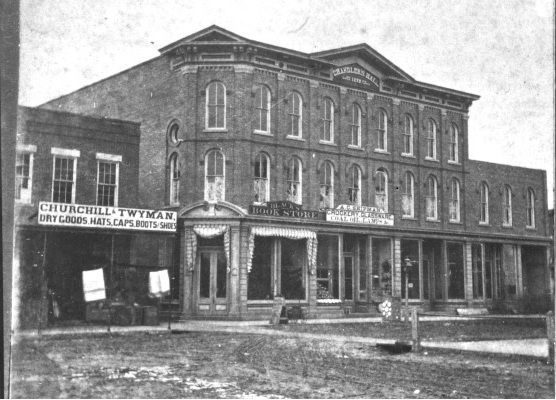
In 1873, Joseph Sosman assisted scenic artist T. B. Harrison at the Chandler Opera House in Macomb,. Illinois.  At the time, Sosman was well-known as a sign painter in town, having moved to Macomb only eight years earlier.

On April 17, 1873, “The Macomb Journal” reported, “SCENE PAINTING. As well as the entire design and arrangements of the stage is the handiwork of the eminent artist, T. B. Harrison, of Chicago. The stage, of course, is the focal point of all the attractions of the establishment and he who took the task of its design and execution has indeed an onerous one. But the one who looks upon the work of Mr. Harrison will decide that he has in masterly manner accomplished more than was expected. In the painting he has been ably assisted by our young friend, Joe Sosman; Joe has superior abilities, and our citizens will wake up some fine morning and fin in him, that Macomb has a first-class artist” (page 3). Sosman continued to make the Macomb news over the years, as this small town followed his continued success as a scenic artist and founder of Sosman & Landis.

Chandler’s Opera House in Macomb, Illinois: http://www.wimuseum.org/wp-content/uploads/2015/10/chandler_hall.jpg

This was a turning point in Sosman’s career, initiating his shift from sign painting to scenic art. In regard to Harrison, Sosman could not have selected a better mentor.

This post is about the life and career of Thomas B. Harrison (1836-1895). In later years, Harrison was remembered by citizens of Clinton, Missouri, as an “erratic genius” (June 23, 1900, “The Clinton Eye”). Harrison must have greatly inspired Joe Sosman at the beginning of his career. Here was an individual who appears to have dreamed big, trying his hand at everything within reach. Harrison was also key to the later Chicago connections for Sosman, facilitating many introductions for Sosman’s later success.

I do wonder how involved Harrison was with the mechanical engineering at Sosman and Landis throughout the 1880s and early 1890s. I also wonder how much he really contributed to the firm, contributions that made Sosman so loyal to Harrison throughout his life.

Newspaper accounts purport that Thomas Benjamin Harrison was born in Hull, England, on February 16, 1836. However, I have yet to locate any definitive proof. Harrison’s baptismal records were dated less than a week later on Feb. 21, 1836, in Selby in North Yorkshire. For geographical context, the Selby is approximately 38 miles due west of Hull, with a river and canal system connecting to two. In 1840 the railway from Selby to Hull opened, expanding transportation options.

The parish of Selby where T. B. Harrison was baptized in 1836.

Thomas was the eldest of two children born to Benjamin Harrison (1804-1891) and Ann Smith (1804-?). Benjamin and Ann’s Marriage Banns, dated from May 15, 1834, in nearby Leeds.  This is the same year that the Leeds and Selby Railway was completed, further expanding transportation options for local residents. Leeds is approximately 25 miles due west of Selby. Selby is approximately halfway between Hull and Leeds. Here is a great link to an article about Selby that was published in the “Yorkshire Post” – https://www.yorkshirepost.co.uk/heritage-and-retro/heritage/history-selby-once-port-west-riding-and-reputed-birthplace-henry-i-2936178

The 1841 England Census listed the Harrison family as living in Selby. Household members included head-of-household Benjamin Harrison (35 yrs.), wife Ann (35 yrs.), son Thomas (5 yrs.) and daughter Ann (1 yr.). Sometime between the 1841 census and 1847, the Harrisons relocated south to Oxfordshire. In 1847 Benjamin Harrison was listed as a cabinet maker, located at 28 St. Aldate’s street. It remains unclear as to what prompted the move or what exactly happened to his first wife; I have yet to locate any death certificate.

The trip from Selby to Oxfordshire if one were to travel by foot.

In 1849, Benjamin Harrison married a second time. He and Sarah Schutt were wed at St. Wilfrid’s Church in Calverley on Feb. 18, 1849. Calverley is approximately six miles northwest of Leeds.

St. Wilfrid’s Church, Calverly.

Soon after their marriage, the Harrisons emigrated to the United States of America. Sailing aboard the Columbus, their arrival is documented in an Arriving Passenger Crew List, dated June 29, 1850. At the time, the Harrison family included Benjamin (46 yrs. cabinet maker), wife Sarah (41 yrs.), and four children: Thomas (14 yrs.), Ann (10 yrs.), Charles (9 yrs.) and unnamed infant. I have yet to confirm if Charles was the biological son of Benjamin and his first wife, or Sarah’s child from a previous marriage. He could have even been relative, simply traveling with the couple at the time, which may be possible as he disappeared shortly after arrival.

A view of NY Harbor at the time of the Harrisons’ arrival: https://digitalcollections.nypl.org/items/510d47e0-d305-a3d9-e040-

The Columbus sailed with 661 passengers from Liverpool to New York. Amazingly, the Harrison family is even included in the publication, “The Famine Immigrants: Lists of Irish Immigrants Arriving at the Port of New York, 1846-1851 Vil VI (June 1850-March 1851)” by Ira Glazier and Michael Tepper (Baltimore: Genealogical Publishing Co., 1985, pp. 1-150).

The Harrison family was also counted in the 1850 US Federal Census. At the time, they were living in Bloomfield, Clinton County, Iowa.  Oddly, only two of the four children from the ship’s passenger list were listed in the census report: Thomas (15 yrs.) and Anne (11 yrs.). It remains uncertain if 9 yrs. old Charles and the infant passed away, or if they were reunited with relatives. There were only a few months in between their arrival and the census report.  

Six years later, the Harrisons were living in nearby Maquoketa, Iowa, counted in the State census. The 1856 Iowa census listed 52-yrs.-old Benjamin Harrison as a cabinet maker, living with his wife Sarah (47 yrs. old) and four children: Thomas Harrison (20 yrs.), William H. (4 yrs.), Sarah J. (2 yrs.), and Mary A. (1 yr.). These were all the biological children of Benjamin and Ann, born after the couple’s arrival in America, and when Sarah was in her mid-40s; Thomas’ half-siblings. The 1850 census also listed Thomas Harrison’s occupation as a painter.  Later reports purport that Harrison’s artistic and academic training were solely obtained in England, but this would have been only until the age of 14.

The 1860 US Federal Census report listed that the Harrison family household included Benjamin (58 yrs.), Sarah (50 yrs.), William (8 yrs.), Sarah (7 yrs.) and Mary (5 yrs.), all still living in Maquoketa. By this time, Thomas was 24-yrs.-old and living on his own. I have yet to locate his whereabouts between 1857-1861. He briefly disappears from public records until 1862 when he enlisted in the Iowa Infantry. He possibly traveled as an itinerant painter, going from town to town throughout the region, as was common with many scenic artists at the time.

Harrison’s US Civil War draft registration card listed his occupation as “painter.” At the time, he was 27 yrs. old.  The US Army register of enlistments provides addition information about this young unmarried man. His appearance was listed as black, hair, black eyes, and a ruddy complexion. Harrison enlisted Sept. 30, 1862, as a 2nd Lieutenant in Co. B., 26th Iowa Infantry. He was soon discharged, however, due to constant illness. He served a second time, with the same company.  Harrison’s obituary remembered, “He saw much service and was twice severally wounded at Fort Donelson and in Arkansas, from the effects of which he never recovered. He was a true soldier and patriot.” Harrison mustered out on March 10, 1863, in Young’s Point, Louisiana. From Louisiana, he headed to New York. By fall, he sailed from New York to New Orleans aboard the Evening Star. On Oct 18, 1863, “The New York Times” listed T. B. Harrison of a steamship passenger bound from New Orleans (page 8).

From New Orleans, Harrison moved to Chicago, where he rapidly rising to the top of his profession as a scenic and easel artist. In 1864, Harrison was listed a one of several artists exhibiting their oil paintings at Jevne & Almini’s. The group included two other well-known scenic artists such as Minard Lewis and William Voegtlin. On June 17 – 20, 1864, a “Chicago Tribune” advertisement announced:

“Chicago Artist’s Sale, by Gilbert & Sampson, of Fine Oil Paintings, at Auction. We will sell on Tuesday Evening, June 21st at 8 o’clock precisely, the fine collection of Oil Paintings, by Chicago Artists, which have been on exhibition at Jevne & Almini’s, and are now removed to our salesroom, in order to accommodate those who wish to purchase and could not get admittance at the room on Washington street. All the paintings exhibited at our room will be sold without reserve. The paintings of the artists who had someone to bid on their paintings unbeknown to the others will not be put into the sale. The paintings will be on exhibition day and evening until the time of the sale (Sundays excepted.) This collection has been very much admired and are from the hands of our best artists, viz: H. C. Ford, Mrs. Nicholson, J. H. Drury, Paul Brown, P. Fishe Read, Jacob Cox, J. R. Sloan, D. F. Bigelow, Alfred Sederberger, Belden J. Woodman, Kaye E. Cameron, H. N. Gager, Mary A. Thomas, Wm. Voegtlin, Miss E. Mackway, Minard Lewis, Mrs. Hall and T. B. Harrison. The attention of all our citizens who are in want of good paintings particularly called to this sale, and are invited to call and see then while on exhibition. Gilbert & Sampson” (page 4).

T. B. Harrison listed as one of the artists in 1864.

Now, this places a few key players in the same group.  Harrison was intimately involved with the Chicago Academy of Design (CAD) and the Chicago Academy of Fine Arts. There is a fascinating article by John Dryer entitled “The Demise of the Chicago Academy of Design and the Rise of the Art Institute of Chicago (“Journal of the Illinois State Historical Society” Vol. 113 Nos. 3-4 Fall/Winter 2020). According to Dryer, “Shortly after the war ended, the CAD was founded in 1866. Its stated purpose was to offer artists a studio to rent, regular exhibitions and teaching ateliers.” By 1867, many of the organizations activities were held at the top floor of the newly constructed Crosby Opera House on Washington Street.

To place this within the history of American scenic art, Lou Malmsha (1845-1882)  was one of the scenic artists who worked at Crosby’s Opera House during this time. He initially trained with Mr. Arragon at the venue, having emigrated from Sweden in 1863. By 1866, Malmsha was also painting scenery in New York, and was listed as one of the scenic artists who delivered scenery for the original production of “The Black Cook” at Niblo’s Garden.

Thomas G. Moses trained with Malmsha in 1873, at the same time that Sosman trained with Harrison. Both Moses and Malmsha also worked at P. M. Almini’s during this time as decorative painters.  Late in life, Moses recalled the talents of Malmsha, writing, “He was a very clever man. In all the years that have passed since then, I have never found a man that could do so little and get so much out of his work, very simple in drawing and color, but very effective.”

In 1868, Harrison was listed as one of the Committee members  for a Chicago Academy of Design event, held at Crosby’s Opera House. At the time, there were approximately sixty members in the organization.

On March 3, 1868, the “Chicago Evening Post” included T. B. Harrison was listed as a Committee member or the tableaux vivant, a featured event for the Chicago Academy of Design art reception at the Opera House (page 4). The tableaux scenes that were reproduced included The Laocoon Groupe; Fighting for the Dead Body of Patrocius, as seen on the frieze of the Parthenon; Dirce; Thorwaldsen’s Apollo and the Muses; Groupings from Raphael and Murillo; and a scene reproducing the features of ancient Egyptian art.  The article reported, “The effects of these pictures, given living figures, will be indescribably beautiful and afford something that has never been presented in this city. Tickets can only be attained from the Committee, which is composed of the following gentlemen: Chas. Knickerbocker, U. H. Crosby, Conrad Diehl, H. C. Ford, Walter Shirlaw, J. F. Gookins, Louis Kurtz, Chas. H. Brower, P. Almini, Chas. Peck, J. F. Aitken, G. S. Collis, T. B. Harrison, G. A. Binkert, W. B Baird, or at Room No. 9 Opera House.”

There are a few things to note about some of the abovementioned individuals in this group. In 1865 Jevne & Almini joined with Louis Kurtz to form the Chicago Lithographing Co. Their portfolios provide great insight into the bustling city of Chicago before the great fire of 1871. Kurtz, a German emigrant, moved to Chicago in 1864 where he worked as a scenic artist at both Crosby’s Opera House and McVicker’s Theatre.

The Chicago Academy of Design held private gatherings and public events at Crosby’s Opera House prior to the great Chicago Fire of 1871. The organization’s art exhibitions were frequently featured at the Crosby Art Gallery or in The Almini & Jevne Building on Clark Street. The CAD also leased space at a new building on Adams Street by 1870.

For a little more context, after the 1871 fire, Jevne and Almini separated, each going their own way and founded two new companies: Otto Jevne & Co., 226 E. Washington Street and P. M. Almini & Co., 344 State Street.  Almini remained much more active with the CAD, constantly employing many of the artists.

Although CAD membership greatly declined after the firs, in 1872 the Council of the Chicago Academy of Design rented L. W. Volk’s building at the corner of Michigan Avenue and Van Buren Street (Chicago Tribune 18 Oct 1872, p 8). Leonard Wells Volk (1828-1895) was a sculptor and president of the CAD. This was a period of great transition for the CAD, helping prompt the rise of the Chicago Academy of Fine Arts.

Like many scenic artists after the fire, Harrison travelled throughout the country again, securing work as a scene painter, photographer, lecturer, and inventor. He sporadically appeared various directories across the country.

Keep in mind that his travels also coincide with the onset of the Long Depression in 1873, and economic downturn that and lasted until 1879. This period of financial struggle is considered the first Great Depression in the United States. The event prompted many artists to expand their services, and immediately grasp at any business opportunity that came their way.

The 1873 Chicago Directory listed Thomas Harrison as a photographer at 79 Blue Island Ave. Again, this was a common listing for many scenic artists who were very active in early photographic endeavors. They accepted a variety of projects that included, photography, interior décor, sign painting, carriage painting and illustration. Photograph was also the same occupation as Harrison’s later short-term business partner Ed Pearce.

In 1873 Harrison was likely accepting any work that came his way. It was at this time that he  painted scenery at Chandler’s New Opera House in Macomb, Illinois. Again, it was in Macomb that he met, befriended, and trained Joe Sosman. Chandler’s New Opera House opened on Monday, April 21, 1873. Constructed by C. V. Chandler as a cost of $30,000, work commenced on April 7, 1872. The theater was located on the second floor of the building, with retail occupying the first floor. The lower story was 16’ high and the second story was 24’ high. The seating arrangements were divided as follows: level floor (60×40, 850 chairs); the rear 20×60 is separated by low balustrade, the seats five in number, rising one above another to the rear, thus giving the farthest from the stage an elevated position; about 175 persons can, with ample room for each occupy this division….Dress circle, or gallery seats 225.

On April 17, 1873, “The Macomb Journal” reported, “SCENE PAINTNG. As well as the entire design and arrangements of the stage is the handiwork of the eminent artist, T. B. Harrison, of Chicago. The stage, of course, is the focal point of all the attractions of the establishment and he who took the task of its design and execution has indeed an onerous one. But the one who looks upon the work of Mr. Harrison will decide that he has in masterly manner accomplished more than was expected. In the painting he has been ably assisted by our young friend, Joe Sosman; Joe has superior abilities, and our citizens will wake up some fine morning and fin in him, that Macomb has a first-class artist” (page 3).

On May 8 and 15, 1873, “The Macomb Journal” reported, “Oh! How beautiful! A thing of beauty is a joy forever. They include nearly every scene now finished in Chandler’s magnificent new Opera House and all are for sale any size card, stereoscopic, or 8 x 10. These pictures are from the paintings by Prof. T. B. Harrison, who is a master in his profession. They can be had at Hover & Zumbro’s, East Side Square” (page 3).

Harrison continued to travel throughout the country, and briefly settled in Boston during 1874.  On Jan. 16, 1874, the “Chicago Tribune” announced Harrison’s arrival at the Sherman House in Chicago (p. 7). Despite extended travels, Harrison maintained a home with Edward Pearce in Macomb, Illinois, until 1875. On Jan. 7 and 14, 1875, “The Macomb Journal” announced, “Prof. T. B. Harrison and Ed Pearce have gone to make their home in the city of Quincy. How the band will get along without them we can’t tell” (page 3).

Pearce returned to Macomb two years later. On Oct. 25, 1877, “The Macomb Journal” reported, “Ed Pearce has returned to Macomb and opened a new photograph establishment in the rooms over Joe Adcock’s store” (page 3). He continued in this business for the next few years. On Oct 16, 1879, “The Macomb Journal” reported, “Ed Pearce having returned from taking lessons in the higher art of photography, can be found at Tom Philpot’s excellent photographic rooms” (page 3).

Harrison also returned to Macomb for various projects. In 1876 he designed “Red Man’s Room” decorations. The local newspaper described Thos. B. Harrison as  “a well-known artist of this City.” The paintings were executed by both Harrison and Jos. S. Sosman.

On June 7, 1877, “The Macomb Journal” reported the following in regard to “Proceedings of a Regular Meeting of the Macomb City Council” (page 2):

“On motion, an appropriation of $10 was made to pay T. B. Harrison for a map of cemetery, and clerk was instructed to draw order on treasurer for the amount.
 A second announcement stated, “On Motion, T. B. Harrison was instructed to make another map similar to the one just finished, the cost not to exceed $7.50.”

Later in life, Harrison’s obituary recalled that he studied in Europe, Egypt and the Holy Land. It detailed that his natural proficiency for multiple languages prompted his career to branch off in an additional direction. Harrison’s obituary recorded that he contributed magazine articles on both scientific and art subjects under a nom de plume, and publicly lectured on foreign lands.

In 1878, Harrison was still traveling as a scenic artist throughout the Midwest. On October 10, 1878, The Osceola Sun  reported, “T. B. Harrison scenic artist of Chicago is here painting the scenery for Hedrick’s new Hall. This hall when completed will be one of the best in southwest Missouri” (page 3). On Nov. 2, 1878 the Butler Bates County Record reported, “The Messrs. Hendrick, of Appleton City, are finishing one of the finest halls in the southwest. It is 25×100 feet, is provided with a stage and scenery and will be seated with chairs. The scenery and fresco work is being done by Mr. Harrison, a scenic artist of Chicago, and is as fine as that done anywhere. The Appleton Dramatic society will dedicate the hall as soon as completed, due notice of which will be given” (page 3).

Harrison purportedly helped establish the Chicago Academy of Fine Arts in 1879, later renamed the Art Institute of Chicago. Harrison was well respected as a professor at the Institute.  

On Oct. 31, 1879, “The Cass County News” reported, “T. B. Harrison, the artist-traveler, has been entertaining our people with his lectures on Foreign travel during the past three evenings, closing the season for which he was advertised on Wednesday evening, having had good audiences of a highly appreciative class during the entire course. At the close on Wednesday evening a request was made by a unanimous expression of the audience, asking him to remain longer, whereupon Mr. H. signified his willingness, and announced the three nights closing the week. Our citizens who have not attended these superbly illustrated lectures, which are in themselves of the highest order, have missed a treat, Yesterday evening the lecture embraced a tour of Holland, Denmark, Norway, Sweden, Russia, Turkey and Greece. To-night (Friday) Africa, Palestine, the Ruins of Pompeii, and Spain. Saturday evening, the Lakes of Northern Italy, Milan, Pisa, Florence, Bologna, Naples, Venice, Rome, St. Peter’s Church and the Vatican. We predict large audiences, as a lifetime may be spent without another opportunity of hearing lectures of as high an order or of witnessing as superb illustrations” (page 3).

On November 29, 1879, “The Lexington Intelligencer” reported, “Thos. B. Harrison’s Pantascope, a unique series of art illustrations, forming an epitome of foreign travel, producing with realistic effect the most beautiful, picturesque and romantic places of the world, which has been exhibiting at the opera house the past week, is an entertainment of the highest order of merit and has been liberally patronized by our citizens. The programme for the first  evening was France, Paris and Switzerland, the second evening, Germany and the river Rhine; third, England, Ireland and Scotland; fourth, the Netherlands, Russia, Turkey, Greece and Egypt, and last evening, the Holy Land, Pompeii, Africa and Spain. To-night will be Italy, Venice, Rome and the Vatican. There will also be a matinee this afternoon at two o’clock, at which will be presented Germany and the river Rhine. Mr. E. D. Graham, the advance agent and business manager, was formerly editor of the Clinton Advocate, in this state, and is a thorough gentleman, as are all those connected with the exhibition. From here they go to Richmond, and we cordially recommend them to the citizens of that ancient burg. The money expended in thus getting a glimpse of the Old World and its many historic places and buildings could not be more beneficially spent by either old or young”  (page 3).

1880 advertisement for Harrison’s Pantascope.

On February 27, 1880, the “St. Joseph Gazette” included an advertisement for Harrison’s Pantascope (p. 1). Harrison exhibited “A Unique series of Art Illustration Forming a Perfect Epitome of Foreign Travel, producing with realistic Effect the Most Beautiful Picturesque and Romantic Places of the World.” The advertisement promised, “Am entertainment of the Highest Order of Merit, universally commended by all persons of culture, taste and refinement.” Harrison’s show was performed at the Fifth Street Methodist Church every day that week for a price of 25 cents for adults and 10 cents for children. A short announcement in the “St. Joseph Gazette” on Feb 27, 1880, reported, “Harrison’s Pantascope is among the very best entertainments of the season. To-night the program is unusually attractive. It includes a ‘journey’ through the Holy Land, views of Pompeii, and scenes in Old Spain” (page 4).

On March 11, 1880, “The Macomb Journal” announced, “T. B. Harrison, formerly of this place was in St. Joseph, Mo., last week, exhibiting his pantascope” (page 2). On Oct 29, 1885, “The Macomb Journal” reported, Professor Thomas B. Harrison, a former well-known citizen of Macomb, has been in our streets the present week” (page 5).

Later that spring Harrison returned to Macomb. The “Henry County Democrat” announced, “Remember, Pantascope, City Hall, April 19” (p. 3).

Although his work with Sosman in Macomb was short-lived, the two remained close friends until Harrison’s passing in 1895.  Sosman was even mentioned in Harrison’s obituary. The “Henry County Democrat” remembered, “While painting scenes in the Macomb Opera House, he took in a young boy to mix paints and be of general utility. That boy was Joe Sosman, now senior member of Sosman & Landis, Chicago, the leading theatrical contractors, and outfitters in America. Joe Sosman made his fortune, but he never forgot how much he owed to Tom Harrison. And during all of the ups and downs of Tom’s career, Joe was his steadfast friend.”

Harrison was also an inventor, developing a series of inventions over the years that included a steam hammer, a compressed air hammer, and other improvements for both manufacturing machinery and typewriter machines.

Described as an “artist of rare merit,” he remained in Clinton, Missouri, after painting a drop curtain for the opera house, teaching both drawing and music.

While in Clinton, Harrison grew attached to Samuel J. Seifried, taking the young man on as an assistant The 1880 Census listed Harrison, Samuel Seifried, and his father, William Seifried, all living at the same boarding house on Main Street. The census report listed Harrison as a 41 yrs. old artist, Seifried as 14-yrs. old “at home,” and William as 36 yrs. old “hotel clerk

Samuel Seifried was born in 1866 in Missouri, the eldest son of William J. Seifried (1844-1935) and Amelia M. Heckler (1858-1885). His siblings included Henry C. (1872-1875), Charles E. (1875-1896), George E. (1877-1878), Willie E. (1879-1881), and Barbara (1882-1912). Amelia passed away on Feb. 18, 1885. William married his second wife Emma E. Volkman (1867-1934), about 1889, and five children were born to this union: Winfred W. (1891-1976), Louis M. (b. 1897), Alberta (1895-1979), Reinhold V. (1904-1968), and Eunice (?-1896)

Samuel’s maternal grandmother, Katherine Drach, was known in Clinton, Missouri, as “Mother Seifried.” She was born in 1818 in Unistadt, Germany, emigrating to America in 1837, and marrying Jacob Seifried (?-1899) in March 1841. The couple celebrated the birth of eight children, including Samuel’s father, William John Seifried (1844-1935).

For a little context…Samuel’s father worked as an interior decorator, who, in 1882, he was listed as a painter in the St. Louis directory, residing at 2821 Sheridan Ave.

On Nov. 1881, “The Windsor Review” in Missouri reported, “Last Weeks Spree. Four Days at the Appleton City Fair.

By the kindness of Mr. Harrison, the scenic artist, we were shown through the magnificent Durley Hall of which this town is justly proud. It is undoubtedly the finest Opera House in Southwest Missouri and stands an everlasting record to one man’s enterprise. Harry W. Grantley, the builder of this gran edifice has spare neither money nor brains in rearing it and it certainly does him great credit, Complete in every detail, any play can be realistically produced on the stage. The artist, Mr. Harrison, has done excellent work here, the drop curtain being a masterpiece of artistic originality, and all of the vast amount of scenery shows evidence of his genius.”

On April 23, 1882, The Leavenworth Standard reported, “Around the World. The unique art delineation of European life will open at the Delaware Street Opera House Tuesday evening. It is said to produce with realistic effect the most beautiful, picturesque and romantic places in the world. It is in the hands of G. W. Hutchins, of Philadelphia, and T. B. Harrison, artist traveler and member of the London, Paris, Berlin, Florence and Rome schools of art” (page 4)

On July 26, 1882, the Ottawa Daily Republic of Kansas announced, “Mr. Harrison, the scenic artist of the new Opera House had begun work on the large drop curtain, and it promises to be one of the handsomest pieces of art in the state” (page 1).

Harrison also produced stock scenery for Moore’s Opera House in Nevada, Missouri.  Harry Miner’s Dramatic Directory for the 1882-1883 season credited Harrison with 20 sets of scenery at the venue. Harrison’s scenic art was also listed in Harry Miner’s Theatre Directories, for 1884 and 1887. He was credited with stock scenery collections at the Opera House in Clinton, Missouri; L&S Moore’s Opera House in Nevada, Missouri; Lamar Opera House in Lamar, Missouri; and the New Odeon Theatre in Maquoketa, Iowa.

Here is a summary of the known stock scenery collections delivered by Harrison during his lifetime:

Chandler’s Opera House (Macomb, Illinois, 1873)

Opera House (Clinton, Missouri, 1880)

Opera House (Lamar, Kansas, c. 1882-1884)

New Odeon Theatre (Maquoketa, Iowa, c. 1882-1884)

L&S Moore’s Opera House (Nevada, Missouri, c. 1882-1884)

Opera House (Ottawa, Kansas, 1882)

Opera House (Sedalia, Missouri, 1883)

On May 13, 1882, “The Falls City Journal” of Falls City, Nebraska, reported, “Around the World. A unique series of artistic delineations of European life; by G. W. Hutchings, of Philadelphia, and T. B. Harrison, Artist Traveler, and member of celebrated art schools of London, Paris, Berlin, Florence, and Rome. A perfect epitome of foreign travel. Am entertainment of the highest order of merit, universally commended by all persons of culture, taste and refinement. At the Opera House, May 16th and 20th, Admission 25 cts. Reserved seats 35 cts. Children and gallery seats, 15 cts. Season tickets only 75 cts” (page 5).

On Aug. 5, 1882, The Ottawa Daily Republic (Kansas) reported,
“Mr. Harrison, the scenic artist at the new opera house, thinks the REPUBLICAN was premature in inviting folks to see the new drop curtain. He don’t care to be bothered by visitors and has locked the public out. So you needn’t go to see the new curtain just now.” (page 4)

1883- Sedalia, Missouri: On March 13, 1883, the “Sedalia Weekly Bazoo” of Missouri reported, “H. C. Moore, president of the opera house stockholders. presented T. B. Harrison, the scenic artist, with a fine gold headed case on which is handsomely inscribed” From W. C. Moore to F. B. Harrison, 1883” (page 5). All this time, Harrison traveled with his assistant “Sammie.”

On March 24, 1886, Harrison became a naturalized citizen in Montgomery, Missouri. This may have been prompted by a series of inventions that both he and Seifried were working on at the time. On Dec. 27, 1888, the “Versailles Republican” announced the patent was granted for T. B. Harrison’s Anderson, typewriter” (page 4).

Seifried proved to be not only a wonderful assistant, but also a fellow inventor.  Harrison later listed “Sammie” as his adopted son, leaving him everything upon his passing in 1895; an estate valued at $4000. The two repeatedly toured the European continent for well over a decade, although I have yet to uncover any travel records or passport applications. During their travels through France became interested in the Braille system, returning with information and several ideas. Upon their return, the couple developed a typewriter for use by the blind and established the manufacturing firm of Harrison & Seifried. Harrison & Seifried was located at 181 E. Division Street in Chicago. They advertised as “Designers and Builders of Light Machinery.”

Here is a link to Bi-fold brochure of Harrison & Seifried, “Sole Manufacturers of the Hall Braille Writers and the Stereotype Maker.” https://aphmuseum.org/record/hall-braille-writers-and-stereotype-maker-brochure/

T. B. Harrison and Samuel Seifried advertisement for their firm Harrison & Seifried, Chicago.
The typewriter manufactured by Harrison & Seifried.

The Hall Braille typewriter (also called a Braillewriter or Brailler) was invented in 1892 by Frank Haven Hall, who was the Superintendent of the Illinois Institution for the Blind. The Hall Braille typewriter was manufactured by the Harrison & Seifried company in Chicago, Illinois, USA. Hall introduced his invention on May 27, 1892, at Jacksonville, Illinois. It types raised Braille dots onto paper. For more information, see: http://www.enchantedlearning.com/inventors/1800b.shtml]

Here is a link to another detailed history of the machine: https://www.antiquetypewriters.com/typewriter/hall-braille-writer-1/

“In 1892, Hall had the skilled local Gunsmith and Metal worker Gustav Siebel make a prototype of his machine. Hall took Sieber’s prototype to the Munson Typewriter Company in Chicago, where superintendent T.B. Harrison and designer Samuel J. Seifried, inventor of the Munson typewriter, created six pilot models. Harrison and Seifried in seeing the great potential of this revolutionary machine, then left the Munson Typewriter Company to start their own company. They made an additional 94 machines based on the initial design for Hall. The Hall Braille-writers that followed were essentially of the same design but there were alterations to be seen, especially in the carriage construction.”

The braille typewriter manufacturer by Harrison & Seifried, c. 1892.

Previously, each was associated with the Munson Typewriter Company. On Dec. 7, 1890, the “Chicago Tribune” announced, Samuel J. Seifried, Secretary of the Munson Typewriter company, filed a certificate to record the increase of the capital stock of the company from $60,000 to $100,000”  (page 6).

Harrison’s involvement with the typewriter was detailed in an 1887 newspaper article. On April 7, 1887, “Logansport Pharos Tribune” of Logansport, Indiana, reported:

“The Pharos spoke briefly the other day of the Harrison type writer being on exhibition in the city, but if failed to mention some interesting facts connected with the history of the patent. The machine is the result of the genius of Prof. T. B. Harrison, the gray-haired gentleman who gave a series of illustrated art lectures at Dolan’s opera house last year. The Professor has traveled all over the world and is a cultured and interesting talker. After leaving Logansport he went to Anderson, and while there fell in with Father Weichtman, the Catholic minister, a whole-souled gentleman who immediately took a great liking to the aged traveler. Prof. Harrison was full of his proposed type-write patent, and Rev. Weichtman immediately set to work to interest local capitalists in the device. The result was they advanced the money to secure the model and patent, and the little machine was finally built and improved, until it was brought to the point of perfection shown in this city, the model alone costing $900. We see from the Indianapolis papers that the Anderson company has been incorporated with $10,000 capital and will soon begin manufacturing Harrison’s typewriter. It can be stated in this connection that good judges in this city who examined the machine pronounce it decided improvement over other standard typewriters” (3).

Harrison continued to invest in the performing arts and established a touring company. I have yet to track down the details, but on July 7, 1892, the “Sterling Standard” the T. B. Harrison Theatrical Co. as the employer of leading man, Thomas Alexander  (page 3).

In regard to Harrison’s extended family in America…his father, Benjamin, passed away on Oct. 8, 1891. Buried in Mt. Hope Maquoketa, Jackson, Iowa, he is buried next to several other family members, including his eldest son Thomas. Thomas B. Harrison passed away on August 13, 1895 in Chicago, Illinois. Newspapers reported that Harrison’s death was caused from “slight paralysis occasioned by excessive mental labor.” His noted occupation at the time was listed as “inventor.”

On Sept. 19, 1895, “The Henry County Democrat” of Clinton, Missouri (page &) reported,

“Death of Tom Harrison. Sketch of the Life of a Talented Artist and Genial Man.

The people of Clinton who learned to admire Tom Harrison, the artist, for his many genial qualities, will be pained to learn of his death in Chicago. Mr. Harrison painted the scenery for the Clinton Opera house and as a young man, of this city, Sam J. Seifried, has been his constant companion for years. The editors of the DEMOCRAT had a warm personal acquaintance with Mr. Harrison long before he came to Clinton. For many years he lived in Macomb, Ill., and every man, woman, and child in that city admired his abilities and excellent qualities of mind and heart.

While painting scenes in the Macomb Opera House, he took in a young boy to mix paints and be of general utility. That boy was Joe Sosman, now senior member of Sosman & Landis, Chicago, the leading theatrical contractors, and outfitters in America. Joe Sosman made his fortune, but he never forgot how much he owed to Tom Harrison. And during all of the ups and downs of Tom’s career, Joe was his steadfast friend. The Chicago “Inter Ocean” of Sept. 8th contains the following brief account of his life:

Thomas B. Harrison who died recently at his residence, No. 27 Pleasant street, of slight paralysis occasioned by excessive mental labor, was buried with Masonic and G. A. R. honors Friday, Aug. 30, at his former home, Maquoketa, Iowa.

He leaves a sister and half-brother, as well as an adopted son, Samuel L. Seifried, to mourn his loss.

Mr. Harrison came of an excellent English family and was distantly related to the family of that name which was so conspicuous in England and has been in the United States, two of the members having been presidents.

He was born in Hull, England, Feb. 16, 1836. His preliminary and academical education was obtained there and, in this country, though he was an essentially self-educated man, and his attainments in the arts, sciences and general literature were extraordinary. He has an immortality of fame in this connection and by virtue of his material achievements.

He came to this country in 1850, with his father’s family, which settled in Maquoketa, Iowa, where he lies beside his father.

At the outbreak of the war, he enlisted in an Iowa cavalry regiment, but after a few months’ service was discharged on account of constant illness. When restored he again enlisted in Company B., Twenty-sixth Iowa Infantry, served to the end of the war and obtained a captaincy. He saw much service and was twice severely wounded at Fort Donelson and in Arkansas, from the effects of which he never recovered. He was a true soldier and a patriot.

At the close of the war, he came to Chicago and entered upon a successful career as an artist, and at the time of the great fire he was in the front rank of his profession. He was one of the founders of the Academy of Fine Arts and one of its ablest professors. He lost largely in the fire, and instead of resuming his business he concluded to indulge he love for travel and adventure and gratify his professional instinct by a trip abroad.

Thereafter he was a constant traveler for fourteen years in most of the European countries, also visiting Egypt, the Holy Land, becoming familiar with the language, habits, and customs of many people. He could speak and write several languages. He was a contributor to magazine literature on scientific and art subjects, but always over a nom de plume, hence not known to the public directly. On his return to the country, he was engaged in various pursuits in connection with art and obtained favor as a lecturer on foreign lands.

He had decided genius as an inventor. Among the most useful of his inventions are a steam hammer, a compressed air hammer, various improvements in manufacturing machinery, a stereotype printing machine for making printing plates for the use of the blind. The latter is in use in all parts of the world. The last year of his life, while in partial retirement, was devoted largely to the inventing and perfecting of typewriter machines.”

Harrison lies in rest at Mt. Hope Cemetery in Maquoketa, Iowa, near many members of his biological family.

The grave of T. B. Harrison, scenic art instructor to Joseph S. Sosman.

After Harrison’s death in 1895, Seifried and his younger brother Ed developed the latest improved on the stereotype maker and created the Seifried Braille Shorthand Machine.  In the years following Harrison’s death, Seifried continued to pop up in newspapers, here and there.

On April 25, 1897, “The Chicago Chronicle” announced the following real estate transfer “North Fifty-ninth st., 112 ½ ft. w of Wright st. s.f., 25.28×124 ½, April 22 – M. A. Trainer to S. J. Seifried”  (page 21). This pinpoints a location for Seifried in the late 1890s.

In 1900, “The Clinton Eye” reflected on the town’s history, again mentioning Seifried and Harrison. On June 23, 1900, “The Clinton Eye” reported, “Sometime after T. B. Harrison, another erratic genius, came here to paint the drop-curtain for the opera house. He was an artist of rare merit. Though not learned, he was well read, cultured. He painted the curtain, taught drawing, music. Was so pleased with Clinton remained two or three years. He painted and arranged a scenic exhibition, writing the accompanying lectures, and interesting the genial Will Graham, then publishing the Advocate, the late Henry Marvin and others, put the venture on the road, with varying success. While here Harrison grew very much attached to Sammie Seifried, son of W. J. The attachment was so reciprocal that young Seifried became his protégé. They toured the continent, returning located in Chicago. The protégé proved to be a genius too, of the inventive sort, and bringing forth a typewriter of extraordinary value, and the firm Harrison & Seifried ventured into the manufacturing business, successfully. A recent production is a typewriter for use by the blind, spoken of in highest praise by the Eastern press. Harrison died a year or two since, but Sam J. Seifried revers his memory by continuing the business under his name” (page 6).

I was surprised to read about an accident involving Seifried and his sister in 1906.

On Sept. 27, 1906, the “Henry County Democrat” reported “Miss Barbara Seifried Narrowly Escapes Injury. The following from the Galesburg, Ill. Republican Register of Monday will greatly interest the many Clinton friends of Sam J. and Miss Barbara Seifried:

The second railway-automobile accident to occur I the history of Galesburg, took place Saturday night when S. J. Seifried and sister, Miss Barbara Seifried, narrowly escaped severe bodily injury at the crossing of the Knoxville road and the Peoria tracks, of the C.B.&Q., their machine being struck by a freight engine and the occupants severely shaken up. The accident occurred shortly after 7 o’clock. The machine in which the Seifrieds were riding was a light Frankly touring car and they were out for a ride to Knoxville. At the crossing of the Knoxville road and the Peoria tracks the road makes a sharp turn and crosses the tracks at a right angle.

No notice of the approach of the freight train was brought to the ears of the pair in the auto, until just as they were on the tracks when Miss Seifried noticed the engine of the train, then almost upon them. It was too late to attempt to run the car over ahead of the train and Mr. Seifried’s hastily utilized what spare moments were left in the effort to back the car clear of danger, Miss Seifried having jumped when the danger became apparent. The efforts to back the car clear of the tracks was successful and the entire front end of the machine was smashed by the pilot of the locomotive, entailing a loss of several hundred dollars.

Fortunately neither of the occupants were severely injured, although both were badly shaken up and would not care to repeat their experience. No bones were broken, Miss Seifried having sustained a sprained ankle in the jump from the car seat to the ground while the close proximity of the crash between the car and engine pilot to Mr. Seifried served to give him a severe shaking up. The nervous shock and narrow escape was unusually severe, and even as late as this morning neither of the pair had completely recovered their normal nervous state” (p. 2).

On Jan. 9, 1913 the “Henry County Democrat” of Clinton, Missouri, announced: “All persons having claims against the estate of Barbara H. Seifreid, deceased, are hereby notified to present same at once to Samuel J. Seifried, 1712 Foster Ave., Chicago, Ill.” (page 8).

Seifried passed away on Dec. 29, 1912 in Chicago, Illinois, and was buried at the Englewood Cemetery in Clinton, Missouri. He was only 45 yrs. old at the time.

“Great Loss.

Sam J. Seifried Mourned by the Blind.

The death of Samuel J. Seifried, whose funeral service was held in Clinton Thursday afternoon, will be felt with keenest sorrow in all parts of the civilized world, on account of the service his life has brought to the blind.

For many years he has devoted his energies to inventions and devices for the amelioration of the condition of the sightless. When a young man he was an intimate friend of Thomas B. Harrison, an artist well known here, and accompanied him on a journey to France. Both became much interested in the Braille system of writing for the blind, which had not made much progress in later years; and upon their return devoted much study to a plan of bringing it up to date. After Mr. Harrison’s death, the opportunity at length came to Mr. Seifried to carry out a long-cherished plan of devoting his entire time to the needs of the blind; and he added to inventive genius, a good judgement that placed the venture on a sound basis that insured its permanence. The company was incorporated and closely associated with the founder was his younger brother Ed. A practical type writing machine was invented making the Braille characters, so that books and manuscripts were easily transcribed for the use of the bind. The business so broadened so as to take care of every necessity of these afflicted ones, and it stands alone in the world today, the only one of its sort in existence. A recent triumph of his inventive genius is a stenograph or shorthand machine suited for the use of the blind; and there are stenographers and even court reporters who use these machines, indenting characters on a long tape which they can afterwards readily read and transcribe on an ordinary typewriter.

So it is that his life was one of service, too, where it was most needed. And -to-day, wherever there are those in darkness, they love this man who has gone to his reward and will long mourn him as a friend and helper.

Clinton is proud that one of her sons was permitted to achieve so much of real good in the world; and we ae also rejoiced that his work is not to stop, but will be taken up and carried on by his brother.

The funeral service was conducted at the home of his father, Wm. J. Seifried, on North Third street, on Thursday afternoon at 2 o’clock, by Rev. A. N. Lindsey, who spoke words of appreciation of the departed and comfort to the bereaved relative. The house was filled with old time friends who braved shill weather to show by their presence their friendship and extend their heartfelt.

The interment was by the Masonic fraternity, which deposited the body in mother earth with beautiful ritualism” (page 6).

On Jan. 9, 1913, “The Henry County Democrat” announced, “Ed Seifried and wife arrived last night from Chicago, to accompany the remains of the late Samuel J. Seifried” (page 3).

To be continued…

Travels of A Scenic Artist and Scholar: Henry E. Burckey and Henry C. Tryon, Scenic Artists at the Tabor Grand Opera House

Copyright © 2020 by Wendy Waszut-Barrett

Back of a jungle wing noting stage carpenter and scenic artist, dated October 6, 1890.

 “W. J. Moon carpenter and H. E. Burpey [sic.] scenic artist, October 6, 1890” is penciled on the back of a jungle wing at the Tabor Opera House in Leadville, Colorado. William J. Moon was a local resident and Henry E. Burkey was a scenic artist who began his career in Chicago. By 1884, “Harry Miner’s Dramatic Directory” listed “Burckey, Tabor Opera, Denver” as the scenic artist for the Tabor Opera House in Leadville; he was working for both venues. Burckey was still working for Tabor five years later. After completing the jungle wings for the Tabor Opera House in Leadville, the “Herald Democrat” reported his departure for Denver on October 16, 1890, noting “Mr. H. E. Burcky left last evening for Denver.” 

Yesterday I wrote about stage carpenter and stage manager W. J. Moon. Today I explore the life and career of  Henry E. Burckey (1852-1908). Burckey was been a bit tricky to track down, as the spelling of his name greatly varies in newspaper accounts and historical records. Variations included Burckey, Burkey, Bercky, Berkey, and Burcky; I am going with Burckey.

Born in 1852, Henry E. Burckey was the son of German immigrant Frederick Burckey (1813-1902). The 1850 US Federal Census lists that Frederick Burckey was born in “Frankfurt-Main” and emigrated from Germany in 1830. He eventually settled with family in Chicago area where he resided until his passing on October 21, 1902. Frederick was employed as a confectioner until he opened a restaurant with Augustus Berlin. He later worked as a clerk.

The 1870 census listed that Burckey was living with his three sons William, Henry and Charles, ages 16, 13 and 7.  Between 1870 and 1875, Henry entered the theatre industry and became a scenic artist.  He entered the scene about the same time that Thomas G. Moses did, about 1873-1874. By 1875 Henry was listed as “scenic artist” in the “Chicago Directory” living at 83 S. Halsted. Interestingly, Henry’s younger brother Charles followed him into the painting business and was listed as a “painter” in the 1880 Census. Burckey remained in the directory for the next decade, despite working for extended periods of time in other regions. At this time Chicago was a major theatrical hub with equal access to almost all of the country; it was the place to be during the second half of the nineteenth century. Ever-expanding railways provided easy routes for the marketing and shipping of both goods and services. A vast transportation network allowed remote communities access to a variety of services when constructing a performance venue that included scenic art. Many scenic artists, such as Burckey and Moses, made the Windy City their home and constantly traveled to new venues. Even when working for a studio, their lives remained that of itinerant artists.

By 1880, Henry Burckey, painted an old mill scene for the “Frog Opera.” The production toured New York, Philadelphia and Baltimore. By the spring the production played at Chicago’s Central Music Hall (Chicago Tribune, 16 May 1880 page 11). As Burckey made a name for himself, he began to partner with other well-known and respected scenic artists, such as Henry C. Tryon.

In 1880, Tryon was working as a scenic artist at McVicker’s Theatre, where he came in close contact with Thomas G. Moses, as well as Joseph Sosman, of Sosman & Landis. Moses joined Sosman & Landis in 1880 as their first employee, Tryon would follow four years later. There was an abundance of work for many, and the fortunate few secured permanent positions in popular theaters and opera houses.

By 1881, “H. E. Burcky” was listed as scenic artist at Hooley’s Theatre in Chicago. At this same time Burckey partnered with Tryon to provided scenery for Cincinnati’s Opera Festival. They worked alongside some other very respected gentlemen, including Fox, Magnani, Humphreys, Hughes, and Rettig & Waugh. An article in the “Cincinnati Enquirer,” reported, “Messrs. H. E. Burcky and Henry Tynor [sic.], the young and talented artists who came here from Chicago to assist painting the scenery, have been doing excellent work. They are bright, intelligent and rapid worker and but for their assistance it would have been difficult to have the scenery ready by Monday next. Mr. Burcky is scenic artist at Hooley’s Theater in Chicago, and Mr. Tryon at McVickers. They express themselves as amazed at the extent and magnitude of the affair” (“Cincinnati Enquirer,” 15 Feb 1881, page 4).” Burckey and Tryon were applauded for one “Magic Flute” setting, heralded as a “Beautifully painted scene.” The “Cincinnati Daily Enquirer” article described the painting; “…massive rocks in the foreground appear so real as almost to deceive the eye.  Rich masses of dark foliage relieve their barrenness while their golden-yellow color is projected boldly from the deep blue sky.  Two transformation tableaux occur in this scene, the first the ordeal, by fire, remarkable for its brilliancy and warmth of color; the second, the ordeal by water, for its cool and delicious coloring, complete contraries delightfully portrayed” (23 February 1881, page 4).

The opera festival was not only a game changer for each artist, but an incentive to travel westward. By the fall of 1882, Tryon had left Chicago and was working in Denver, Colorado, for Horace Tabor. Even when Tabor traveled to Salt Lake City for work, newspapers listed the artist as “Mr. Henry C. Tryon, of the Tabor Grand Opera House” (“Ogden Standard,” 30 Sept, 1882, page 3).  Two years later, Burckey became known as “H. E. Burckey, the artist of the Tabor Grand” (“Memphis Daily Appeal,” 19 Nov. 1884, page 2). It remains unclear if they worked together on scenery at the Tabor Grand between 1882 and 1884.

An example of Henry E. Burckey’s scenic art.
Jungle wings by Henry E. Burckey stacked against the upstage wall at the Tabor Opera House in Leadville, Colorado.
An example of Henry E. Burckey’s scenic art.

Regardless, Burckey became the sole scenic artist at the Tabor opera house by 1884, the same years that Tryon returned to Chicago to work for Sosman & Landis. In 1884, Moses wrote, “Henry C. Tryon came to the studio to work.  He enthused Young and I more than anyone ever had.  He was a pupil of Thos. Moran and James and William Hart and was very clever, but awfully eccentric.” Tryon also joined Moses and John H. Young on a sketching trip to West Virginia in 1885. I will expand Tryon’s story in the next few weeks.

Between 1880 and 1884, Tryon submitted a series of articles about the scenic art profession in papers across the country. On Dec. 19, 1880, the “Chicago Tribune” published “ Scene Painting: Some hints to the Public Regarding a Special Department of the Painters’ Art Not Well Understood” by Henry C. Tryon (page 19). Here is the link to the article as I included it today as part of my “Tales from a Scenic Artist and Scholar” storyline (part 1087): https://drypigment.net2020/10/11/tales-from-a-scenic-artist-and-scholar-part-1087-henry-c-tryon-scene-painting-some-hints-to-the-public-regarding-a-special-department-of-the-painters-art-not-well-understood/

To be continued…

Tales from a Scenic Artist and Scholar. Part 1044 – Mrs. Howard Lind and the Bal Surprise, 1920

Copyright © 2020 by Wendy Waszut-Barrett

In 1920, Thomas G. Moses wrote, “A big ball at the North Side Armory, given by Mrs. Howard Linn gave us a hard job to put up, and we just did that and nothing else.”

Mrs. Howard Linn was in charge of the “Bal Surprise” in 1920. From the “Chicago Tribune,” 31 Jan. 1920, page 3.

This was another Chicago Studios project supervised by Moses before his return to Sosman & Landis in April 2020.

Mrs. Howard Linn was a well-known Chicago socialite, residing at 55 Cedar Street. Linn was involved with many public charity endeavors, social pageants, and social organizations. In 1920 Linn was the chairman of the committee in charge of the Junior League ball held on January 30, 1920, at the Second Field Artillery armory on Chicago avenue and the lake.  The feature of the ball was a pageant, announced in the “Chicago tribune” on January 3, 1920 (page 15). This was the event that Moses was referring to in his memoirs.

From From the “Chicago Tribune,” 3 Jan. 1920, page 4.

On Jan. 25, 1920, the “Chicago Tribune” reported, “The ‘Bal Surprise’ to be given on Friday evening by the Junior League will be a sort of grand finale to the most brilliant social season Chicago has had in many a year. Mrs. Howard Linn is in charge of the arrangements for the ball, which gives promise of being one of the most interesting affairs ever given here. The feature of the evening will be ‘tableau vivants,’ in which a number of well-known matrons and maids will take part. Herman Rosee, Randal Davey, Allan Philbrick, and Mr. Norton of the Art Institute are assisting Mrs. Linn with the tableaux, the costumes, and the decorations of the First Artillery armory, where the ball is to be held. Mrs. J. Andrews King is co-chairman with Mrs. Linn, and the chairmen of the subcommittees are as follows: Ushers, Miss Edith Cummings; tickets, Miss Caryl Dunham; refreshments, Mrs. Frederick C. Letts; program, Mrs. Lowel Chapin; music, Miss Emily Bisell; decorations, Mrs. Barney Goodspeed; costumes, Mr. Thorne Donnelley, and boxes, Mrs. Frank Hibbard.”

On the day after the ball, the “Chicago Tribune” reported, “’Bal Surprise’ Nets $12,000 for Charity” (Jan. 31, 1920, page 3). The article continued, “If it had not been for the modern dress of the guests at the Junior League ‘Bal Surprise’ last night, one would have imagined one’s self at a ball in a medieval castle. The first artillery armory, the scene of last night’s revel, is of medieval architecture and the members of the league, who acted as hostess, were gowned in the picturesque modes of those days long ago. In long trained gowns with basques and tall pointed square headdresses, they looked as if they had stepped out of the frames of old paintings of the fourteenth and fifteenth century. They were divided into two groups, the ushers, whose duty it was to see that everyone present enjoyed the party to the utmost, and the cushion bearers, who between dances flung gaily colored cushions on the floor so that the guests might be seated during the ‘tableaux vivants,’ which were the ‘piece de resistance’ of the affair.

“The tableaux, seven in number, were shown in a larger gilt frame which was hung at the end of the ballroom behind curtains of star dotted midnight blue. Mrs. Howard Linn, chairman of the ball, was assisted in arranging the tableaux by Abram Poole and by several artists from the Art Institute, Randall Davey, Harman Rossé, Allan C. Philbrick and John W. Norton. The backgrounds, which were particularly attractive were painted by these artists and they also assisted Mrs. Thorne Donnelley in designing the costumes. In the first tableau Mrs. John Andrews King and Mrs. Morris L. Johnston, dressed in pastel shaded Grecian robes, posed as figures on a Grecian vase. They were followed by Mrs. Rufus J. Zogbaum, Jr., who, with her lovely auburn hair hanging loose, made a perfect Giorgione Madonna. Preceding the next tableau, in which Miss Polly Carpenter, who is as dainty as a bit of Dresden china, with a figure in an Arras tapestry. James L. Breeze, dressed as a bird vendor with a big hoop on which his wares were perched around his hips, danced a sort of clog dance. He was assisted by Miss Sylvia Shaw and Miss Elizabeth Farwell, dressed as court ladies.

“Mrs. and Mrs. John R. Winterbotham Jr., danced a gavotte as a prelude to the fourth tableaux, in which Mrs. David Adler, attended by an Ethiopian slave, posed as a Van Dyck portrait. Preceding the fifth tableaux, a Chinese screen, Mrs. Mitchell Hoyt sang a Chinese lullaby, accompanied by Miss Louise Thorne on the mandolin. Miss Lucretia Green and Miss Alice Bradely also were in this group. The figure son the screen, which was one of the most interesting of the tableaux, were Miss Mary Rend, Miss Mabel Linn and Mrs. Joseph T. Bowen Jr.

“Mrs. John Root as a figure in a Persian print was next, and last was a Wedgwood plaque in which Mrs. Charles Edward Brown, Mrs. Philip D. Armour III., Miss Gladys High, Miss Lois Kellogg, and Miss Adelaide Pierce posed. Dressed in White robes, with their faces, necks, and arms as white as plaster and their hair covered with white wigs, the group made a base relief against a background of that wonderful Wedgwood blue, one of the most effective and attractive of the pictures.

“The cardroom, or aviary, so-called because it resembles a monstrous bird cage, was decorated with tropical birds, vines and flowers, bright colored lights and awnings. Mrs. Charles Barney Goodspeed was chairman of the committee in charge of decorating the building.

“Miss Edith Cummings, Miss Elizabeth Martin, and Miss Betty Quick were dressed as heralds and carried horns, with which they summoned the guests to the ballroom of the tableaux…a buffet supper was served during the evening in the lounge.

“The proceeds amounted to about $12,000, and will be devoted to charities to which the league annually contributes, including St. Luke’s hospital, the Visiting Nurse association, the Juvenile Protection association, the Infant Welfare society, Practical Housekeeping centers, the Mary Bartlme club, the Mental Hygiene society, the Legal Aid Society, the United Charities, the Park Ridge Home for Girls, the Fort Sheridan beach fund, and the Fort Sheridan Christmas fund.”

The monetary equivalent of $12,000 in 1920 is $153,836.40 today.

The tableaux backings were produced under the supervision of artists from the Art Institute, including Poole, Davey, Rossé, Philbrick and Norton. Moses and many scenic artists were also members of the Art Institute. My research suggests that the tableaux were produced at Chicago scenic studios, as the scenic artists had paint frames large enough to produce scenery for the event, unlike most fine artists.

From the “Chicago Tribune,” 7 May 1920, page 101.
From the “Chicago Tribune,” 17 Feb. 1920, page 3.

To be continued…

Travels of a Scenic Artist and Scholar. Henry E. Burcky, Scenic Artist

Copyright © 2020 by Wendy Waszut-Barrett

Today, I examine the life and career of Henry E. Burcky. Burcky was credited as the scenic artist for the Tabor Opera House in “Harry Miner’s American Dramatic Directory” for the 1884-1885 season. As I noted yesterday, theatrical guides are tricky. There is no distinction between the scenic artist who worked at a theater and the scenic artist who simply produced stock scenery for a venue. By 1879, Burcky was a well-known scenic artist living in Chicago, traveling across the country for work. I believe that Burcky delivered painted scenery for the Tabor, but did not work at the venue, creating roll drops, borders, wings and shutters on site.

Painted detail from the wing and shutter scenery that predates the 1902 scenery at the Tabor Opera House in Leadville, Colorado.

Like many scenic artists of his day, Burcky travelled across the country, following an ever-expanding theatrical network that steadily spread from east to west. Traveling with cotton sheeting, dry colors, glue, and brushes, Burky arrived on site. Once situated and after the paint frame was built, he painted the entire stock scenery collection for the Tabor Opera House. The railway had not reached Leadville in 1879; so all materials were brought to town by coach. Keep in mind that the Tabor Opera House was just one of many theaters that Burcky provided scenery for in 1879. He is quite a fascinating individual.

Henry Burcky was born in 1852, one of three sons born to German immigrants. Yes, the German contribution to American theatre again! His father, Frederick Burcky (1814-1902), was a widower and baker; advertising in the 1862 Chicago city directory as running a bakery at 86 Wells. Eight years later, Baker Burcky worked as a confectioner in downtown Chicago. He never remarried and always lived with at least one of his sons.

Henry E. Burcky was the middle child; William was three years older and Charles was nine years younger. The 1870 US Census listed all the three boys attending school in Chicago; Burcky was eighteen years old at the time, an advanced age for public schools. It is possible he was attending art school, or another form of advanced education, the education institution remains unknown at this time.

By 1875, the US Census Records lists Henry as an “artist” and his younger brother Charles as a “printer,” all three sons are still living with their father. The oldest son, William works at a restaurant. All three boys were still living at home with their father, who was now working as a baker and renting a unit at 173 Randolph Street. In 1876, Chicago’s Lakeside Directory listed Burcky as a scenic artist working at 83 S. Halsted. By 1878, Burcky painted the new scenery for “Our Bachelors” at Hooley’s Theatre in Chicago. The program from January 28, 1878 noted, “Entire New Scenery for this Piece. Painted by H. E. Burcky.” His stage settings included a Breakfast Room at Mrs. Mouser’s, Terrace at Central park, Drawing Room and Conservatory, and Bangle’s Bower on the Hudson.” In 1879, Burcky was still painting scenery for Hooley’s Theatre when he was also credited wit the new scenery for the Tabor Opera House in Leadville, Colorado. On May 26, 1879, Hooley’s production of “Adirondacks” also listed H. E. Burcky as their “scenic artist.” Burcky continued to be listed as the scenic artist at Hooleys until 1881, painting settings for “The Danites” that summer (March 20, 1881) and the scenery for “Mulligan’s Silver Wedding” (June 13, 1881). Later that summer, J. W. Ritter was listed as the new scenic artist for the venue, as Burcky began a new partnership.

1878 program listing H. E. Burcky as the scenic artist for Hooleys Theatre.
1879 program listing H. E. Burcky as the scenic artist for Hooleys Theatre.
1881 program listing H. E. Burcky as the scenic artist for Hooleys Theatre.

In many cases, large painting projects required more than one scenic artist on site. Scenic artists would partner up, sharing experience and contacts.  In 1881,  “The Cincinnati Enquirer” credited H. E. Burcky and Henry C. Tryon as providing the scenery for the city’s Opera festival (15 Feb 1881, page 4). The article reported. “The scenery is nearly completed for every opera. Messrs. H. E. Burcky and Henry Tynor [sic. Tryon], the young and talented artists who came here from Chicago to assist in painting the scenery, have been doing excellent work. They are bright, intelligent and rapid workers, and by for their assistance it would have been difficult to have scenery ready by the Monday next. Mr. Burcky is scenic artist at Hooley’s Theatre in Chicago, and Mr. Tryon at McVickers. They express themselves as amazed at the extent and magnitude of the affair.”  Messrs. Burcky & Tryon of Chicago were especially credited with the sixth scene of the production, noted as a “Beautifully painted scene – massive rocks in the foreground appear so real as almost to deceive the eye.  Rich masses of dark foliage relieve their barrenness while their golden-yellow color is projected boldly from the deep blue sky.  Two transformation tableaux occur in this scene, the first the ordeal, by fire, remarkable for its brilliancy and warmth of color; the second, the ordeal by water, for its cool and delicious coloring, complete contraries delightfully portrayed” (Cincinnati Daily Enquirer, 23 February 1881, page 4). Tyron worked all over the country, including in the Sosman & Landis studio in Chicago.

By 1885, the “Chicago Inter Ocean” reported that H. E. Burcky provided new settings for Dion Boucicault’s Irish Drama “The Colleen Bawn,” at the Olympic Theatre.  (9 Aug. 1885, page 13).  The article reported, “New sets of scenery, showing the Lakes of Kiliarney, the cave by the sea, and other beautiful bits of scenery incidental to the play have been painted for the occasion by H. E. Burcky, the scenic artist.” That same year, the “Chicago Tribune,” advertised “Realistic stage effects and the great battle scene by H. E. Burcky” for the production of “Custer” at the Olympic Theatre. The advertisement listed “Custer” as the great drama by Alfred Trumball that starred Wm. J. Fleming and company.

By 1887, roles had reversed for parent and child, as Burcky’s father began boarding with his son at 254 Ogden Ave in Chicago, an address that would remain constant until the younger Burcky married and moved to Cincinnati. On June 26, 1888, Henry Burcky married his second wife Lizzie Smith, a native of New Orleans, in Hamilton, Ohio. The “Cincinnati Enquirer reported, “Henry Burcky and Lizzie Smith were married yesterday by Squire Hauser” (27 June 1888, page 6). I have been unable to find any information about his first wife. By 1888, Henry and Lizzie were living at 6611 Halsted Englewood in Lake City, Illinois, although Burcky was still listed at 254 Ogden Ave in the Chicago Directory that year.  His son Charles was listed as a painter, residing at 3636 Dashiel. By 1889, the Chicago Business Directory listed Henry E. at the Same address, still working as a scenic artist.

By 1893 and 1894, Burcky was listed as the scenic artist for the Walnut Street Theatre in Cincinnati, residing in nearby Newport. Burcky remained in the area, and in 1897, Burky was living with his two sons, George and Thomas, at 330 E. 5th Street, Both were paperhangers.

By 1900 the US Census listed Henry and Lizzie the couple living with six adult children:  Charles (b. 1871), George (b. 1875), Thomas (b. 1880?), Charlene (b. 1880), and Milton (1882). All of the sons were involved in the decorative arts with Henry and his youngest son Milton working as scenic artists. Charlie worked as a carpenter, with both George and Thomas making their living as paperhangers. In 1900 the Burcky family was living at 716 Kenyon in 17 Precinct of Cincinnati with his second wife Lizzie, five children and a daughter-in-law. However, the new century brought new opportunities, as Burcky followed many other artists east to the coast where another building boom was occurring.

In 1905, Burcky was listed as a “scenic painter” residing at 232 Ambler, in the Camden City Directory (New Jersey). And that’s where Burcky’s trail has ended so far.

To be continued…

Tales from a Scenic Artist and Scholar. Part 478 – Thomas G. Moses and “The Red Café” and “Mazeppa”

Part 478: Thomas G. Moses and “The Red Café” and “Mazeppa”

In 1903 Moses & Hamilton produced the scenery for “The Red Café” and “Mazeppa.” Little is known of the specific shows with which they were associated, but they are worth mention as they are just two examples of over two-dozen projects that they worked on during that season The plots of each featured the trials and tribulations of foreign characters; one set in Russia and one set in Poland.

Advertisement for “The Red Café” from “The Philadelphia Inquirer,” 16 Oct. 1904, page 34.

“The Red Café” was advertised as a melodramatic spectacle in five acts. The play was an adaptation of Matthew Brennan’s novel “Zetka,” telling the story of a soldier to the Czar and his efforts to marry the woman he loves. “The Boston Globe” reported, “The play, telling the story of Russian life, has many thrilling scenes which keep the audience at a high pitch. The scene in the czar’s palace at St. Petersburg, where the sentence of exile to Siberia is read, is excellently staged and very interesting. The uprising of the serfs and the quelling mob with the arrival of the czar in the second act is another highly picturesque scene” (The Boston Globe 29 Sept 1903, page 8). Little else is known of this production other than that it traveled with two carloads of special scenery and effects produced by Moses & Hamilton.

The same year, Moses & Hamilton produced scenery for another foreign story – “Mazeppa.” The well-known tale had been performed for decades by 1903 and is often cited the first equestrian dramatic spectacle. “Mazeppa; or, the Wild Horse of Tartary,” was a play adapted from Byron’s 1819 poem. It is based on a popular legend about the early life of Ivan Mazepa (1639–1709), who later became Hetman (military leader) of Ukraine.   In the poem Mazeppa has an affair with a young Polish Countess while serving as a page at the Court of King John II Casimir Vasa. The count punishes Mazeppa by tying him naked to a horse and letting the horse run wild. Much of the poem described the traumatic ride of the young man strapped to the horse.

“Mazeppa” was first adapted for the stage by H. H. Milner and performed at Astley’s during 1831. It remained a popular show for the next thirty years, but in 1863 Adah Isaacs Mencken (1835-1868) became the first woman to portray the Tartar Prince. Menken caused a sensation when she wore a nude-colored outfit on stage; it created the illusion of nudity as she rode the horse. In previous productions performers used a “dummy steed,” but Menken allowed herself to be bound to a real horse for the thrilling ride.

Photograph of Adah Isaacs Mencken (1835-1868) in her nude suit for “Mazeppa.”

Photograph of Adah Isaacs Mencken (1835-1868) in her nude suit for “Mazeppa.”

The production that Moses & Hamilton likely created settings for was the 1903 tableaux version. “The Philadelphia Inquirer” reported, “the Mazeppa Tableaux is being exhibited at one of the popular theaters,” after a local reader inquired about the history of Ivan Mazeppa (7 Oct. 1903, page 8). I have not been able to locate any information pertained to the painted settings for the tableaux.

When I think to the process to design and paint scenes for dozens of productions over the course of one year, my mind whirls a bot. Many of the settings that I have located depict elaborate compositions, such as a Russian Czar’s palace or the palatial home of a Polish Count. Moses & Hamilton were creating complex painted compositions that also needed to travel; it was a daunting task to be sure.

To be continued…

Travels of a Scenic Artist and Scholar: The Joplin Scottish Rite, July 2

The Joplin Scottish Rite, July 2

The Scottish Rite in Joplin, Missouri

I arrived at the Joplin Scottish Rite by 8:15am. We examined all of the backdrops over the next four hours, with Andrew and the Secretary Richard Lowery handling the lines. Richard worked tirelessly with my husband to raise and lower the lines while I catalogued each drop, photographed painted details, and set entire scenes. To show our appreciation, we took Richard out to lunch at a fabulous local restaurant – the Red Onion.

At the Joplin Scottish Rite, I was like a kid in a candy store, as I uncovered a new scenic studio stencil – The Fabric Studio.

A Fabric Studio of Chicago stencil, placed on the backside of some Scottish Rite backdrops in Joplin, Missouri.

Another Fabric Studio of Chicago stencil, placed on the backside of some Scottish Rite backdrops in Joplin, Missouri.

It will take many more hours to untangle the compilation of various installations, only some attributed to the Fabric Studio, after closely examining the backdrops in context. The majority of scenery contain a studio stamp for Fabric Studio of Chicago, located at 117 N. State, 4th floor, Chicago, Illinois. However, the drops were not all produced at the same time or for the same venue. One distinguishing characteristic of many backdrops is the horizontal seams on octagonal-shaped sandwich bottom battens. They are a distinct departure from late-nineteenth century oval battens.

The earliest mention of the Fabric Studio that I have located to date is in 1921; the company was advertising for girls to help in the sewing room (Chicago Tribune, 27 August 1921, page 14). From all appearances, this was second generation scenic studio, like many that emerged during the twenties when scenic artists left the employ of the larger, companies to strike it out on their own. They began competing with the older studios and offering a new aesthetic. The Fabric Studio was a competitor to the Kansas City Scenic Co., of Kansas City. In 1922, the Wellington Daily News reported that two scenery salesman were competing for the contract of a new front curtain and the scenery for the new Memorial Auditorium project: E. L. Gossage of Kansas City Scenic Co. and W. S. Mayer of the Fabric Studios of Chicago (Wellington, Kansas, 25 August 1922, page 1). Gossage would later be the salesman for the Great Western Stage Equipment Company of Kansas City.

The Fabric Studio of Chicago is credited with the painted scenery for the 1922 Orpheum Theatre in Wichita, Kansas. The Wichita Eagle (3 September 1922, page 48) reported the Fabric Studio’s work as including the original asbestos curtain depicting a gold gauze curtain with an exterior garden scene, a Spanish market scene; a silk velour for the valance; a grand drapery; a silver gauze tableaux curtain; a picture sheet; “two exterior oleos and drops;” a complete conservatory set; and a complete Gothic set.

Head artist for the Fabric Studio of Chicago – P. T. Blackburn, published in the “Daily Times” (Davenport 17 May 1922, page 10).

The chief artist to the Fabric Studios of Chicago was P. T. Blackburn who worked mostly on the fine plushes, satins, and velours, such as the gold gauze front curtain and the silver gauze tableaux curtain for the Orpheum.

The new Wichita Orpheum, from the “Wichita Beacon” (3 Sept, 1923, page 27)

The front gold gauze curtain produced by the Fabric Studio of Chicago for the Orpheum Theater in Wichita, Kansas.

A scene produced by the Fabric Studio of Chicago for the Joplin Scottish Rite, with practical opening and painted fabric.

Detail of painted fabric. A scene produced by the Fabric Studio of Chicago for the Joplin Scottish Rite, with practical opening and painted fabric.

A scene produced by the Fabric Studio of Chicago for the Joplin Scottish Rite, with practical opening and painted fabric.

A scene produced by the Fabric Studio of Chicago for the Joplin Scottish Rite, with practical opening and painted fabric. 

A detail of the painted fabric. A scene produced by the Fabric Studio of Chicago for the Joplin Scottish Rite, with practical opening and painted fabric.

By 1949, Blackburn would become the head artist for Paramount Studios and a weekend resident of the San Jacinto mountain resort area (The Desert Sun, Palm Springs, California, 17 May 1949, page 4). In addition to scenic art, he and his department also developed new stage equipment and curtain tracks for scenery painted by Paramount artists.

This explains the exceptional hand-painted silk curtains in the practical opening of some Joplin Scottish Rite scenes. Blackburn was the head of the artistic staff for several stock companies over the years, including the Grand Players from Davenport, Iowa.Another artist on staff at the Fabric Studios was Max Schroeder, who specialized in landscapes. The Fabric Studio’s head installation expert was J. A. Bannon, credited as “an old timer in the show business and has installed scenery in theaters in nearly every city in the United States” (Wichita Daily Eagle, 3 September 1922, page 48).

There is more to report about this unique collection and its current condition, but that will be saved for tomorrow.

To be continued…

Tales from a Scenic Artist and Scholar. Part 257 – The Ben-Hur Chariot Race 

One of the things that I love about theatre is the magic – the “how did they do that?”

Just like a good magic trick, or slight of hand, I want to understand the magic on the stage. The simple illusion of Pepper’s Ghost in Fort Scott captivated seasoned stagehands by the simple reflection of a skeleton on plate glass. This scenic illusion and many other “smoke and mirror” effects still captivate audiences. We love the theatre magic that facilitates our willing suspension of disbelief during a production.

Wednesday’s post examined Thomas G. Moses’ involvement in creating a model and scenery for “Ben-Hur in Dramatic Tableaux and Pantomime.” This 1892 version was still touring the country when other productions, such as the 1899 Broadway show appeared on the stage. The 1899 production was produced by Klaw & Erlanger, adapted to the stage by William Young and designed by Ernest Albert (more about Albert in installments #131, 133-139, 145, 154, 179 and 2480).

Poster for Klaw & Erlanger’s 1899 production of “Ben-Hur” on Broadway with designs by Ernest Albert, a friend of Thomas G. Moses.

An August 7, 1899, an article in the Indianapolis Journal quoted Marc Klaw in an interview discussing the 1899 production. Although not going into detail, he stated “Our scenic calls for six acts, with the chariot race as the fifth act.” Klaw continued, “We are not quite ready to give out the exact details of the different acts, but the principal events of the book which will be dealt with will be the appearance of the three wise men, the chariot race, the galleon fight, the scene in the grove of Daphne, the boat ride of Iris, the scenes at the palace of the Hurs and the famous Palm Sunday scene.” The sixth act was to depict Palm Sunday with music that included the singing of Hosanna, “Star of Bethlem,” by Edgar Stillman Kellman who was a professor of Oriental and Greek Music.

The Indianapolis article also published, “The most extensive research has been resorted to in selecting the designs for the costumes and obtaining accurate scenes. Our artists spent weeks searching the libraries and old book collectors to find scenes of ancient Jerusalem…All the old books in Columbia University have been kindly placed at our disposal.” Ernest Albert was known for his close attention to detail and historical accuracy.

The September 22, 1899, issue of the Laredo Times (Laredo, Texas, page 1) published an article, “Ben Hur Chariot Race.” The article stated,” “General Lew Wallace’s ‘Ben Hur’ is to be dramatized and presented on the stage. For twenty years General Wallace refused to allow this dramatization because he believed that no mechanism could be devised to give lifelike imitation on the stage of the great chariot race, around which the historical novel centers and because ‘Ben Hur’ with the chariot race left out would not be ‘Ben Hur.’” Moses’ design in 1892 for “Ben Hur in Dramatic Tableaux and Pantomine” was just that – a stage picture for the audience with a live narration.

The design for the stage to accommodate the famous “Ben-Hur” chariot race on Broadway.

The staging of the Broadway race included eight horses and two chariots. It absolutely fascinated theatre audiences. As with other scenic effects for the theatre, the chariot race’s treadmill was even examined and illustrated in “Scientific American” (August 25, 1900, Vol. 83, issue 8). The Laredo article continued, “A New York manufacturer of stage appliances, however, devised a chariot race illusion which General Wallace believes will give the audience as stirring a portrayal of the great contest as he has given in the novel.” The production necessitated the tearing out of the Broadway Theatre stage and bracing it with steel beams in order to support the unusual weight and heavy impact of all the horses as they came thundering down the stage. The treadmill mechanism involved an amphitheater as well as an arena to create a panoramic effect.

Scientific American presented the complex mechanical device that facilitated a race on stage with eight horses and two chariots.

Here is the November 5, 1899 New York Herald’s description of the great chariot race:

“The stage has been propped underneath by enormous cross-beams and great uprights until it is impossible for the eight horses that pound away for dear life to break through. The great treadmill, large enough for eight horses and two chariots, is neatly fitted into the floor and seems to be part of the stage, so that you don’t notice that it is any different from the roadway.” The article went on to describe how the thunder of the horses hooves and whirr of chariot wheels drowned out any noise of the treadmill and moving panorama. The rubber and felt coverings were credited with the mechanism’s success. The article explained that the great moving panorama of painted crowds in coliseum seats moved as the chariots raced side-by-side. The cloaks and skirts of the chariot drivers fluttered in the wind, caused by powerful electric fans, placed immediately in the off-stage area and near the chariots. Furthermore, an additional blast of air from under the horses’ hooves and under the chariot wheels would throw great clouds of real dust through holes in the stage floor. The final “smash-up’ of the chariots is caused when Ben-Hur drives his chariot against Messala’s. A wheel is knocked off and the chariot goes spinning off the stage. When this catastrophe occurred every stage and auditorium light goes out for a moment, plunging the space into darkness. At this same time, the moving panorama stopped and 150 actors raced onto the dark stage. The lights go up to reveal the victor amidst cheering crowds.

On October 8, 1899, the Salt Lake Herald published an article, “The Chariot Race in ‘Ben Hur’” that looked at the preparation for this stage scene (pg. 8). It noted, “For more than a month expert horsemen have been training for this scene. Twelve horses are needed, says a New York paper. More that sixty have been tried and only eight competent ones found. They have to run at full speed on a mechanical device, a thing that some horses will by no means do. Eight horses will be on the stage at a time, and there will be four trained “understudies.”

There will be four bays for Ben Hur’s chariot, “chosen for beauty as well as speed.” Messala’s chariot will be drawn by two blacks and two whites. The substitutes will be two bays, a black and a white. The illusion, so far as the running of the horses is concerned, will be produced in a manner similar to that used by Burgess in the race scene in “The County Fair,” only on an enlarged scale. It is the treadmill principle. There will be eight treadmills built into the stage, one for each horse.

The framework and endless chain of slats which form the running surface are of selected hickory. The slats are two inches wide, and enough space is left between them to allow them to run over steel wheels about eight inches in diameter at either end of the machine. Between the larger end wheels, their tops forming the support for the running surface slats, is a mass of smaller wheels. There are 196 of these in each machine, 1,568 in all. They are of steel, about four inches in diameter and each has a solid rubber tire.

As the horse attempts to run each movement of his hoofs sends the movable platform back, running swiftly on the scores of perfectly balanced rubber-tired wheels beneath. The faster he goes the faster spin the wheels and the more perfect the illusion.”

The intricacy of this mechanical effect is astounding to me. If only I had a time machine to witness this production firsthand.

To be continued…

Tales from a Scenic Artist and Scholar. Part 256 – Thomas G. Moses Painting Scenery for the Ben-Hur Tableaux and Pantomime

In 1892, Moses recorded that he found some work with Will F. Hamilton. They were making models and scenery for a production of Ben-Hur. Moses would eventually leave the Sosman & Landis studio, forming a partnership with Hamilton, then moving to New York in 1900. About “Ben-Hur” Moses wrote, “I enjoyed this work – very interesting. This was before the story was dramatized. It was to be done as a tableaux and pantomime.”

This is the publication for the touring production with scenery designed and painted by Thomas G. Moses.

“Ben-Hur” in Dramatic Tableaux and Pantomime was arranged by Lew Wallace for Messrs. Clark & Cox and based on the author’s “Ben-Hur: A Tale of the Christ” (1880, Harper & Brothers). In an attempt to make his popular novel even more profitable, Wallace licensed his literary property to business managers and formed a tableau company for the purpose of presenting an adaptation of the novel for commercial purposes. This created a significant new and authorized market for the phenomenon. The author insisted on maintaining control and this is what differentiated this endeavor from previous ones of publications such as “The Last Days of Pompeii,” “Alice’s Adventures in Wonderland,” “Uncle Tom’s Cabin” and “20,000 Leagues Under the Sea.” This was also on a much grander scale than previous tableaux popularized throughout the 1880s. In many ways, Wallace’s endeavor was unprecedented for a licensed literary property in the 1890s and was not terminated even after the appearance of Klaw & Erlanger’s production of “Ben-Hur” that opened at the Broadway Theatre on November 29, 1899. For the Broadway opening, Wallace was the special guest of honor. Interestingly, the Broadway production was designed by Moses’ long-time friend Ernest Albert (see past installment #137 that includes images from the souvenir program).

The first page of “Ben-Hur in Dramatic Tableaux and Pantomime” with the first Act opening with the Meeting of the Three Wise Men. Thomas G. Moses created a model for Gen. Lew Wallace and later painted the scenery for his production.

Here is the division of scenes for “Ben-Hur in Dramatic Tableaux and Pantomime” in its entirety:

Act I

Scene 1 – Meeting of the Three Wise Men

Scene II – Joseph and Mary at the Joppa Gate

Scene III – The Three Wise Men at the Damascus Gate

Scene IV – The Three in the Palace before Herod

Scene V – Ben-Hur and Messala in the Garden

Scene VI – Street in Jerusalem

Scene VII – Deck of a Roman Trireme. Arrius and Ben-Hur in Conversation

Scene VIII – Entrance Gate of the Grove of Daphne

Scene IX – The Fountain of Castalia

Scene X – The Orchard of Palms

Scene XI – Door of Ilderim’s Tent

Scene XII – Same Interior of Tent

Scene XIII – Iras and Ben-Hur on the Lake at the Orchard of Palms

Scene XIV – Interior of Simonide’s House

Scene XV – Saloon in the Palace on the Island

End of Act – The Chariot Race

Tableaux – The Chariot Race

Act II

Scene I – A Splendid Atrium in a Roman Place

Scene II – Desolate Home of the Hurs. The Gates of the South Side. Bright Moonlight

Scene III – The Well En-Rogel

Scene IV – The Road-side between Bethany and Jerusalem east of Mount Olivet

Scene V – On the Roof of the Restored Palace of the Hurs

Scene VI – In a Summer House on the Roof

Scene VII – The Shadow of the Cross

Scene VII I– Chamber in the Villa by Misenum

End of the Second Act

Transformation, Iras Story of the Nile

Scene 1 – Iras relating the story

Scene 2 – The Nile – Sphynx – Pyramids

Scene 3 – Opening of the Lotus Flower

Scene 4 – The Temples of Egypt

Scene 5 – The Priestesses of Isis and Osiris

In the January 4, 1893 issue of the “Wichita Daily Beacon” (page 4), the Amusements section reported on the production of “Ben Hur,” under the management of Messrs. Clark & Cox, “who have won remarkable success in the larger cities of the east.” The article noted “’Ben Hur’ is presented in the form of a spectacular pantomime, beautiful, impressive, refined, sanctioned and approved by Gen. Lew Wallace, author of Ben Hur. A special car load of scenery, painted by Chicago artist, Thomas G. Moses, representing historic scenes in Jerusalem and the Holy Land, will be brought to Wichita.” The article went on to describe that there were “twenty-two scenes of surpassing beauty” and that 150 people took part in the living tableaux.

On May 10, 1896, “The Nashville American” published and article “Scenes of the Orient” that described the scenery painted by Moses for the Ben-Hur production (Part 2, Vol. XX, No. 7123, pages 9 to 16). The Woman’s Board of Tennessee Centennial were preparing for the production of the “grand spectacular, Ben Hur at the Vendome beginning the week of May 18.“

The article noted, “The scenery used is from the brush of the celebrated scenic artist Thomas G. Moses, of the Schiller Theatre, Chicago, and the subject of the play itself offers for spectacular effects the best opportunity of any amateur production ever had in Nashville. Rapidly shifting scenes will pass before the eyes of those who have taken delight in reading Gen. Lew Wallace’s incomparable tale of Ben Hur.

The play will begin in the lonely desert where the Magi meet, Joseph and Mary will appear at the Joppa Gate, and the Wise Men will arrive at the Damascus Gate in search of him who is to be born King of the Jews. The appearance of these men before Herod and all the Bible story will be vividly presented. The scenes will again shift, and Ben Hur will be introduced in all the beauty and strength of his youth. The succeeding scenes will carry him through the thrilling experiences of the tale, from the home of happy companionship to the sad position of a galley slave.

The famous chariot race will be introduced, and this part is almost unexcelled in scenic pantomime. The reuniting of the separating families will be shown, ending with the dramatic farewell to Iras. The production will close with a beautiful transformation scene, Iras’ Dream of the Nile. In this closing view is represented $10,000 worth of scenery and costumes, and, taken together with the many pretty faces of Nashville’s society girls, it will be the most gorgeous spectacle to gaze upon.”

Even in 1899, the same year that Klaw “Erlanger’s Braodway production opened, Moses’ contribution was still noted in newspaper publications as the production continued to tour. The “Harrisburg Star-Independent (Feb 10, 1899, page 2) published “Thomas G. Moses of Chicago, an artist of national repute, with two assistants, worked for a whole year on the scenery employed in the production, which is conceded to be the finest of its kind ever shown in America.”

Well, it might have taken Moses a whole year to finish the scenery as he was juggling numerous projects throughout the duration of the year, but this was not his sole focus during his employment in 1892.

To be continued…

One of many published images illustrating the chariot race described by Gen. Lew Wallace in “Ben-Hur.”